
www.ptreview.co.uk
14
'26
Written on Modified on
Low-Power Four-Channel Digital Isolators for Industrial Networks
Toshiba introduces magnetic-coupling digital isolators for reliable signal transmission and lower power consumption in automation networks.
www.global.toshiba
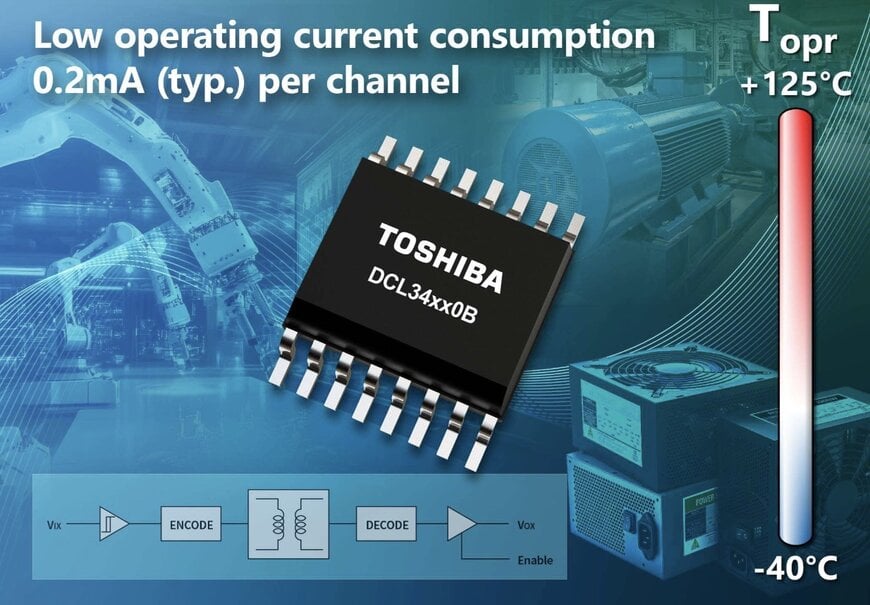
Toshiba Electronics Europe is releasing four new models within its DCL34xx0B range of standard digital isolators engineered for industrial automation equipment. This hardware expansion provides integrated signal isolation solutions specifically developed for programmable logic controllers, input/output interfaces, sensors, actuators, and variable frequency drives.
Magnetic Coupling Mechanisms and Power Efficiency
In high-density industrial control environments, thermal management and power draw are critical design constraints for printed circuit boards. The newly added digital isolators utilize magnetic coupling isolation technology to transmit digital signals across a galvanic barrier. This architectural approach allows the components to achieve a typical power consumption of 0.2 milliamperes per channel. The devices support supply voltages ranging from 2.25 V to 5.5 V and are rated for continuous operation across an extended temperature range of -40 °C to +125 °C, making them suitable for enclosed industrial units such as switched-mode power supplies where ambient temperatures fluctuate significantly.
Signal Integrity in Industrial Communication Systems
Maintaining data integrity in automation environments requires robust protection against electrical noise and ground loops. The components support data rates up to 25 megabits per second while providing a minimum isolation voltage of 3000 Vrms. To handle the electrical noise generated by industrial machinery, the devices feature a minimum Common-Mode Transient Immunity (CMTI) of 30 kilovolts per microsecond. This specification dictates the maximum rate of voltage change between the isolated ground planes that the component can withstand without corrupting the transmitted data, an essential parameter for stabilizing signals in motor inverters and variable frequency drives.
Configurable Architecture for Automation Equipment
The expansion of the DCL34xx0B series offers hardware engineers multiple channel configurations housed in compact SSOP16 packaging. The DCL340L0B and DCL340H0B models feature four forward channels with no return channels (4:0 configuration). Conversely, the DCL342L0B and DCL342H0B models provide symmetrical bidirectional data flow with two forward and two return channels (2:2 configuration). These components integrate with the existing 3:1 configuration models in the series, which are typically deployed for Serial Peripheral Interface (SPI) protocols. This modularity allows system designers to select the precise channel layout required for specific industrial communication protocols without modifying the underlying isolation architecture.
Additional Context
This section details technical specifications and competitive benchmarking not included in the original news release.
In the digital isolator component market, magnetic coupling technologies compete directly with capacitive isolation devices manufactured by companies such as Texas Instruments, as well as alternative magnetic isolators from Analog Devices. Standard competitive benchmarks for these semiconductor components focus on data throughput, power consumption per channel, isolation ratings, and transient immunity.
While some modern capacitive isolators achieve CMTI ratings exceeding 100 kV/µs for highly demanding automotive traction inverters, they frequently exhibit higher current consumption at their maximum data rates. The 0.2 mA per channel power draw of the DCL34xx0B series positions it as a highly energy-efficient option for standard 25 Mbit/s industrial logic networks, prioritizing thermal efficiency over ultra-high-speed or ultra-high-transient specifications. The 3000 Vrms isolation rating within a standard SSOP16 package aligns with established industry requirements for basic galvanic isolation in common industrial control voltages, providing a direct alternative to legacy optocouplers which typically suffer from higher power consumption and degradation over time.
Edited by Aishwarya Mambet, Induportals Editor, with AI assistance.
www.toshiba.com
