
www.ptreview.co.uk
31
'26
Written on Modified on
Rockwell Automation Expands Remote Support with Launch of TechConnectIQ
New digitally enabled support experience helps manufacturers address skills gaps, simplify updates and resolve issues faster.
www.rockwellautomation.com
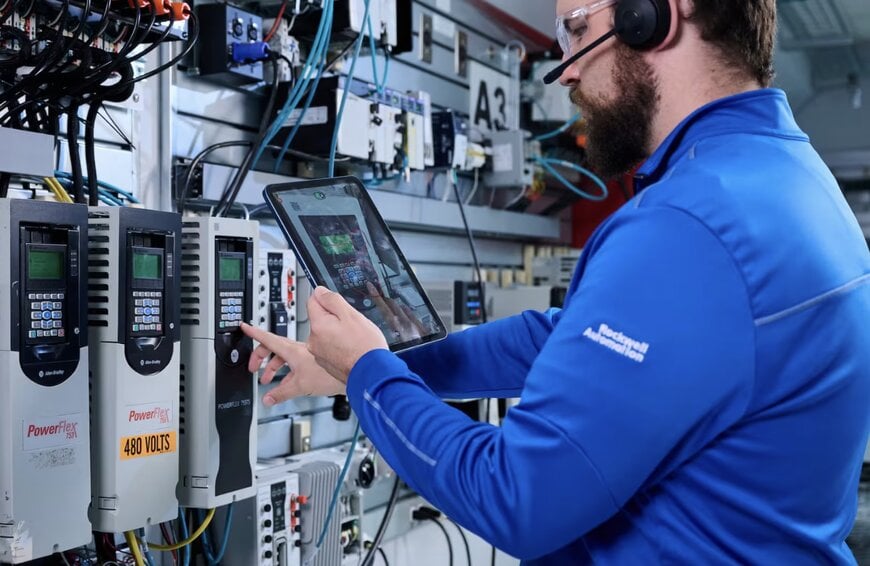
Rockwell Automation introduced TechConnectIQ Support to provide plant maintenance, operations, and engineering personnel with 24/7/365 access to industrial automation domain specialists. The service framework addresses technical staffing constraints and rising system complexity by enabling remote troubleshooting, configuration, and maintenance across factory environments.
AI-Driven Assistance and Tiered Service Architecture
TechConnectIQ combines artificial intelligence tools with direct engineering support to streamline daily plant maintenance and incident response:
- Direct Specialist Access: Provides web-based interactive tools, live technical support, and scheduled engineering callbacks for real-time troubleshooting.
- Unified Asset Visibility: Centralizes installed base tracking, active service agreements, and historical support data through the myRockwellAutomation TechConnect portal.
- AI and Digital Tools: Integrates artificial intelligence-powered federated search engines, augmented reality (AR) visual guidance, and instructional video workflows to guide technicians during physical repairs and maintenance.
- Tiered Support Coverage: Unifies hardware and software maintenance contracts into three defined operational service tiers: Basic, Standard, and Professional.
Availability and Deployment Timeline
TechConnectIQ Support is commercially available for single-site contract customers across North America, with rollout to international regional markets scheduled throughout 2027.
Additional Context
This section details technical specifications not included in the original news release.
Modern industrial remote support platforms utilize secure, encrypted outbound tunnels to establish remote access to programmable logic controllers (PLCs), distributed control systems (DCS), variable frequency drives (VFDs), and human-machine interfaces (HMIs). By routing connections through plant-floor edge appliances using Transport Layer Security (TLS 1.3) or IPsec VPNs over port 443, remote engineers can access diagnostic registers, trace real-time logic execution, and analyze system event logs without requiring inbound firewall port openings within industrial demilitarized zones (IDMZs).
Federated AI diagnostic engines index distributed equipment manuals, firmware errata, and operational logs to automate root-cause analysis for diagnostic fault codes (such as major non-recoverable faults or communication loss on CIP networks). Augmented reality workflows utilize spatial mapping and computer vision algorithms on mobile or wearable devices to overlay real-time terminal connection schematics, module replacement sequences, and torque specifications onto physical control panels, reducing the likelihood of human error during component replacement.
Edited by Romila DSilva, Induportals Editor, with AI assistance.
TechConnectIQ Support is commercially available for single-site contract customers across North America, with rollout to international regional markets scheduled throughout 2027.
Additional Context
This section details technical specifications not included in the original news release.
Modern industrial remote support platforms utilize secure, encrypted outbound tunnels to establish remote access to programmable logic controllers (PLCs), distributed control systems (DCS), variable frequency drives (VFDs), and human-machine interfaces (HMIs). By routing connections through plant-floor edge appliances using Transport Layer Security (TLS 1.3) or IPsec VPNs over port 443, remote engineers can access diagnostic registers, trace real-time logic execution, and analyze system event logs without requiring inbound firewall port openings within industrial demilitarized zones (IDMZs).
Federated AI diagnostic engines index distributed equipment manuals, firmware errata, and operational logs to automate root-cause analysis for diagnostic fault codes (such as major non-recoverable faults or communication loss on CIP networks). Augmented reality workflows utilize spatial mapping and computer vision algorithms on mobile or wearable devices to overlay real-time terminal connection schematics, module replacement sequences, and torque specifications onto physical control panels, reducing the likelihood of human error during component replacement.
Edited by Romila DSilva, Induportals Editor, with AI assistance.
