
www.ptreview.co.uk
18
'26
Written on Modified on
NEXCOM Introduces NViS 6712 AI-Ready NVR Platform
The 2U hardware platform combines 312 TB storage and Intel Core Series 2 processing for smart factory video workloads.
www.nexcom.com
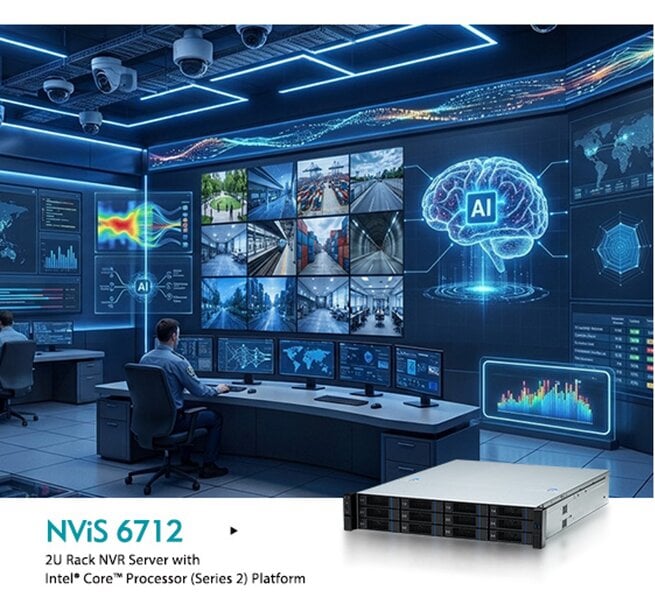
NEXCOM has launched the NViS 6712, a new 2U Network Video Recorder (NVR) hardware platform designed for system integrators building high-capacity video recording and AI analytics systems. The platform utilizes a tiered storage architecture to prevent system bottlenecks, featuring 12 hot-swappable 3.5-inch HDD bays that support up to 312 TB of raw JBOD capacity for continuous, high-volume video retention. To eliminate I/O contention between recording and active processing, two M.2 PCIe NVMe SSDs provide ultra-fast storage dedicated to latency-sensitive tasks such as Video Management Systems (VMS), metadata processing, and database operations.
Powered by Intel Core Series 2 processors utilizing a Performance-core (P-core) only architecture, the system supports up to 24 processing threads and a Max Turbo frequency of 5.9 GHz. For configurable AI acceleration, a PCIe Gen5 x16 expansion slot accommodates dual-slot graphics cards up to 250W from Intel or NVIDIA, while an additional M.2 interface supports the Hailo-8 AI accelerator. This robust edge processing capability allows industrial facilities to retain massive video datasets on-site while executing advanced AI tasks—such as object recognition, anomaly detection, and worker safety analytics—in real time before transmitting curated metadata to centralized cloud systems.
Additional Context
This section provides technological and market background not explicitly detailed in the original release.
The role of video in industrial environments is rapidly shifting from passive security surveillance to active, real-time operational technology (OT) data. However, running deep learning computer vision models at the edge introduces severe hardware challenges. If an AI application attempts to read frames for inference from the same spinning hard disk array that is simultaneously writing incoming streams from dozens of high-resolution IP cameras, the resulting I/O bottleneck causes dropped frames and latency spikes. By physically separating the sequential write storage (HDDs) from the high-speed random-access storage (NVMe SSDs) where the AI models and VMS databases reside, modern AI NVRs resolve this storage-compute mismatch. Furthermore, the inclusion of PCIe Gen5 x16 slots is critical for edge AI, as it provides the massive data bandwidth required to feed uncompressed, multi-camera video streams into discrete GPUs without starving the accelerators of data.
Edited by Lekshman Ramdas, Induportals editor – adapted by AI.
www.nexcom.com
