
www.ptreview.co.uk
25
'26
Written on Modified on
PFAS-Free Polymer Bearings and Overhead DC Charging Systems
igus introduces compliant polymer components and automated cable management infrastructure to support the electrification and regulatory adaptation of heavy commercial vehicle fleets.
www.igus.eu
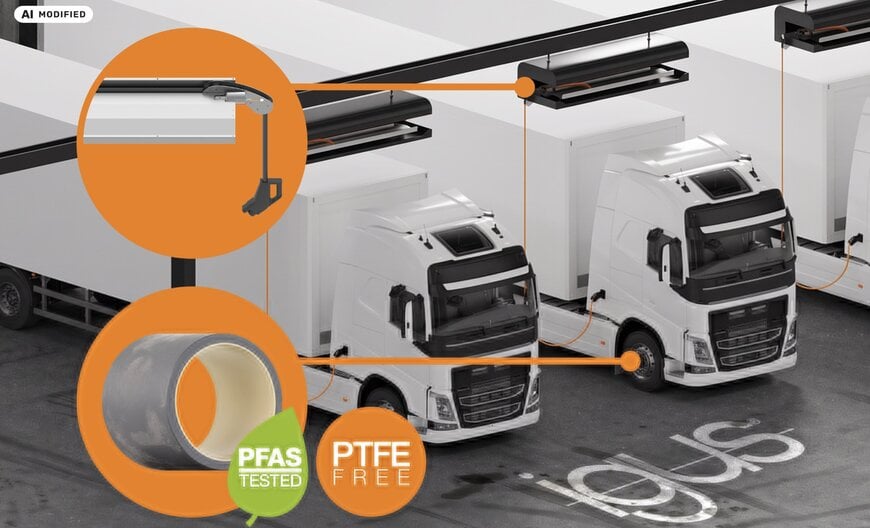
igus has released a portfolio of PFAS-tested polymer bearing technologies and the e-tract DC horizontal overhead charging system for electric commercial vehicles. These technical solutions address material compliance requirements and heavy direct-current cable management challenges within the commercial electric vehicle infrastructure.
Material Compliance in Commercial Vehicle Manufacturing
At the IAA TRANSPORTATION 2026 exhibition in Hanover (September 15 to 20), the manufacturer presented components designed to meet anticipated European Union regulatory restrictions on per- and polyfluoroalkyl substances (PFAS). The automotive data ecosystem and manufacturing supply chain are shifting toward compliant materials to ensure long-term production stability. To address this, the company developed nearly 30 plain-bearing materials engineered without polytetrafluoroethylene (PTFE) and over 40 materials that eliminate 96 critical PFAS compounds. These dry-running polymer plain bearings are utilized in heavy vehicle hinges, driver cab tilting mechanisms, braking systems, bus pantographs, and wheelchair ramps. By eliminating external lubrication requirements, the bearings reduce maintenance intervals while weighing up to seven times less than standard metal alternatives, thereby contributing to the energy efficiency of electrified vehicle platforms.
“Regardless of the final political decisions, we want to offer PTFE-free and PFAS-tested solutions that are not affected by possible future restrictions,” stated Dirk Tietz, Head of Automotive igus Subsidiaries. This material transition allows commercial vehicle manufacturers to maintain mechanical performance parameters while adapting to shifting chemical compliance standards.
Overhead Cable Management for High-Power Charging
Alongside tribological components, the company introduced the e-tract DC horizontal, an automated overhead cable guide system for heavy commercial vehicle charging. High-capacity DC charging infrastructure, particularly systems exceeding 400kW with liquid-cooled cables, presents handling and spatial challenges in logistics centers and public charging yards. The e-tract system operates via a conveyor belt principle without slip rings, suspending the charging cable above the vehicles. The mechanism automatically lowers the connector for vehicle attachment, preventing the heavy cables from dragging on the ground. This architectural approach minimizes abrasive wear on the cable jacket, mitigates trip hazards, and restricts unauthorized access to the copper cabling. Durability testing demonstrated that the mechanical guide sustained over 20,000 double strokes with minimal structural degradation.
Additional Context
This section details technical specifications and competitive benchmarking not included in the original news release.
Within the commercial vehicle component market, polymer plain bearings compete directly with traditional sintered bronze and lubricated steel rolling-element bearings produced by conventional bearing manufacturers. Leading competitors in the tribological polymer space are actively developing PFAS-free (and PTFE-free) equivalents. For example, Saint-Gobain (Omniseal Solutions / EQYO) has introduced Norglide® Purple and Norglide® Teal, which are marketed as PFAS-free metal-polymer bearing materials designed to replace traditional PTFE friction layers in automotive exterior and interior applications. Similarly, GGB (part of Timken) manufactures the EP® series of engineered polymer bearings that compete directly with igus's iglidur materials for weight reduction and dry-running capabilities in automotive mechanisms.
In the charging infrastructure sector, the e-tract DC horizontal system competes against alternative automated connection methods. The primary competing technology for high-power (400kW to 1MW+) depot charging is the automated pantograph system (manufactured by companies such as ABB, Kempower, and Heliox). Pantographs eliminate manual cable handling entirely by connecting automatically from a gantry down to the vehicle roof or vice-versa. For manual plug-in systems, standard EV infrastructure often relies on spring-loaded cable retractors or counter-weighted balancers (from companies like ChargePoint or Conductix-Wampfler). The igus e-tract differentiates itself by offering a slip-ring-free, linear conveyor motion rather than a simple spring tensioner, which can reduce mechanical stress on heavy liquid-cooled cables compared to traditional retractors.
Edited by Aishwarya Mambet, Induportals Editor, with AI assistance.
www.igus.com
