
www.ptreview.co.uk
30
'26
Written on Modified on
Strain Wave Actuators for Humanoid Robotic Joint Applications
Nabtesco introduces a series of compact precision drives designed to manage zero-backlash movement and sensor integration in humanoid robotics.
www.nabtesco.com
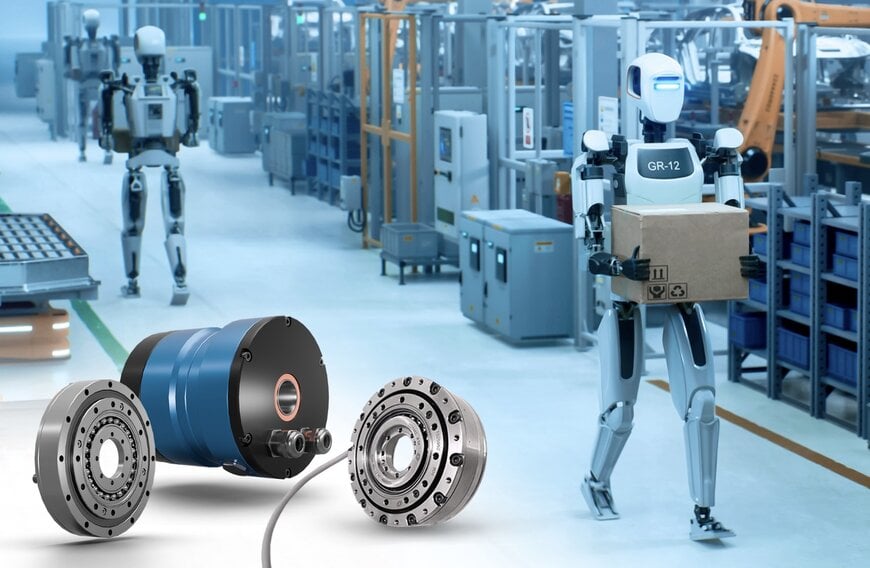
Nabtesco is releasing a line of backlash-free strain wave gears and actuators engineered specifically for humanoid robotic joint actuation. These drive systems integrate high reduction ratios and sensor arrays into a compact footprint, addressing the spatial constraints and dynamic control requirements of bipedal robotic shoulders, elbows, hips, and legs.
Mechanics of Zero-Backlash Joint Actuation
Humanoid robots require highly responsive kinematic systems to maintain balance and interact safely with their environments. Strain wave gears operate with zero mechanical backlash and high rigidity, minimizing transmission errors during rapid directional changes or reverse operation. This mechanical stability reduces the continuous control loop adjustments normally required to maintain static joint positions, thereby lowering electrical power loss and conserving energy for extended operational cycles. Compared to standard planetary gears, which typically require multiple linked stages to achieve high reduction ratios, strain wave mechanisms achieve these ratios within a single stage. This significantly reduces the installation space and weight required in anthropomorphic joint designs.
Spatial Optimization and Structural Integration
Installation volume in humanoid joints directly dictates overall robotic kinematics and payload distribution. The new actuator units consolidate the strain wave gear, electric motor, and supporting mechanical components into a single housing to simplify integration. A hollow shaft configuration permits the internal routing of power cables and electronic communication lines, preventing external cable fatigue or interference during complex rotational movements. For highly constrained joints, a shortened gear variant provides a 20 percent increase in torque capacity and a 40 percent longer service life relative to standard strain wave gears of equivalent dimensional footprint.
Embedded Digital Analytics and Sensor Integration
Modern robotic control relies on continuous hardware feedback. The digital strain wave gear embeds sensors directly into the internal gearbox architecture to measure position, torque, temperature, and vibration without expanding the external dimensions of the drive. The system generates metadata and analytical outputs, allowing the robot's central processing unit to adapt to varying load conditions and external physical resistance. Future firmware updates will introduce dynamic load limit adjustments to temporarily push operation beyond nominal ratings. Additional planned features include AI-driven anomaly detection to calculate a mechanical condition index based on wear patterns, alongside an overload detection system that logs mechanical stress events and triggers preventative alarms.
Scalable Manufacturing and Quality Standards
Scaling humanoid robotic production requires consistent component quality to ensure repeatable kinematic performance. The strain wave gears are manufactured at an IATF-certified facility in Germany, adhering to rigorous mass-production quality standards adopted from the automotive industry. This manufacturing infrastructure supports robotics developers in scaling from prototype design to high-volume production with consistent dimensional and performance tolerances.
Additional Context
This section details technical specifications and competitive benchmarking not included in the original news release.
In the market for precision strain wave gearing within robotic joint actuation, the primary technological benchmark is Harmonic Drive, the company that originally patented the strain wave mechanism. Strain wave systems utilize an elliptical wave generator deforming a flexible spline inside a rigid circular spline to achieve zero backlash and high positional accuracy. Comparable systems from manufacturers such as Harmonic Drive and Nidec Shimpo typically offer reduction ratios ranging from 30:1 to 160:1 in a single compact stage, evaluating performance based on peak torque density and arc-minute repeatability. Nabtesco, traditionally dominant in the heavy-payload cycloidal gearbox market for industrial articulated robots, targets the lower-payload, high-precision humanoid segment with these strain wave gears. The integration of built-in torque and vibration sensors directly into the gear housing aligns with an industry shift toward edge-computing and predictive maintenance, directly competing with smart servo actuators developed by motion control companies like Kollmorgen and maxon.
Edited by Aishwarya Mambet, Induportals Editor, with AI assistance.
www.nabtesco.com
