
www.ptreview.co.uk
30
'26
Written on Modified on
Circulating Inkjet Printhead Technology for Industrial Packaging
Kyocera Corporation announced the KJ4A-EX600RC-HX circulating inkjet printhead to support high-opacity white ink, spot varnish, and digital cold-foil embellishment across label converting lines.
global.kyocera.com
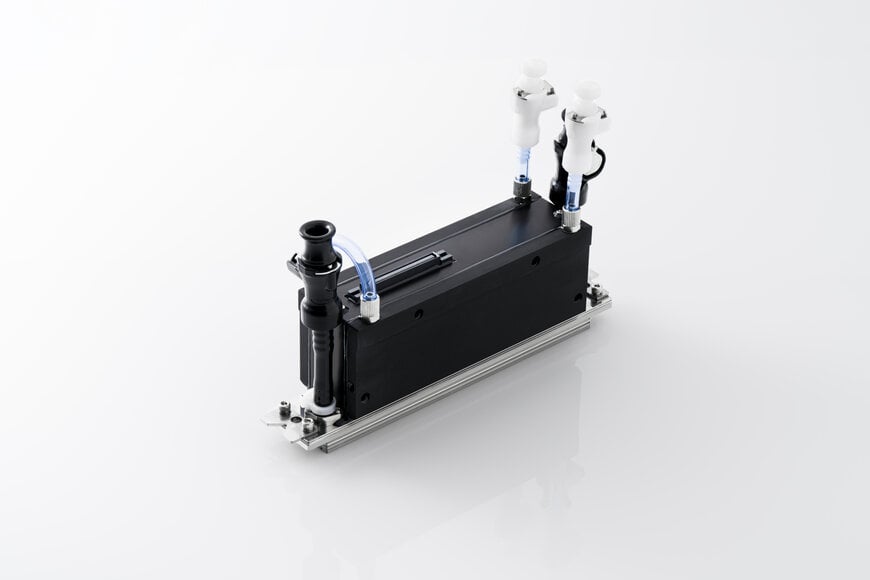
Industrial label converters and packaging manufacturers face ongoing throughput bottlenecks when shifting from analog flexography to on-demand digital printing. High-pigment functional fluids, such as titanium dioxide-based white inks and heavy-build UV varnishes, exhibit high fluid densities and chemical sedimentation tendencies that cause frequent nozzle clogging, uneven dot placement, and excessive maintenance downtime. To solve these fluid-handling and rheological constraints, Kyocera Corporation developed the KJ4A-EX600RC-HX, a piezo-driven circulating printhead designed for digital packaging systems and scheduled for commercial release in November 2026.
Near-Nozzle Recirculation Architecture and Fluid Temperature Stability
The fundamental engineering challenge associated with heavy-deposition decorative fluids lies in maintaining particulate suspension directly at the meniscus. Heavy pigment particles settle rapidly during standby periods, while high-viscosity coatings are susceptible to local drying and viscosity drift caused by thermal gradients across the nozzle plate.
The KJ4A-EX600RC-HX incorporates a continuous internal fluid micro-channel design that circulates ink across the rear of the nozzle orifices. This continuous flow prevents heavy solids from falling out of suspension, purges micro-bubbles before they induce jetting dropouts, and stabilizes fluid temperature directly at the firing zone. By maintaining homogeneous ink conditions at the ejection interface, the system eliminates prolonged purge cycles and reduces manual mechanical cleaning during press restarts.
Acoustic Ejection Dynamics and High-Deposition Droplet Metrics
To achieve high-opacity undercoats and raised tactile embellishments without multiple print passes, printhead architectures must eject larger fluid masses at elevated repetition rates. The KJ4A-EX600RC-HX expands droplet emission capabilities through re-engineered piezoelectric actuators:
- Maximum droplet volume is rated at 21 picoliters, representing a 23 percent increase over the 17-picoliter maximum of the preceding KJ4A-AL platform.
- High droplet volume increases optical density and background opacity for white ink barriers on transparent and metallic substrates.
- Expanded ink volume output supports thick-film deposition for textured tactile varnishes and structural adhesive layers used in cold-foil transfer.
- Operational drive frequency operates at 40 kilohertz, doubling the 20-kilohertz firing frequency of the earlier model to support web press line speeds up to 100 meters per minute.
Rheological Operating Window for High-Viscosity Decorative Formulations
Standard industrial piezoelectric printheads typically operate within a narrow fluid viscosity window between 6 and 7 millipascal-seconds. Formulating functional inks within this limited band often requires aggressive solvent or monomer dilution, which compromises cured film thickness, pigment loading, and structural adhesion.
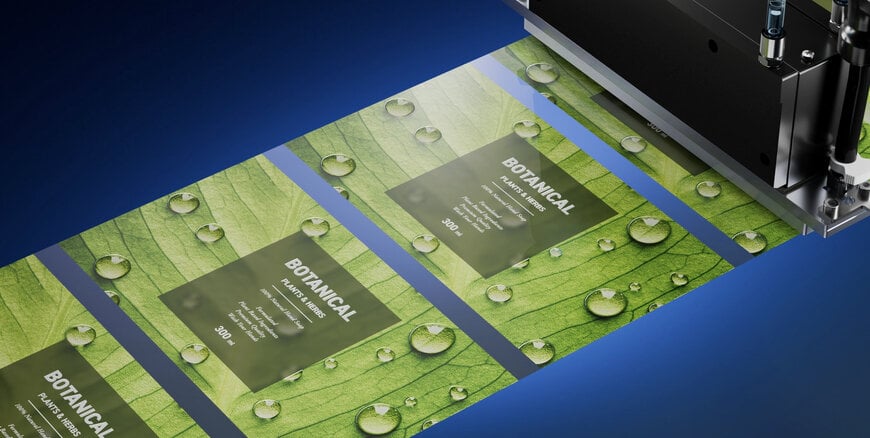
The fluidic architecture of the KJ4A-EX600RC-HX expands the operating viscosity threshold to a range of 8 to 11 millipascal-seconds. This elevated viscosity allowance enables ink chemists to formulate UV-curable fluids with higher active solids content, advanced functional oligomers, and specialized decorative polymers. Label converters can consequently deposit high-gloss varnishes, haptic textures, and metallic-receptive bonding layers directly inline within single-pass production workflows.
Additional Context:
This section details technical specifications and competitive benchmarking not included in the original product announcement.
Industrial single-pass digital label printing architectures rely on specialized printheads capable of handling high-viscosity fluids and heavy pigment loadings. In commercial packaging environments, primary benchmark platforms include the Seiko RC1536 and the Xaar 2002 series. The Seiko RC1536 utilizes isolated channel technology with continuous fluid recirculation, supporting droplet sizes from 13 to 217 picoliters across an operating viscosity range up to 25 millipascal-seconds, operating at maximum drive frequencies near 37 kilohertz. The Xaar 2002 features through-flow recirculation architecture, delivering drop sizes typically configured between 6 and 40 picoliters at firing frequencies up to 36 kilohertz with viscosity limits around 10 to 12 millipascal-seconds.
While larger-drop benchmark heads such as the Seiko RC1536 emphasize heavy ceramic and heavy tactile fluid deposition at lower native resolutions, the Kyocera KJ4A-EX600RC-HX balances high-frequency jetting at 40 kilohertz with native 600 dots-per-inch addressability. Operating with a 21-picoliter maximum drop size at web speeds reaching 100 meters per minute, the KJ4A-EX600RC-HX aligns specifically with narrow-web label presses requiring high fine-text legibility and crisp graphic boundaries alongside high-opacity white ink foundations and tactile UV coatings.
Edited by Natania Lyngdoh, Induportals editor, with AI assistance.
www.global.kyocera.com
