
www.ptreview.co.uk
06
'26
Written on Modified on
Water-Hydraulic Actuation Optimizes Inline Blending in Fluid Control Systems
GEA integrates closed-loop water-hydraulic technology into its modular valve portfolio to reduce compressed air dependence and improve inline blending accuracy for beverage producers.
www.gea.com
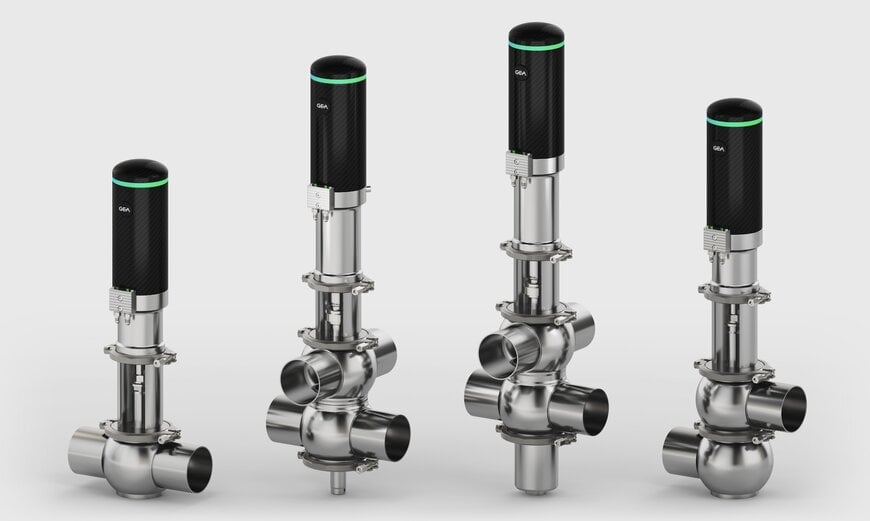
GEA integrates Hydract actuation technology into selected VARIVENT single-seat, divert and double-seat valves. Image: GEA
GEA introduces water-hydraulic actuation technology as a new option for its modular valve systems, targeting dairies, breweries, and beverage manufacturers with high hygienic process-control requirements. The technology replaces traditional pneumatic components with a precise fluid control solution, enabling continuous inline blending and significantly reducing electrical energy demand in industrial processing environments.
Closed-Loop Water-Hydraulic Mechanism
The actuation technology replaces pneumatic compressed air systems with a closed hydraulic circuit utilizing treated water or an approved water-glycol mixture. Because the hydraulic fluid is virtually incompressible, it maintains absolute valve positioning even when subjected to fluctuating process pressures and flow rates. A centralized, compact pump station supplies the valves through designated supply and return lines. This mechanical stability allows for high control accuracy during continuous flow tasks, whereas traditional pneumatic systems can experience positioning latency due to air compressibility.
Continuous Inline Blending and Tank Utilization
For beverage production, exact valve positioning facilitates continuous inline blending. Product streams can be combined dynamically, allowing a shared base liquid to remain in the process pipeline longer while specific product variants are blended directly into the filling line. At a Carlsberg facility in Fredericia, Denmark, this mechanism holds Brix, alcohol, and carbon dioxide levels stable despite throughput variations.
According to production metrics, deploying this architecture in a greenfield plant reduces the required number of bright beer tanks from 26 to 14 and increases average tank utilization from 54 percent to 90 percent. Furthermore, production lead times to filling are shortened from weeks to hours, which proportionally reduces the cleaning effort and costs associated with holding multiple finished-product variants in parallel.
Energy Reduction and System Integration
Transitioning from pneumatic to hydraulic actuation eliminates the electrical energy required to compress air for continuous valve operations. Industrial measurements from the Carlsberg application indicate a 95 percent reduction in power consumption for valve actuation. In new plant designs, this allows engineers to specify a much smaller compressed-air infrastructure.
The hydraulic components are not limited to greenfield projects; operators can retrofit the technology onto existing process valves and run them alongside pneumatically actuated valves within a single facility.
Bastian Tolle, Head of Business Development & Digitalization at GEA's Valve & Pumps unit, notes that precise valve control allows for late product differentiation, meaning existing tanks are utilized more efficiently and new plants can be planned with less buffer capacity. Anders Kokholm, Brewing and Quality Director at Carlsberg Supply Company, adds that maintaining closed, precisely regulated valves enables on-demand production and minimizes liquid waste at the bottling plant.
The actuation technology will launch with integration into single-seat (type N), divert (type W), and double-seat (types R and D) valves. The hardware will be exhibited at BrauBeviale 2026 from November 10 to 12, 2026, in Nuremberg, Germany, in Hall 9, Booth 362.
Additional Context
This section details technical specifications and competitive benchmarking not included in the original news release.
Within the hygienic process valve market, GEA’s water-hydraulic actuation competes against both advanced pneumatic systems and electromotive actuators. Market leaders such as Alfa Laval (Unique Mixproof series) and SPX FLOW (APV DELTA series) optimize legacy pneumatic actuation using digital control tops to minimize air consumption. However, pneumatic systems fundamentally rely on compressible air, which can introduce positioning latency during continuous inline blending. To entirely eliminate compressed air, manufacturers like Bürkert utilize electromotive actuators (Type 3360/3361) which, like GEA’s Hydract, provide absolute mechanical locking force and consume energy only during the actuation stroke. While electromotive valves require decentralized electrical wiring to each unit, the Hydract system relies on a localized fluid pump, making water-hydraulics particularly suited for dense valve matrices requiring high locking forces against fluctuating line pressures.
Edited by Aishwarya Mambet, Induportals Editor, with AI assistance.
www.gea.com
GEA introduces water-hydraulic actuation technology as a new option for its modular valve systems, targeting dairies, breweries, and beverage manufacturers with high hygienic process-control requirements. The technology replaces traditional pneumatic components with a precise fluid control solution, enabling continuous inline blending and significantly reducing electrical energy demand in industrial processing environments.
Closed-Loop Water-Hydraulic Mechanism
The actuation technology replaces pneumatic compressed air systems with a closed hydraulic circuit utilizing treated water or an approved water-glycol mixture. Because the hydraulic fluid is virtually incompressible, it maintains absolute valve positioning even when subjected to fluctuating process pressures and flow rates. A centralized, compact pump station supplies the valves through designated supply and return lines. This mechanical stability allows for high control accuracy during continuous flow tasks, whereas traditional pneumatic systems can experience positioning latency due to air compressibility.
Continuous Inline Blending and Tank Utilization
For beverage production, exact valve positioning facilitates continuous inline blending. Product streams can be combined dynamically, allowing a shared base liquid to remain in the process pipeline longer while specific product variants are blended directly into the filling line. At a Carlsberg facility in Fredericia, Denmark, this mechanism holds Brix, alcohol, and carbon dioxide levels stable despite throughput variations.
According to production metrics, deploying this architecture in a greenfield plant reduces the required number of bright beer tanks from 26 to 14 and increases average tank utilization from 54 percent to 90 percent. Furthermore, production lead times to filling are shortened from weeks to hours, which proportionally reduces the cleaning effort and costs associated with holding multiple finished-product variants in parallel.
Energy Reduction and System Integration
Transitioning from pneumatic to hydraulic actuation eliminates the electrical energy required to compress air for continuous valve operations. Industrial measurements from the Carlsberg application indicate a 95 percent reduction in power consumption for valve actuation. In new plant designs, this allows engineers to specify a much smaller compressed-air infrastructure.
The hydraulic components are not limited to greenfield projects; operators can retrofit the technology onto existing process valves and run them alongside pneumatically actuated valves within a single facility.
Bastian Tolle, Head of Business Development & Digitalization at GEA's Valve & Pumps unit, notes that precise valve control allows for late product differentiation, meaning existing tanks are utilized more efficiently and new plants can be planned with less buffer capacity. Anders Kokholm, Brewing and Quality Director at Carlsberg Supply Company, adds that maintaining closed, precisely regulated valves enables on-demand production and minimizes liquid waste at the bottling plant.
The actuation technology will launch with integration into single-seat (type N), divert (type W), and double-seat (types R and D) valves. The hardware will be exhibited at BrauBeviale 2026 from November 10 to 12, 2026, in Nuremberg, Germany, in Hall 9, Booth 362.
Additional Context
This section details technical specifications and competitive benchmarking not included in the original news release.
Within the hygienic process valve market, GEA’s water-hydraulic actuation competes against both advanced pneumatic systems and electromotive actuators. Market leaders such as Alfa Laval (Unique Mixproof series) and SPX FLOW (APV DELTA series) optimize legacy pneumatic actuation using digital control tops to minimize air consumption. However, pneumatic systems fundamentally rely on compressible air, which can introduce positioning latency during continuous inline blending. To entirely eliminate compressed air, manufacturers like Bürkert utilize electromotive actuators (Type 3360/3361) which, like GEA’s Hydract, provide absolute mechanical locking force and consume energy only during the actuation stroke. While electromotive valves require decentralized electrical wiring to each unit, the Hydract system relies on a localized fluid pump, making water-hydraulics particularly suited for dense valve matrices requiring high locking forces against fluctuating line pressures.
Edited by Aishwarya Mambet, Induportals Editor, with AI assistance.
www.gea.com
