
www.ptreview.co.uk
06
'26
Written on Modified on
Automated Liquid Handling with Dual Architecture Controllers
Festo showcases the CECC-AX controller to bridge deterministic machine control and high-level scripting in compact laboratory automated liquid dispensing devices.
www.festo.com
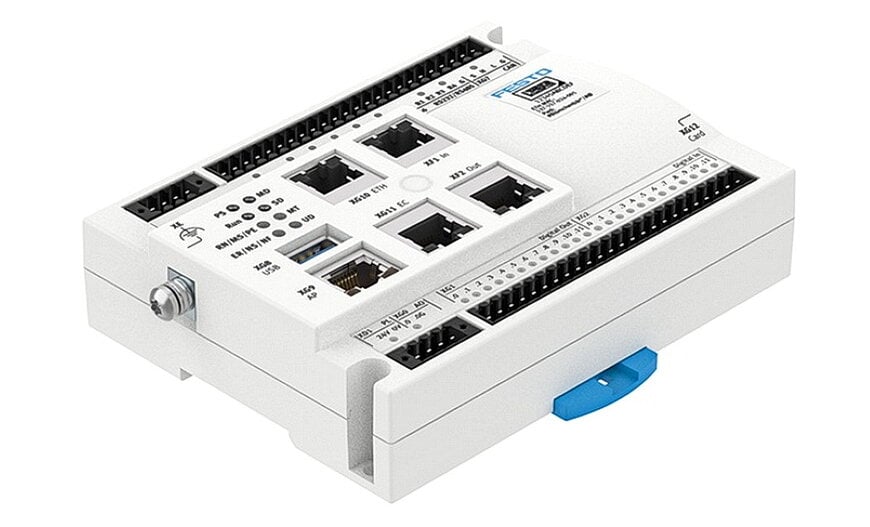
In automated life sciences and diagnostic instrumentation, engineering teams routinely face the operational challenge of reconciling deterministic fluid dosing with high-level data processing and script execution within restricted benchtop footprints. Festo addressed this integration bottleneck by developing the CECC-AX, a dual-programming compact controller designed to operate both conventional programmable logic controller routines and interpreted Python scripts directly on embedded hardware.
Targeting automated liquid handling, in vitro diagnostics, and pre-analytical sample preparation, the system serves the growing market demand for modular, space-efficient fluid management subsystems. Rather than forcing instrument designers to incorporate separate industrial computers alongside real-time input and output modules, the unit centralizes motion coordination, pneumatic valve switching, and procedural routines within a single enclosure.
Integrated Embedded Architecture and Industrial Communication
The primary engineering challenge in analytical benchtop instruments stems from workflow diversity. Deterministic operations, such as micro-dispensing valve sequencing and coordinate positioning, require predictable cycle times and jitter-free execution. Conversely, dynamic assay recipes, experimental data logging, and laboratory information system protocols benefit from the agility and library ecosystem of Python.
The CECC-AX addresses this duality by maintaining an architecture where fieldbus communication and deterministic I/O tasks operate alongside high-level scripting runtime environments. For physical machine integration, the unit features built-in digital and analogue inputs and outputs, as well as serial interfaces for auxiliary lab peripherals. Distributed architecture requirements are handled through integrated Ethernet and EtherCAT interfaces, supplemented by additional fieldbus options to facilitate seamless integration into broader automation networks.
To address evolving regulatory standards governing connected analytical instrumentation, the hardware and firmware baseline incorporates security design principles aligned with the European Union Cyber Resilience Act. This framework focuses on secure boot mechanisms, communication integrity, and vulnerability mitigation across the operational lifespan of the medical or diagnostic device.
Implementation in Analytical Dosing and Life Sciences Workflows
At the Compamed trade fair, Festo demonstrated the controller operating a pressure-controlled liquid dispensing workstation. Precise dispensing in analytical testing relies on rapid pressure regulation combined with micro-valve actuation to deliver fluid volumes without mechanical shear or cross-contamination.
In this application setup, the CECC-AX executes the pressure regulation loop and valve actuation sequence using real-time control, while Python scripts process dispensing profiles, adjust dosing parameters based on fluid viscosity tables, and communicate with user interfaces. This configuration illustrates its suitability across three primary operational areas:
- Automated Consumable and Sample Handling: Moving microplates, sorting sample vials, and manipulating disposables via integrated electric and pneumatic actuators.
- Pre-Analytical Sample Preparation: Metering reagents, pipetting specimens, and managing mixing stations where dynamic parameter changes occur frequently.
- Compact Benchtop Instruments: Eliminating external IPC control cabinets in space-constrained analytical workstations and cleanroom laboratory environments.
By consolidating motion control, microfluidic valve operation, and high-level communication tasks into a single platform, the unit reduces wiring overhead, minimizes failure points, and simplifies validation procedures for diagnostic equipment manufacturers.
Additional Context
This section details technical specifications and competitive benchmarking not included in the original product announcement.
The convergence of IEC 61131-3 PLC programming environments with high-level languages like Python and C++ represents a major architectural trend in industrial automation and laboratory robotics. Driven by the need for edge computing, local telemetry, and cloud connectivity, traditional controller manufacturers are shifting away from closed, proprietary runtimes toward open, multi-paradigm execution engines.
In the analytical device and compact automation sector, embedded controllers are evaluated on physical volume, cycle deterministic behavior, interface versatility, and support for open communications. The earlier CECC series from Festo established compact footprint standards for 24 V DC decentralized systems using CoDeSys V3 programming over CANopen, Modbus TCP, and Ethernet/IP. The CECC-AX advances this lineage by incorporating an embedded Linux foundation capable of executing native Python runtimes alongside standard fieldbus stacks.
Comparable architectures within the compact and micro-controller space include the WAGO Compact Controller 100 and the Phoenix Contact Axioline Smart Elements running on the PLCnext platform. The WAGO Compact Controller 100 utilizes a real-time Linux operating system, dual Ethernet interfaces, and native support for both CoDeSys 3.5 and containerized applications, though its I/O layout is primarily fixed for building and light industrial automation. Phoenix Contact’s PLCnext technology pioneered the parallel execution of IEC 61131-3 logic, C++, and Python, but typically targets cabinet-mounted DIN-rail installations with modular slice expansion rather than dedicated sub-chassis laboratory instruments.
By targeting the mechanical and fluidic interface requirements specific to liquid handling—including EtherCAT master capabilities within a compact benchtop form factor—the CECC-AX fills the gap between low-cost programmable relays and bulkier industrial PC enclosures, standardizing automation protocols across diagnostic instruments.
Edited by Evgeny Churilov, Induportals Media - Adapted by AI.
www.festo.com
Additional Context
This section details technical specifications and competitive benchmarking not included in the original product announcement.
The convergence of IEC 61131-3 PLC programming environments with high-level languages like Python and C++ represents a major architectural trend in industrial automation and laboratory robotics. Driven by the need for edge computing, local telemetry, and cloud connectivity, traditional controller manufacturers are shifting away from closed, proprietary runtimes toward open, multi-paradigm execution engines.
In the analytical device and compact automation sector, embedded controllers are evaluated on physical volume, cycle deterministic behavior, interface versatility, and support for open communications. The earlier CECC series from Festo established compact footprint standards for 24 V DC decentralized systems using CoDeSys V3 programming over CANopen, Modbus TCP, and Ethernet/IP. The CECC-AX advances this lineage by incorporating an embedded Linux foundation capable of executing native Python runtimes alongside standard fieldbus stacks.
Comparable architectures within the compact and micro-controller space include the WAGO Compact Controller 100 and the Phoenix Contact Axioline Smart Elements running on the PLCnext platform. The WAGO Compact Controller 100 utilizes a real-time Linux operating system, dual Ethernet interfaces, and native support for both CoDeSys 3.5 and containerized applications, though its I/O layout is primarily fixed for building and light industrial automation. Phoenix Contact’s PLCnext technology pioneered the parallel execution of IEC 61131-3 logic, C++, and Python, but typically targets cabinet-mounted DIN-rail installations with modular slice expansion rather than dedicated sub-chassis laboratory instruments.
By targeting the mechanical and fluidic interface requirements specific to liquid handling—including EtherCAT master capabilities within a compact benchtop form factor—the CECC-AX fills the gap between low-cost programmable relays and bulkier industrial PC enclosures, standardizing automation protocols across diagnostic instruments.
Edited by Evgeny Churilov, Induportals Media - Adapted by AI.
www.festo.com
