
www.ptreview.co.uk
06
'26
Written on Modified on
Industrial Machine Vision on ctrlX OS Architecture
Evopro launches evoVIU VIUx camera running Bosch Rexroth ctrlX OS to bridge edge vision and machine automation across distributed hardware tiers.
www.boschrexroth.com
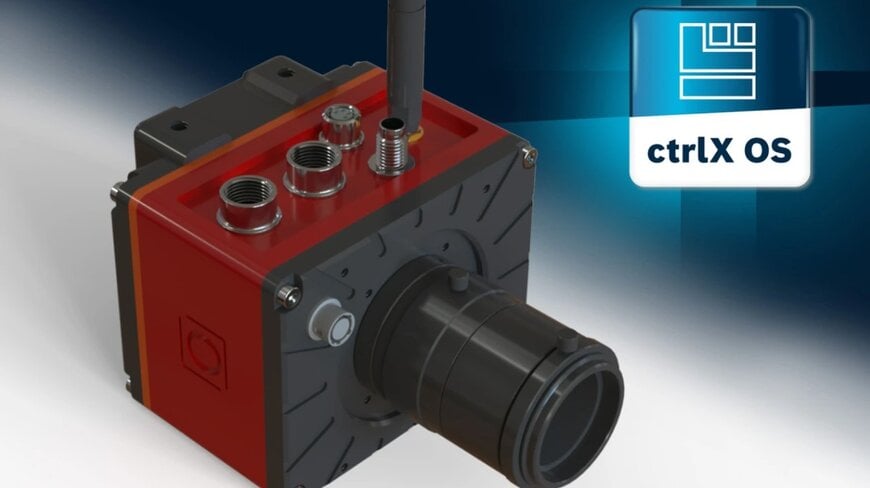
Heterogeneous computing demands across production plants frequently require engineering teams to maintain separate development stacks for compact sensors, industrial PCs, and centralized servers. Addressing this architectural fragmentation, evopro systems engineering AG, a Bertrandt AG subsidiary, has integrated the Linux-based operating system ctrlX OS from Bosch Rexroth into its vision automation portfolio. By deploying its VISIONWEBx application environment on ctrlX OS, the cooperation establishes a standardized runtime framework for an automotive data ecosystem and digital supply chain where machine vision tasks can scale across multiple execution layers without code rewrites.
Solving Vision Deployment Fragmentation in Industrial Automation
Machine vision implementations in modern discrete manufacturing and logistics have historically suffered from rigid architectural coupling. An inspection algorithm designed for a compact smart camera typically cannot execute on an industrial PC (IPC) or an edge server without substantial software refactoring. This disparity increases total engineering overhead, complicates lifecycle maintenance, and impedes the real-time transfer of visual inspection metrics to higher-level operational systems.
By adopting ctrlX OS as an OEM partner and launching the evoVIU VIUx software-defined camera, evopro establishes an architecture where vision algorithms are decoupled from specific physical targets. The browser-based VISIONWEBx development and runtime environment, delivered through the ctrlX OS Store, allows engineers to design, parameterize, and run vision inspection workflows once, then scale the identical execution logic from an on-device smart camera to a centralized server.
Embedded Hardware and Processing Architecture
The evoVIU VIUx hardware platform operates directly on the machine layer to process image data at the point of capture, minimizing network bandwidth load and pipeline latency for deterministic downstream control.
At the core of the camera's computing architecture is an NXP i.MX95 application processor paired with a Hailo-8 artificial intelligence accelerator. This heterogeneous silicon structure offloads complex deep learning workloads — such as high-speed inference for anomaly detection — from the main host processor. To address varied sensing requirements across factory floors, the camera platform supports modular sensor configurations, including:
- Short-Wave Infrared (SWIR) sensors for non-destructive material analysis and inspection through opaque packaging.
- High-resolution global shutter image sensors for distortion-free capture of components moving at high line speeds.
- Time-of-Flight (ToF) sensors for precise 3D spatial coordinate generation and volumetric analysis.
For control integration, the device includes real-time industrial fieldbus support via EtherCAT, enabling vision inspection data to trigger axes and motion logic directly without routing through external intermediate gateways. Independent network interfaces ensure operational separation between Operational Technology (OT) determinism and Information Technology (IT) telemetry.
Industrial Applications Across Discrete Production and Logistics
The combination of edge AI acceleration and native automation connectivity targets several production domains:
Industrial Applications Across Discrete Production and Logistics
The combination of edge AI acceleration and native automation connectivity targets several production domains:
- In-line quality assurance: Automated optical inspection, surface defect screening, and optical character recognition (OCR) or Data Matrix code reading on continuous assembly lines.
- Industrial robotics: 3D point-cloud acquisition and localized coordinate transmission for robotic guidance, bin picking, and automated pick-and-place routines.
- Intralogistics: Volumetric tracking, automated item sorting, and material flow monitoring across conveyor networks.
Software-Defined Vision Strategy
Positioning machine vision software as containerized apps on a standardized Linux distribution reflects an ongoing shift toward software-defined manufacturing. In this model, physical vision devices serve as flexible execution endpoints within a broader software infrastructure.
According to Steffen Winkler, Senior Vice President Sales, Business Unit Automation & Electrification Solutions at Bosch Rexroth, the integration provides an end-to-end foundation for industrial image processing spanning smart cameras, edge controllers, industrial PCs, and virtualized server environments, allowing users to develop an application once and deploy it to their required hardware tier.
Stefan Kraus, Head of Product Development and Product Manager evoVIU at evopro systems engineering AG, states that physical AI requires image processing, artificial intelligence, and automation to operate as a coherent system. The open architecture enables the direct coupling of visual detection routines with actionable control functions in real-time processes.
Additional Context
This section details technical specifications and competitive benchmarking not included in the original product announcement.
The transition toward software-defined automation reflects broader industry alignment around open Linux kernels and standardized communication protocols such as OPC UA and MQTT for IT/OT convergence. Conventional smart cameras historically relied on proprietary, vendor-locked firmware that restricted the installation of third-party control software or custom neural network models.
Benchmarked against dedicated neural network accelerators in the edge vision domain, the integrated Hailo-8 processor provides up to 26 tera-operations per second (TOPS) of AI computing performance with typical power consumption between 2.5 and 5 watts. In industrial inspection workflows, this performance tier enables deep learning inferencing—such as multi-class defect classification and semantic segmentation—at frame rates exceeding 30 to 60 frames per second, a threshold historically demanding discrete, cabinet-mounted industrial PCs with high-wattage graphics cards.
Furthermore, running an open operating system architecture standardized on real-time Linux extensions enables deterministic industrial Ethernet synchronization (IEC 61158 standards, including EtherCAT slave implementations) directly from the vision enclosure. This eliminates the multi-millisecond latency penalties associated with conventional vision-to-PLC communication over asynchronous TCP/IP sockets, aligning edge vision hardware directly with deterministic motion control cycles.
Edited by Evgeny Churilov, Induportals Media - Adapted by AI.
www.boschrexroth.com
Positioning machine vision software as containerized apps on a standardized Linux distribution reflects an ongoing shift toward software-defined manufacturing. In this model, physical vision devices serve as flexible execution endpoints within a broader software infrastructure.
According to Steffen Winkler, Senior Vice President Sales, Business Unit Automation & Electrification Solutions at Bosch Rexroth, the integration provides an end-to-end foundation for industrial image processing spanning smart cameras, edge controllers, industrial PCs, and virtualized server environments, allowing users to develop an application once and deploy it to their required hardware tier.
Stefan Kraus, Head of Product Development and Product Manager evoVIU at evopro systems engineering AG, states that physical AI requires image processing, artificial intelligence, and automation to operate as a coherent system. The open architecture enables the direct coupling of visual detection routines with actionable control functions in real-time processes.
Additional Context
This section details technical specifications and competitive benchmarking not included in the original product announcement.
The transition toward software-defined automation reflects broader industry alignment around open Linux kernels and standardized communication protocols such as OPC UA and MQTT for IT/OT convergence. Conventional smart cameras historically relied on proprietary, vendor-locked firmware that restricted the installation of third-party control software or custom neural network models.
Benchmarked against dedicated neural network accelerators in the edge vision domain, the integrated Hailo-8 processor provides up to 26 tera-operations per second (TOPS) of AI computing performance with typical power consumption between 2.5 and 5 watts. In industrial inspection workflows, this performance tier enables deep learning inferencing—such as multi-class defect classification and semantic segmentation—at frame rates exceeding 30 to 60 frames per second, a threshold historically demanding discrete, cabinet-mounted industrial PCs with high-wattage graphics cards.
Furthermore, running an open operating system architecture standardized on real-time Linux extensions enables deterministic industrial Ethernet synchronization (IEC 61158 standards, including EtherCAT slave implementations) directly from the vision enclosure. This eliminates the multi-millisecond latency penalties associated with conventional vision-to-PLC communication over asynchronous TCP/IP sockets, aligning edge vision hardware directly with deterministic motion control cycles.
Edited by Evgeny Churilov, Induportals Media - Adapted by AI.
www.boschrexroth.com
