
www.ptreview.co.uk
21
'26
Written on Modified on
High Speed Medium Pressure Pump For Industrial Applications
Bosch Rexroth expands its hydraulic portfolio with the A3V2Q variable displacement pump to significantly reduce energy consumption in presses and injection molding machines.
www.boschrexroth.com
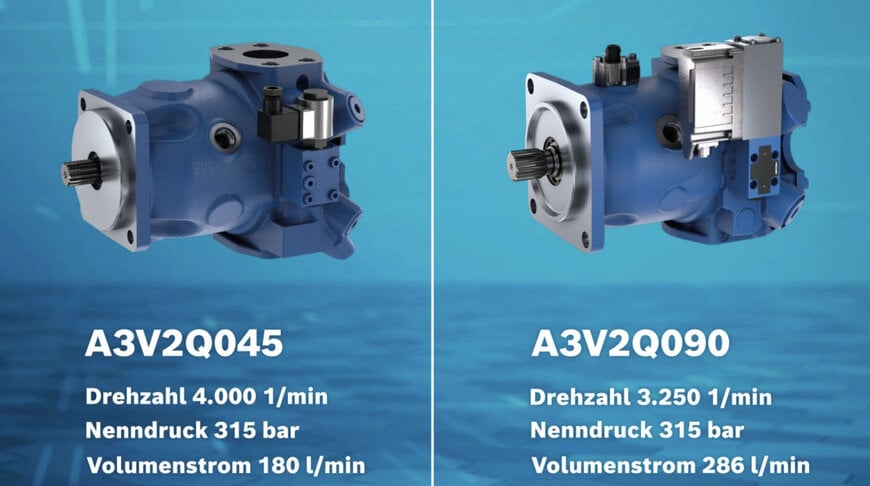
Cyclic industrial applications such as large format presses and injection molding machines require hydraulic drive systems that provide high volume flows alongside precise control and low energy consumption. To meet these industrial demands for overall system efficiency, Bosch Rexroth is expanding its medium pressure range with the 2-quadrant A3V2Q variable displacement pump in the 90 cubic centimeter nominal size.
Drive Architecture And Energy Efficiency
Conventional hydraulic systems with constant speed frequently exhibit high energy losses in highly cyclic applications due to throttling and idling. The servomotor driven A3V pump platform solves this design problem through variable speed adjustment, which, in combination with flexible swivel angles, enables exact adaptation to the respective operating state. With volume flows of up to 286 liters per minute, the A3V2Q achieves an efficiency of over 91 percent in the optimal operating range. This corresponds to an increase of up to five percentage points compared to previous medium pressure variable displacement pumps and enables energy savings of up to 70 percent in cyclic applications compared to conventional constant drives.
Kinematics And Recuperation
The self-priming variable displacement pumps of the A3V series are specially designed for hydrostatic drives in combined pump and motor operation. If the hydraulic pump is driven backwards by the flowing medium - for example, when lowering a heavy lifting platform or counteracting a die cushion in metal forming - it acts as a motor and drives the coupled servomotor as a generator. The electrical current generated by this recuperation can be fed into the intermediate circuit of the machine or returned to the power grid. This recuperation capability also accelerates mechanical processes: in injection molding, the pressure reduction after the holding phase can be actively accelerated by a controlled reversing of the motor, which shortens the overall cycle time of the system.
Downsizing Of The Electrical Drivetrain
The integration of high-speed concepts makes it possible to generate identical volume flows with 30 percent less motor torque. The demand-driven adaptation of the displacement volume via the adjustment mechanism of the pump allows a further torque reduction of 30 percent in many cyclic processes. This engineering approach enables significant downsizing of the entire electrical drivetrain. Both the servomotor and the associated frequency inverter can be dimensioned to be physically smaller and less powerful. This not only reduces material usage and investment costs but also drastically lowers operational emissions. For a medium-sized industrial press, up to 50 tons of CO2 can be saved during the usage phase due to the efficiency increase.
Additional Context
This section contains technical specifications and competitive benchmarking that were not included in the original product announcement.
The electrification and efficiency enhancement of hydraulic systems is a central technological driver in modern mechanical engineering, accelerated by strict global regulatory requirements for reducing the industrial carbon footprint. In the fields of injection molding and forming technology, plant manufacturers are increasingly relying on variable speed pump drives to completely eliminate idling losses. Comparable electrohydraulic drive solutions from manufacturers such as Moog or Parker Hannifin also focus on the seamless integration of servomotors with variable displacement pumps. The capability for active energy recovery in 2-quadrant operation is establishing itself as a critical industrial benchmark to reduce the thermal load on the pressure medium and sustainably lower the Total Cost of Ownership (TCO) in energy-intensive production environments.
Edited by Maria Brueva, Induportals editor - adapted by AI.
www.boschrexroth.com
