
www.ptreview.co.uk
06
'26
Written on Modified on
Industrial Automation Machining Cells with Integrated Robotics
DN Solutions presented an autonomous manufacturing cell at ROBOTWORLD 2026 to resolve cycle-time variance and manual loading bottlenecks in component production.
www.dn-solutions.com
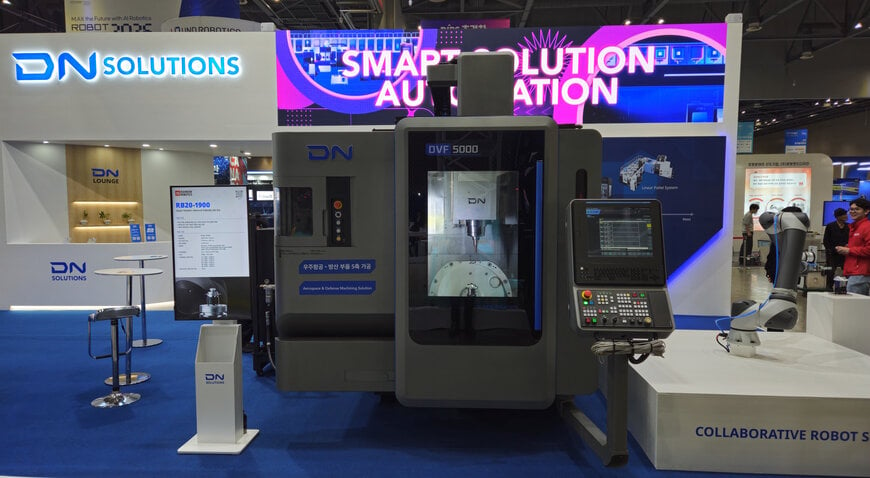
ROBOTWORLD 2026, held from 4 to 7 November 2026 at the KINTEX Exhibition Center 1 in Goyang, Gyeonggi Province, South Korea, focused on robotic systems and advanced industrial automation. At the event, DN Solutions demonstrated an unmanned machining architecture combining computerized numerical control machine tools, industrial robotics, and artificial intelligence diagnostics for high-precision component manufacturing.
Core Technology and System Architecture
The architecture pairs a DVF 5000 second-generation 5-axis vertical machining center with an articulated collaborative robot operating within a closed material-handling loop. Workpiece transfers, chucking, and part positioning occur via coordinated robotic kinematics interfaced directly with the machine tool control unit. The system incorporates the DN Virtual Simulator digital twin platform, which models machining kinematics, evaluates collision envelopes, and calculates cycle times before tool execution. Equipment health monitoring is managed through iDOO RMS+, an algorithmic diagnostic system that captures machine status data and applies deterministic fault analysis to generate corrective maintenance actions during production cycles.
Deployment and Implementation
Implementation operates as a self-contained automation cell designed for integration into brownfield production environments. The collaborative robot handles direct pallet feeding, parts loading, and finished part extraction without continuous human intervention, mitigating thermal and positional drift through standardized mechanical interfaces. Networked sensors transmit operational telemetry from the 5-axis machining center to local and remote monitoring instances, standardizing operational sequencing across the equipment interface.
Industry Applications
The integrated cell addresses manufacturing requirements across the robotics, automotive, and industrial machinery sectors. Specific use cases include the machining of precision robotic components, including cycloidal reducers, harmonic drive housings, joint module interfaces, and rotary actuators. These parts demand micrometer-level structural tolerances and concentricity under serial production conditions, where manual workpiece handling introduces dimensional variance and process instability.
Operational Impact and Performance Metrics
Automating workpiece manipulation while synchronizing toolpaths eliminates transfer delays and reduces non-cutting time across continuous shifts. Process simulation via digital twin verification prevents tooling interference, limits component scrap rates, and ensures predictable cutting parameters prior to physical cutting. Continuous algorithmic monitoring of spindle vibration, motor torque, and axis telemetry reduces unscheduled downtime by identifying component wear prior to mechanical failure.
"Future manufacturing competitiveness depends on manufacturing innovation where machine tools, robots, and AI are organically connected," stated an official from DN Solutions, highlighting that precision machining technologies for core robot components and integrated automation cells define the structural direction for production innovation.
Edited by Evgeny Churilov, Induportals Media - Adapted by AI.
www.dn-solutions.com
