
www.ptreview.co.uk
09
'26
Written on Modified on
Wafer Handling Automation for Semiconductor Manufacturing
Festo Integrated Automation Solutions optimize front-end wafer transfer and chamber motion control to minimize particle contamination and footprint in cleanroom environments.
www.festo.com
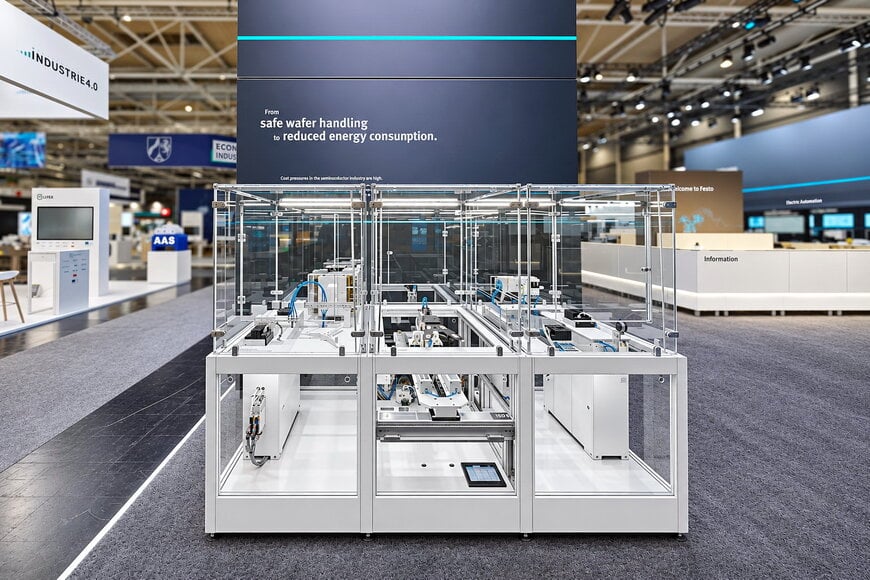
Semiconductor fabrication facilities require stringent particle containment, mechanical vibration dampening, and reduced tool footprint across automated wafer transfer sequences. Festo demonstrated an integrated transfer chamber system engineered to transport silicon substrates across atmospheric and sub-atmospheric manufacturing cells, addressing yield loss associated with mechanical shock and micro-contamination.
Kinematic Architecture and Footprint Optimization
Standard atmospheric front-end modules (EFEM) rely on multi-axis SCARA robots to transfer wafers between storage containers and alignment or metrology stages. The demonstrated handling cell utilizes an overhead inverted gantry kinematics platform as an alternative architecture for transferring wafers from a Front Opening Unified Pod (FOUP).
By suspending the drive mechanisms above the substrate plane, the inverted gantry reduces horizontal machine footprint and optimizes cleanroom air laminarity. Mechanical alignment and substrate retention are consolidated at the end-effector. An integrated wafer aligner combines optical edge detection and positioning directly on the end-of-arm tooling, eliminating the cycle time and tool volume needed for standalone pre-aligner stations.
Contamination Control in Substrate Dispensing Workflows
Substrate yield remains sensitive to relative humidity and oxygen exposure during intermediate storage. Before wafer extraction, controlled nitrogen purging within the FOUP is regulated via a Festo mass flow controller, displacing ambient air to maintain an inert, low-particle microenvironment.
Following extraction, the wafer enters a wet-chemical coating module. Dispensing accuracy across the rotating substrate relies on a synchronized electric linear axis driving the chemical dispensing nozzle. Controlled axis velocity and dynamic positioning minimize flow irregularities, ensuring uniform layer deposition during lithographic coating and chemical surface treatment.
Vibration-Damped Vacuum Chamber Integration
Transitioning silicon substrates from atmospheric pressure into vacuum chambers for dry-etch processes introduces mechanical and pneumatic disturbance risks. The handling cell employs specialized valve-actuation control to cycle the wafer transfer gate valve into the vacuum chamber, eliminating mechanical shock waves that dislodge particulates.
Inside the process chamber, vertical substrate positioning is executed via a pneumatic pin-lift system. The lifter raises and deposits the wafer onto the electrostatic chuck without mechanical bounce. After thermal or plasma processing, the pin-lift actuator lowers the wafer using active force-monitoring loops, preventing substrate fracture or micro-cracking caused by residual chuck stiction. Micro-positioning stages within the module position internal chamber components, including consumable focus rings, with micrometer-scale repeatability to sustain process stability.
Workforce Qualification for Semiconductor Fabrication
The implementation of integrated mechatronic handling systems requires specialized cleanroom maintenance and operational skills. To support industrial workforce development, Festo Didactic provides technical training curricula. The modular program encompasses on-site facility training, the design of dedicated enterprise learning centers, and digital modules hosted on the Festo Learning Experience (Festo LX) platform, focusing on automated handling maintenance, yield protection, and energy management.
Additional Context
This section details technical specifications and competitive benchmarking not included in the original product announcement.
Wafer transfer equipment in front-end semiconductor manufacturing operates under standards defined by SEMI (Semiconductor Equipment and Materials International), including SEMI E47.1 for FOUP mechanical interfaces and SEMI E15.1 for wafer handling environments. Conventional atmospheric transfer modules predominantly implement dedicated 4-axis or 5-axis atmospheric SCARA robots supplied by specialists such as Brooks Automation, Kawasake Robotics, or Rorze Corporation.
In traditional configurations, the robot must retrieve a substrate and place it onto an auxiliary pre-aligner station to determine notch orientation and center offset before moving to a process stage. Integrating optical alignment directly into the end-effector bypasses a multi-point kinematic transfer loop, directly reducing transfer duration and lowering mechanical contact cycles.
In sub-atmospheric processing, vacuum transfer valves commonly face sealing wear and particle generation caused by pneumatic pressure transients. Controlled soft-actuation protocols and closed-loop force-monitored pin lifting directly address SEMI requirements for defect reduction below the 5-nanometer node threshold, where mechanical micro-vibrations exceeding 0.05 g can cause yield-limiting pattern distortions.
Edited by Evgeny Churilov, Induportals Media - Adapted by AI.
www.festo.com
