
www.ptreview.co.uk
11
'26
Written on Modified on
Autonomous Platforms and Collaborative Robotic Architectures for End-of-Line Logistics
Universal Robots and Mobile Industrial Robots are demonstrating integrated hardware and software solutions designed to advance intelligent automation within industrial supply chains.
www.universal-robots.com
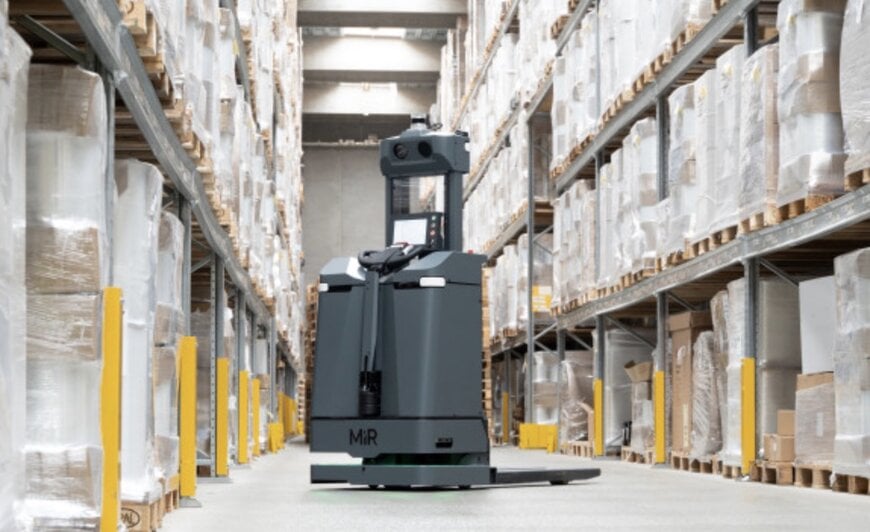
Universal Robots and Mobile Industrial Robots introduced their latest hardware frameworks, including the MiR1200 Pallet Jack and the Gen 7 cobot platform, targeting end-of-line production and warehouse logistics. These solutions integrate artificial intelligence-based perception and unified software environments to optimize material handling and packaging processes in manufacturing facilities.
AI-Driven Perception in Autonomous Pallet Transport
At Empack Madrid 2026 (November 11-12 at IFEMA, Hall 4, Stand 4C49), the robotics manufacturers demonstrated their latest autonomous mobile robot (AMR) capabilities. The MiR1200 Pallet Jack automates the detection, transport, and delivery of pallets and containers weighing up to 1,200 kilograms. Designed for heavy logistics and material handling, the system utilizes an artificial intelligence-based pallet perception framework to dynamically identify loads, reducing cycle times during picking and placing operations.
The unit is engineered to comply with the ISO 3691-4 safety standard, enabling it to navigate safely around human workers and physical obstacles in confined industrial spaces. It operates at a maximum speed of 1.5 meters per second and utilizes a fast-charging battery system that provides eight hours of continuous operation. Because it relies on internal sensor arrays rather than external guides, the unit integrates into existing facility layouts without requiring supplementary infrastructure modifications, serving as an automated alternative to manual pallet trucks.
Unified Architectures for Collaborative Robotic Systems
To address the growing need for a cohesive industrial automation ecosystem, Universal Robots detailed its Gen 7 platform. This seventh-generation collaborative robotics framework consolidates the new g-Series cobots with the CB7 controller, TP7 and SP7 programming interfaces, and the PolyScope X software environment. This unified architecture improves network connectivity and simplifies the integration of third-party peripherals and machine vision systems.
During the exhibition, the companies demonstrated how these combined technologies function in hybrid setups. Mobile robots managed the continuous transport of pallets and trolleys while stationary cobots executed box forming, packing, and palletizing routines. The demonstration also featured a Mobile Cobot configuration, merging autonomous AMR navigation with multi-axis robotic arm manipulation to enable flexible, decentralized end-of-line deployment.
Additional Context
This section details technical specifications and competitive benchmarking not included in the original news release.
In the autonomous pallet jack and AMR market, the MiR1200 competes with systems such as the Agilox OCF and the Seegrid Palion. Competitive benchmarks typically focus on payload capacity, maximum velocity, and navigational modalities. While standard automated guided vehicles (AGVs) rely on magnetic tape or QR codes, heavy-duty AMRs utilize SLAM (Simultaneous Localization and Mapping) combined with 3D cameras and LiDAR for infrastructure-free navigation.
The 1,200 kg capacity and 1.5 m/s speed of the MiR system align closely with industry standards for heavy payload automated forklifts. However, a primary technical differentiator is its explicit integration of AI-driven pallet perception, which allows for dynamic engagement with unaligned, damaged, or non-standard pallets—a critical metric where modern AMRs distinguish themselves from earlier generations of automated systems that require strict positional precision for load engagement. Similarly, UR's Gen 7 platform competes with collaborative ecosystems from KUKA and Yaskawa, benchmarking heavily on the native integration of AI protocols and the modularity of the controller architecture.
Edited by Aishwarya Mambet, Induportals Editor, with AI assistance.
www.universal-robots.com
