
www.ptreview.co.uk
12
'26
Written on Modified on
Contrinex Simplifies Container Fill Level Measurement Using 3D Smart Camera
New no-code embedded use case in the Contrinex Smart Vision App enables automated contactless volume and height inspections to optimize industrial production and reduce waste.
www.us.contrinex.com
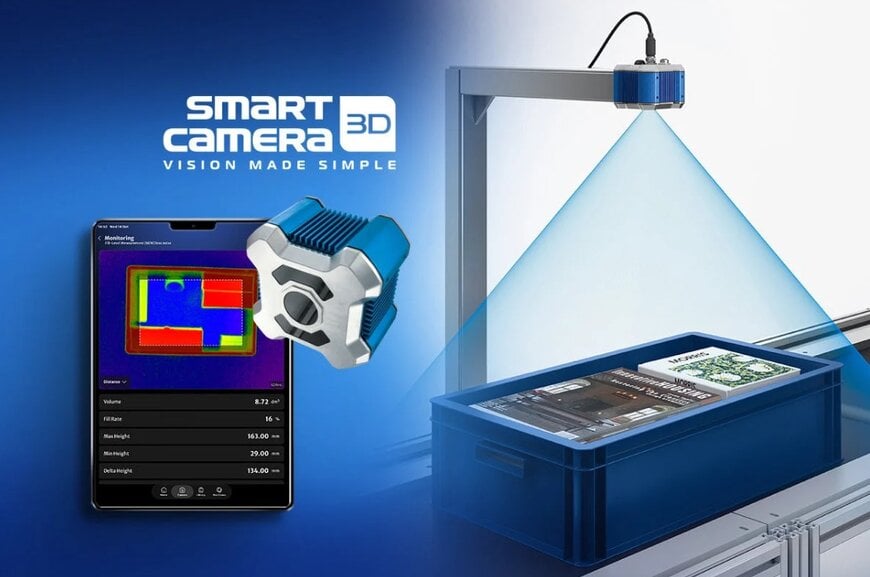
In automated packaging, food processing, and intralogistics lines, verifying container fill levels is critical for meeting net-content regulations, preventing spillage during sealing, and minimizing material waste. Traditional single-point sensors, such as ultrasonic or photoelectric devices, measure distance at only one fixed spot. When containers hold irregular solids, viscous liquids, or unevenly distributed bulk materials, single-point measurements fail to capture true volume or surface peaks and troughs. While 3D machine vision resolves this limitation by mapping the full three-dimensional topography of the container contents, deploying 3D vision systems has historically required specialized vision engineers, external industrial PCs, and custom image-processing code.
To address the engineering bottleneck of 3D vision deployment, Contrinex has added an embedded Fill Level Measurement function to the Smart Vision App on its 3D Smart Camera. By running preconfigured image-processing algorithms directly on the camera hardware through a guided interface, the software enables production and automation engineers to set up multi-parameter volumetric inspections without writing custom software.
Multi-Parameter Volumetric and Surface Profiling
How does 3D vision improve container fill level verification compared to single-point sensing? Rather than relying on a single depth reading, a 3D smart camera captures spatial height data across the entire opening of a container. Within the Contrinex Smart Vision App, the Fill Level Measurement use case processes this spatial data to extract five distinct metrics simultaneously from a single image acquisition:
Fill rate expressed as a percentage to determine overall container capacity utilization.
Total volume of the material contained inside the vessel.
Maximum height in millimeters to identify the highest point of the contents and detect potential overfill conditions that could interfere with capping or sealing.
Minimum height in millimeters to detect the lowest point or voids within the fill profile.
Differential height in millimeters to evaluate surface flatness and height variations across the measured material distribution.
By evaluating differential height alongside maximum and minimum points, quality control systems can detect uneven settling, mounding, or tilted fill surfaces that standard level sensors miss. For automated line integration, operators can assign upper and lower tolerance thresholds to each individual parameter. The camera evaluates the live measurements against these rules and outputs a binary PASS/FAIL signal to the programmable logic controller (PLC) or rejection mechanism.
No-Code Configuration and Workflow Integration
A primary barrier to adopting 3D machine vision on the factory floor is the engineering overhead required for calibration, region-of-interest definition, and algorithm tuning. Contrinex addresses this through an embedded, browser-based workflow within the Smart Vision App.
Instead of scripting point-cloud filters, technicians use a step-by-step configuration wizard. The workflow guides the user through defining the virtual geometry of the container, teaching the target object reference, and setting numerical pass/fail thresholds for volume, fill percentage, and height limits. Because the image-processing algorithms execute directly on the smart camera, the system eliminates the need for external processing units and reduces integration complexity on existing conveyor lines.
Industrial Applications in Food, Beverage, and Logistics
In the food and beverage sector, contactless 3D fill inspection prevents underfilled packages from reaching consumers while catching overfilled containers before they contaminate heat-sealing jaws or capping heads. For dry goods, baked items, or granular ingredients where material mounding occurs, differential height measurement ensures consistent portioning and packaging integrity.
In automated logistics and order fulfillment, the same inspection capabilities verify tote and carton fill rates prior to automated storage, lidding, or shipping. Measuring maximum height ensures protruding items do not jam downstream conveyors or automated guided vehicles, while fill percentage tracking optimizes container volume utilization.
Additional Context
The original product announcement focuses on the software workflow and measurable output parameters of the Fill Level Measurement use case, without detailing the underlying 3D optical sensing method (such as time-of-flight or active stereo vision), measurement accuracy tolerances, frame rates, or specific industrial communication protocols supported by the Contrinex 3D Smart Camera hardware.
Within the broader industrial automation landscape, embedded 3D smart cameras represent a shift toward edge-based vision processing. Competing industrial vision manufacturers, including SICK, IFM Electronic, and Keyence, offer comparable self-contained 3D time-of-flight and triangulation sensors equipped with on-board application wizards for volume and level monitoring. Across this product category, standardizing on no-code graphical setup tools allows plant maintenance teams to deploy and recalibrate optical inspection stations during product changeovers without external system integrators, aligning with broader industry trends toward flexible, modular manufacturing lines.
Edited by Evgeny Churilov, Induportals Media - Adapted by AI.
www.contrinex.com
