
www.ptreview.co.uk
16
'26
Written on Modified on
TURCK Expands Block I/O Portfolio With Hygienic TB Clean Line
Designed for food, beverage, and pharmaceutical washdown environments, the new IP69K-rated modules feature stainless steel connectors, FDA-compliant housing, and seamless cloud data integration.
www.turck.com
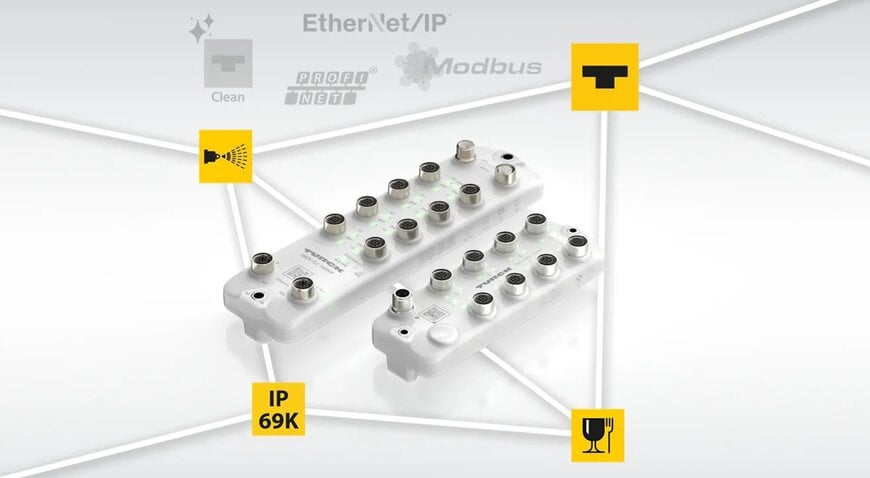
Maintaining signal integrity and equipment hygiene in washdown environments presents a persistent engineering challenge for machine builders and plant operators. Standard industrial fieldbus modules frequently suffer from moisture ingress, chemical corrosion from aggressive sanitizing agents, and microbial accumulation in housing crevices or adhesive labels. To address these operational vulnerabilities without enclosing hardware in expensive stainless steel control cabinets, TURCK has expanded its decentralized automation portfolio with the TB Clean Line, specifically designed for direct machine mounting in the food, beverage, and pharmaceutical industries.
Engineering Requirements in Washdown Production Environments
Hygiene-critical manufacturing relies on regular high-pressure, high-temperature washdowns combined with caustic and acidic cleaning agents. Standard IP67-rated fieldbus devices, while protected against temporary immersion, often fail when exposed to pressurized steam jets or repeated chemical sanitization. Furthermore, conventional housing designs containing rotary address switches, transparent viewing windows, and adhesive rating plates create physical recesses where product residues and bacteria can accumulate, complicating validation procedures for original equipment manufacturers (OEMs).
Decentralized block I/O systems rated for washdown duty eliminate the need for long sensor-actuator cable runs back to centralized control panels. By placing I/O nodes directly on processing and packaging machinery, engineers reduce wiring complexity and installation time, provided the field hardware complies with strict regulatory and material standards.
Hygienic Housing Architecture and Material Compliance
The TB Clean Line addresses washdown durability through a specialized mechanical and material architecture. The internal electronics undergo a two-stage overmolding process and are completely encased in plastics compliant with U.S. Food and Drug Administration (FDA) regulations. To eliminate dead spaces and facilitate runoff during cleaning cycles, the housing features smooth, rounded surfaces and omits physical rotary switches and viewing windows. Integrated spacers create a defined gap between the connectors and the mounting surface, allowing cleaning fluids to flush beneath the module.
All M12 and power connectors utilize stainless steel threads to resist corrosion, while functional grounding is established via a dedicated stainless steel pad. Unused ports can be sealed using blind plugs manufactured from either FDA-compliant plastic or stainless steel. Instead of traditional adhesive labels that can peel and harbor contaminants under thermal stress, identification data—including a direct product link and serial number—is permanently laser-etched onto the housing as a QR code.
The modules are certified to IP67 and IP69K ingress protection ratings and have undergone chemical resistance testing against industrial cleaning agents, supported by Ecolab certification. This compliance-by-design approach enables machine builders to streamline regulatory validation and reduce the engineering overhead required for machine-specific hygiene approvals.
Fieldbus Integration and Cloud Connectivity
The TB Clean Line portfolio encompasses digital I/O modules, IO-Link masters, IO-Link hubs, and network infrastructure components, complemented by matching food and beverage cables rated up to IP69K. The multi-protocol Ethernet modules support configuration and diagnostics through an integrated web interface. To simplify retrofitting and mechanical standardization, the mounting footprints of the new modules are compatible with TURCK's existing TBEN-L and TBIL block I/O series.
Beyond real-time operational technology (OT) control, the architecture supports vertical data integration into information technology (IT) and cloud environments. Process values and diagnostic module data can be extracted and transmitted via the Message Queuing Telemetry Transport (MQTT) protocol using TAS Edge, a software module within the TURCK Automation Suite (TAS). This enables condition monitoring and predictive maintenance workflows without interfering with deterministic fieldbus communication.
Additional Context
This section details technical specifications and competitive benchmarking not included in the original product announcement.
In industrial automation, the deployment of IP69K-rated fieldbus modules reflects a broader shift toward cabinet-free machine design in hygienic sectors, governed by standards such as ISO 20653 for high-pressure washdown protection and guidelines from the European Hygienic Engineering and Design Group (EHEDG). While the press release details TURCK's specific implementation using two-stage overmolding and laser-etched identification, decentralized washdown I/O architecture is an established product category among industrial automation suppliers. Comparable washdown-rated block I/O systems—such as the Murrelektronik Cube67+ and MVK Metal hygienic variants, Balluff BNI washdown series, and ifm electronic AL-series IO-Link masters—similarly combine IP69K sealing, stainless steel fittings, and Ecolab-certified housings to withstand caustic washdowns. Within this segment, mechanical compatibility with established industrial footprints, such as TURCK's TBEN-L mounting pattern, serves to reduce mechanical redesign costs when transitioning existing machine platforms to hygienic specifications.
Edited by Evgeny Churilov, Induportals Media - Adapted by AI.
www.turck.com
