
GPU Industrial PCs for Edge AI in Manufacturing
Rockwell Automation 6300B-SB1 EdgeAI industrial PCs with NVIDIA RTX GPUs run machine vision, predictive maintenance and small language models at the supervisory layer.
www.rockwellautomation.com
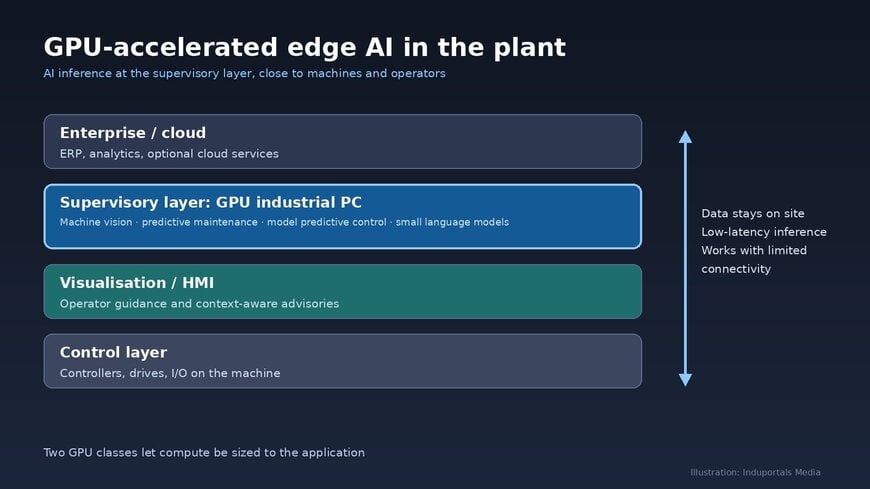
Many industrial AI applications cannot rely on the cloud. Vision inspection and model predictive control need low latency, connectivity on the shop floor is often limited, and some production data must stay on site. At the same time, workloads such as deep-learning vision or language models exceed what conventional controllers and CPU-based industrial PCs can process in real time. Rockwell Automation has introduced GPU-enabled industrial computers powered by NVIDIA accelerated computing to run these workloads close to production.
Two Models for Different Compute Loads
The 6300B-SB1 EdgeAI 4000 industrial PC is equipped with an NVIDIA RTX PRO 4000 Blackwell GPU, while the 6300B-SB1 EdgeAI 2000 uses an NVIDIA RTX 2000E Ada Generation GPU. Rockwell Automation describes the line as a rugged computing option for applications that need more processing capacity at the supervisory layer, above machine control and below enterprise systems.
Supervisory-Layer AI Workloads
The systems are intended for advanced machine vision, model predictive control, predictive maintenance, reinforcement learning and small language models that give operators real-time advisory support. They complement Rockwell Automation's existing control, HMI and visualisation products rather than replacing them. Many of those products already support AI functions without discrete GPUs, and the EdgeAI line adds acceleration where a workload requires it.
Integration With FactoryTalk Optix
Small language models and other compute-intensive applications can run on premises and be connected to FactoryTalk Optix, Rockwell Automation's HMI and industrial visualisation software. This allows context-aware guidance for operators and maintenance teams with low latency, including in plants where cloud connectivity is restricted or data must remain within the facility.
"AI becomes especially powerful in manufacturing when intelligence is available where people are making decisions," said Matheus Bulho, Senior Vice President, Software & Control, Rockwell Automation. "This is an important step as industrial systems move from fixed, deterministic automation toward more intelligent, adaptive operations and expands the range of problems we can automate."
Operational Benefits
Processing data locally removes network round trips from time-critical inference, keeps sensitive process data on site and reduces dependence on external connectivity. Choosing between two GPU classes lets engineers size compute to the application, for example a single vision cell versus a line-level advisory system, instead of over-provisioning hardware.
Rockwell Automation presented the technology at Automation Fair, held from November 16 to 19, 2026, in Boston.
Additional Context:
This section details technical specifications and competitive benchmarking not included in the original product announcement.
In the ISA-95 automation hierarchy, the supervisory layer sits between real-time control at level 1 and manufacturing operations management at level 3. GPU acceleration at this level has become more common as vision inspection moves from rule-based algorithms to deep-learning models, and as small language models are used to interpret alarms, manuals and maintenance records. Alternatives include embedded AI modules for single machines and server-class GPU systems in on-premises data rooms. Rockwell Automation has not published environmental ratings or performance figures for the EdgeAI line, so no quantitative comparison is made here.
Edited by Evgeny Churilov, Induportals Media - Adapted by AI.
