
GPU-Accelerated AI Robotics with ROS 2 and Universal Robots
Universal Robots and NVIDIA integrate Isaac ROS packages with industrial collaborative robot interfaces to deploy real-time perception and motion planning in manufacturing automation.
www.universal-robots.com
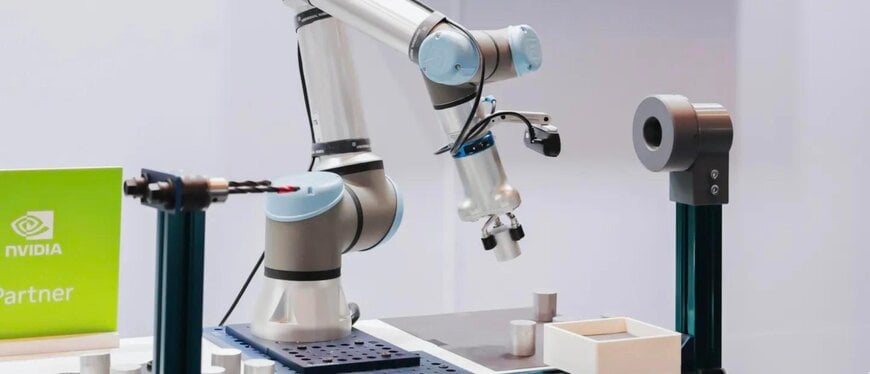
Universal Robots and NVIDIA have collaborated to integrate GPU-accelerated perception and motion planning software with industrial collaborative robotic hardware. The initiative targets manufacturing and industrial automation environments, bridging open-source Robot Operating System 2 development frameworks with deterministic robot control to deploy physical artificial intelligence applications on production floors.
Deployment Bottlenecks in AI-Driven Robotics
Robotics development relies extensively on open-source middleware such as the Robot Operating System to build modular perception pipelines, visualization tools, and simulation environments. However, transitioning robotic applications from virtual simulation to physical industrial deployment presents significant engineering challenges. Connecting high-throughput neural network inference with physical actuators requires deterministic real-time motion execution, standardized communication protocols, and certified functional safety architectures. Addressing this integration gap requires pairing hardware-accelerated computing modules directly with open industrial robot controller interfaces.
System Architecture and Technical Responsibilities
The technical architecture combines NVIDIA’s edge computing and perception libraries with Universal Robots’ mechanical manipulators and controller interfaces. NVIDIA provides the Isaac ROS software suite, comprising GPU-accelerated packages for Robot Operating System 2 validated on Jetson edge hardware. Key modules include FoundationStereo for depth estimation, FoundationPose for six-degree-of-freedom object pose tracking, and cuMotion for GPU-accelerated collision-free trajectory generation.
Universal Robots contributes six-axis collaborative robot platforms, TÜV-certified safety systems, official Robot Operating System and Robot Operating System 2 drivers, and the Universal Robots AI Accelerator software development kit. The hardware exposes real-time telemetry, joint positions, force-torque data, and kinematic states via open interfaces including Real-Time Data Exchange, XML-RPC, TCP/IP, a C++ client library, and native Robot Operating System 2 communication embedded directly within URScript on PolyScope X.
Andrew Pether, Head of AI Partnerships at Teradyne Robotics AI Group, detailed the architectural rationale: "Isaac ROS lets us bring perception and AI-based solutions to market far faster than building from scratch. Components like FoundationStereo, FoundationPose, and cuMotion, already validated by NVIDIA on Jetson, handle the variability of a real robot workspace, so our engineering effort goes into the application itself rather than the perception and motion planning layers beneath it."
Edge Execution and Production Integration
In production deployments, the perception and planning pipeline executes locally on a single NVIDIA Jetson edge computer positioned alongside the robotic workcell, communicating with the robot controller over standard Robot Operating System 2 interfaces. Integrating Robot Operating System 2 messaging directly into URScript allows native robot programs to ingest real-time pose estimates and dynamically planned trajectories at runtime. This runtime bridge enables automation integrators to deploy advanced machine vision and motion planning capabilities within standard robot programming workflows without requiring low-level Robot Operating System 2 software engineering, while maintaining standardized supportability across deployed systems.
Operational Impact in Unstructured Workspaces
Bridging GPU-accelerated spatial perception with deterministic industrial controllers allows robotic manipulators to locate, grasp, and process parts presented in variable orientations. Eliminating rigid mechanical part-presentation fixtures reduces cell tooling costs, shortens changeover times for high-mix manufacturing, and provides a scalable, safety-certified path from simulation to series production across vision-guided manipulation and autonomous assembly workflows.
Edited by Romila DSilva, Induportals Editor, with AI assistance.
www.universal-robots.com
