
www.ptreview.co.uk
25
'26
Written on Modified on
ABB Integrates Edge Computing into Low-Voltage Industrial Motors
ABB introduces the Intelleqt™ low-voltage motor with factory-integrated sensing and edge computing to deliver real-time operational data and help prevent unplanned industrial downtime.
global.abb
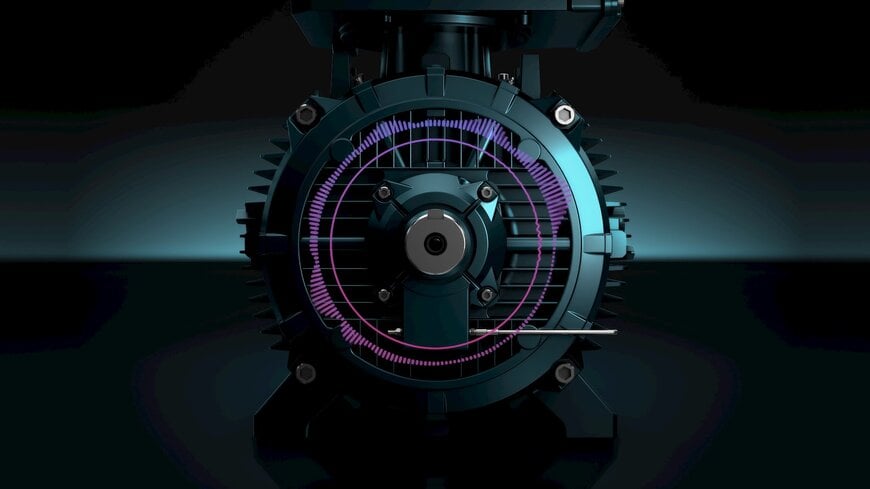
As industrial operators move artificial intelligence from isolated pilot programs into core production workflows, access to reliable, equipment-level data remains a persistent bottleneck. More than 300 million motor-driven systems operate worldwide, accounting for around 60 percent of industrial electricity demand, yet most still run as unconnected mechanical assets that are invisible to analytics platforms. While 84 percent of manufacturers report benefits from artificial intelligence, only 20 percent of AI use cases have successfully scaled, with data quality and availability among the main barriers. Retrofitting legacy motors with external add-on sensors can add installation complexity and create isolated data silos. Overcoming these barriers requires low-voltage motors engineered with factory-integrated sensing, onboard edge computing and open connectivity that deliver operational data from the first shaft rotation.
Factory-Integrated Sensing and Edge Computing Architecture
Launched at the SPS trade fair in Nuremberg, Germany, ABB Intelleqt™ is the world’s first low-voltage motor with intelligence integrated at the factory, according to the company, designed to capture and process operational data directly at the asset level. Positioned within the 18 billion dollar global IEC and NEMA low-voltage motor market, the motor combines sensing, edge computing and connectivity built in during manufacturing rather than relying on aftermarket sensor kits.
This plug-and-play approach enables operators across critical sectors, including data centers, water infrastructure and food production, to stream motor health and performance data into their existing digital platforms from initial commissioning. The open architecture allows end users to retain full ownership of their data, helping them build the data foundation needed to scale AI-driven operations.
Predictive Fault Detection and Energy Optimization
By turning motor data into actionable insights at the edge, Intelleqt supports early fault detection before failures disrupt production. According to ABB, early fault detection can reduce unplanned downtime by up to 50 percent and help operators avoid failures costing up to 1.5 million dollars per incident, based on a 12-hour outage of a critical 110 kW motor. Continuous operating data also helps plant teams improve reliability and productivity and identify energy saving opportunities of 30 percent or more.
Stefan Floeck, President of ABB’s IEC Low Voltage Motors division, noted that while the shift towards AI-driven operations is accelerating, most motors powering global industry do not generate data and remain invisible to the intelligence being built around them. Following its debut, Intelleqt is entering a customer co-creation phase with original equipment manufacturers (OEMs) and end users, with a broader rollout planned for 2027, initially focusing on Europe, Japan, China and India. The development is backed by ABB’s R&D investment of 1.3 billion dollars in 2025 and around 7,800 R&D employees, about half of whom focus on digital and software development.
Additional Context
In industrial rotating machinery, condition monitoring is typically guided by ISO 20816-3 vibration severity limits, while motor efficiency is classified under IEC 60034-30-1 (IE1 to IE5). Conventional monitoring of installed motor fleets relies on external wireless vibration and temperature sensors attached to the motor frame, such as ABB Ability Smart Sensors, Schaeffler OPTIME or SKF Enlight. While such clip-on sensors simplify retrofits, each asset requires separate installation, commissioning and data integration.
Within the connected low-voltage motor landscape, ABB Intelleqt competes with motor and digital service ecosystems from suppliers such as Siemens (SIMOTICS motors with the SIDRIVE IQ platform), WEG (W22 motors with WEG Motor Scan) and Nidec. By integrating sensing and edge computing inside the motor at the factory, ABB aims to deliver standardized, ready-to-use asset data for integration into SCADA, MES and industrial AI applications.
Edited by Romila DSilva, Induportals Editor, with AI assistance.
www.abb.com
