
Developing Robots Capable of Playing Table Tennis Is No Game
Developing robots capable of competing in table tennis is far from mere entertainment. It serves as a technological test bench for validating advances in agile robotics in real-world environments.
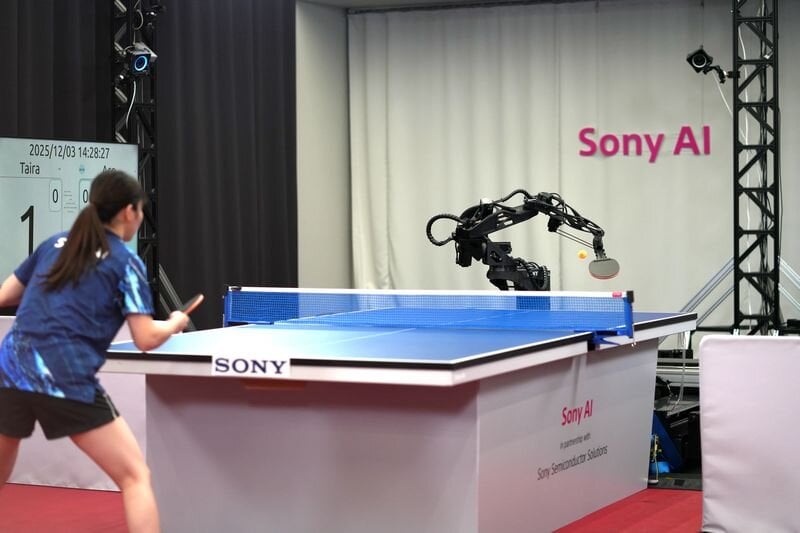
Developing robots capable of playing table tennis represents an engineering challenge that goes far beyond recreation. The sport imposes extreme physical constraints: a ping-pong ball can reach linear speeds exceeding 20 m/s (72 km/h) and rotational speeds of 160 revolutions per second (9,000 rpm). For autonomous systems, the discipline demands millisecond-level perception and decision-making, combined with mechanical coordination capable of absorbing dynamic forces while maintaining millimetre precision.
Two recent projects, led respectively by Google DeepMind and Sony AI (Ace project), illustrate the technical solutions developed to overcome these kinematic and algorithmic barriers.
Technical solutions and deployed architectures
Both laboratories adopted approaches based on simulation, reinforcement learning and modular hardware architectures, while differentiating themselves through their sensor configurations.
Google DeepMind and Sony both rely on Deep Reinforcement Learning. The system is first trained in a highly realistic virtual environment where it simulates millions of trajectories. To bridge the gap between simulation and reality (the Sim2Real gap), characterised by friction, air imperfections, disturbances and random noise, perturbations are injected into the digital models. Sony also initialised its agent using synthetic data generated from recordings of real matches between human players.
To manage responsiveness, the algorithms are structured hierarchically. A high-level controller manages overall strategy, analyses the opponent’s playing style and selects the type of shot to execute (attack, defence or block). Low-level controllers then receive these commands and instantly calculate the precise motion trajectory required to actuate the motors.
Hardware architecture and perception solutions
• Google DeepMind’s system is based on a standard 6-axis robotic arm mounted on rails for lateral movement. Perception is handled by cameras capturing 125 frames per second. To evaluate ball spin without directly observing it on a smooth surface, the algorithm calculates the mathematical deviation between the ball’s actual parabolic curve and a standard theoretical trajectory.
• Sony’s Ace project uses an 8-axis structure (2 prismatic axes for rapid lateral motion and 6 rotational axes). The vision system is hybrid and includes 12 sensors: 9 active high-resolution sensors operating at 200 Hz for 3D triangulation, combined with 3 IMX636 event-based vision sensors (EVS). These sensors record only changes in brightness at pixel level, reducing overall latency to 10.2 ms and enabling direct detection of spin rates up to 9,000 rpm.
Technical challenges overcome
The first major obstacle lies in systemic latency. The time required for cameras to capture images, processors to calculate trajectories and motors to activate creates a delay. As a result, the systems cannot simply react; they must incorporate predictive models capable of anticipating the ball’s future position.
The second challenge concerns interpreting a dynamic environment. When facing a human player, the machine must adapt to strategic changes in real time. Google DeepMind integrated short-term memory capabilities enabling the robot to build a statistical profile of its opponent’s habits during the match.
Finally, the mechanical durability of the components had to be optimised to withstand the sudden accelerations and decelerations required to intercept fast-moving balls without generating vibrations that would compromise shot accuracy.
Results achieved against human players
The performance recorded during testing phases provides a measurable indication of the current capabilities of these technologies.
| Developer | Performance against beginner / intermediate players | Performance against professional / elite players |
|---|---|---|
| Google DeepMind | 100% win rate against beginners. 55% win rate against intermediate players. |
0% win rate. The robot struggles against complex backspin shots and lacks anticipation of human body language. |
| Sony AI (Ace Project) | Not detailed individually (overall competitive rallies). | First documented victory against a professional player under official ITTF rules. |
Implications for industrial robotics
The technologies developed for these table tennis robots have direct applications in the modernisation of industrial production systems.
High-speed handling and automated sorting: Hybrid vision systems (combining conventional sensors and event-based sensors), together with trajectory prediction algorithms, enable the handling of rapidly moving or free-falling parts on production lines. These technologies can be applied to the assembly of electronic or automotive components on high-speed conveyor systems.
Collaborative robotics and industrial safety: Reducing perception latency to around 10 milliseconds is a key factor in collaborative robotics (cobotics) safety. An industrial robot equipped with these sensors can instantly detect unexpected human operator movements and adjust or stop its actions to avoid collisions, facilitating joint work on maintenance or complex assembly tasks.
Adaptability to process variations: Reinforcement learning removes the dependence on rigidly programmed trajectories. Applied to industry, this enables machines such as welding or cutting robots to adjust their behaviour in real time when faced with geometric anomalies in parts, material changes or disturbances in the working environment.
Published by Youssef Belgnaoui, editor for Induportals.
