
www.ptreview.co.uk
05
'26
Written on Modified on
Comprehensive Robotics Stack for Physical AI Deployment
Qualcomm Technologies has introduced a full-stack robotics architecture and a new industrial processor to support scalable deployment of physical AI systems.
www.qualcomm.com
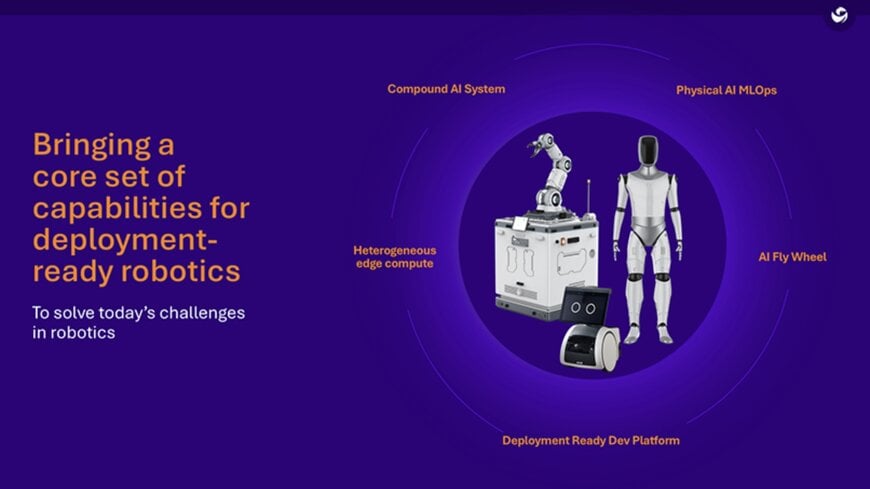
Qualcomm Technologies has unveiled a comprehensive robotics architecture integrating hardware, software, and compound AI, alongside a new high-performance processor aimed at accelerating real-world deployment of autonomous robots.
From robotics prototypes to deployable systems
Robotics developers increasingly face a gap between laboratory prototypes and industrial-scale deployment. Achieving reliable autonomy requires tight integration between compute hardware, real-time software, AI models, and safety-critical systems. Qualcomm Technologies’ newly announced robotics architecture is designed to address this challenge by providing a unified, end-to-end stack that supports perception, planning, and action within a single, scalable framework.
The announcement was made at CES in Las Vegas and reflects Qualcomm Technologies’ strategy to extend its edge AI and low-power computing expertise into industrial autonomous mobile robots (AMRs) and full-size humanoid platforms.
Dragonwing IQ10 industrial robotics processor
At the core of the architecture is the Qualcomm Dragonwing™ IQ10 Series, a robotics-specific processor positioned as the “brain of the robot.” The device is engineered to deliver high compute density with energy efficiency, supporting continuous operation in industrial environments.
The IQ10 is designed for mixed workloads, combining heterogeneous compute for sensing, perception, motion planning, and control. This allows developers to run advanced end-to-end AI models, including vision-language-action and vision-language models, directly at the edge, reducing reliance on cloud connectivity and enabling lower-latency decision-making.
Heterogeneous computing and mixed-criticality systems
The robotics architecture combines heterogeneous edge computing with mixed-criticality system support. Safety-critical functions such as motion control and obstacle avoidance can operate deterministically alongside high-level AI inference and learning workloads.
From a system design perspective, this separation is essential for industrial and humanoid robots operating in shared human environments, where predictable response times and functional safety must be maintained even as AI-driven behaviors become more complex.
Software, AI lifecycle, and partner ecosystem
Beyond silicon, the architecture incorporates software frameworks, machine learning operations, and an AI data flywheel that supports data collection, training, validation, and deployment of models across robotic fleets. This approach is intended to shorten iteration cycles and enable continuous skill improvement after deployment.
Qualcomm Technologies positions the stack as ecosystem-driven, supported by development tools and partners across hardware, robotics platforms, and application domains. This collaborative model is aimed at solving last-mile integration challenges that often delay commercial rollout.
Current deployments and industry engagement
The Dragonwing industrial processor roadmap already supports a range of general-purpose robotics platforms, including humanoid systems developed by companies such as Booster and VinMotion. Demonstrations at CES include VinMotion’s Motion 2 humanoid, powered by the earlier Dragonwing IQ9 Series, and Booster’s K1 Geek platform.
Qualcomm Technologies has also indicated ongoing discussions with KUKA regarding next-generation robotics solutions, signalling potential adoption within established industrial automation environments.
Application scope and operational relevance
The architecture targets applications spanning industrial automation, logistics, public-facing service robots, and humanoid systems designed for complex manipulation and human–robot interaction. By enabling advanced perception and planning at the edge, the platform supports autonomous operation in dynamic, unstructured environments.
Energy efficiency is a key factor in these use cases, particularly for mobile robots and humanoids where battery capacity limits operational duration. The IQ10’s low-power design aims to balance compute performance with practical deployment constraints.
Implications for physical AI
By delivering a tightly integrated robotics stack rather than discrete components, Qualcomm Technologies is addressing a core bottleneck in physical AI adoption: the transition from experimental systems to reliable, scalable machines. The combination of edge AI compute, mixed-criticality support, and lifecycle tooling positions the platform as a foundation for industrial-grade autonomous robots capable of sustained operation outside controlled lab environments.
www.qualcomm.com
