
www.ptreview.co.uk
07
'26
Written on Modified on
Qualcomm Scales Robotics Compute from AMRs to Humanoids
Qualcomm is extending its robotics roadmap with a safety-grade, energy-efficient compute architecture designed to support scalable physical AI across service, industrial, and humanoid robots.
www.qualcomm.com
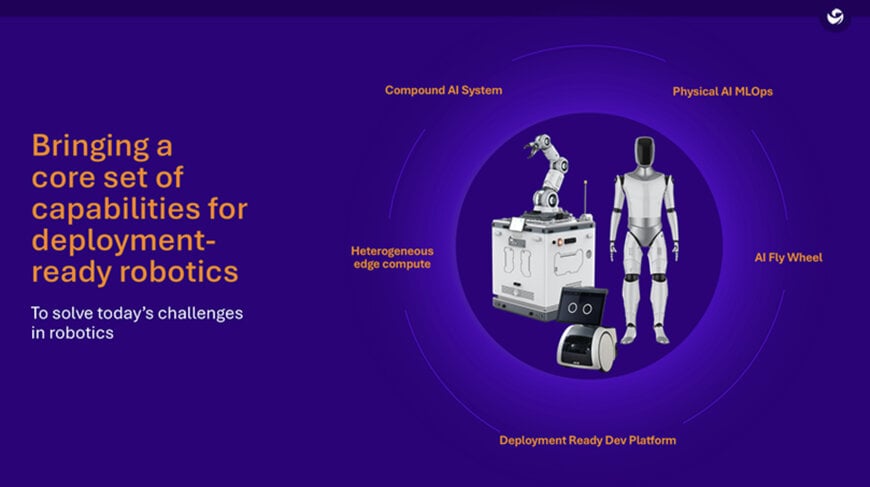
As robotics systems move from controlled environments into real-world deployment, designers face growing demands for compute density, functional safety, power efficiency, and long-term scalability. Qualcomm is addressing these requirements with a general-purpose robotics architecture that integrates hardware, software, and compound AI into a unified platform intended to support everything from household service robots to industrial autonomous mobile robots (AMRs) and full-size humanoids.
The architecture builds on Qualcomm’s experience in edge AI and low-power, high-performance system-on-chip design, targeting robots that must perceive complex environments, plan actions in real time, and adapt continuously during operation. Rather than focusing on a single robot class, the approach is intended to scale across multiple embodiments while maintaining consistent software and safety foundations.
Robotics compute designed for real-world deployment
At the center of the platform is the Qualcomm Dragonwing™ IQ10 Series, a new premium-tier robotics processor aimed at advanced AMRs and humanoid systems. The processor is designed to serve as a centralized “brain of the robot,” combining heterogeneous compute, edge AI acceleration, and mixed-criticality support for workloads ranging from perception and motion planning to safety and control.
The Dragonwing roadmap already supports a range of general-purpose robotic form factors, and the IQ10 expands this capability toward higher-end platforms that require greater compute headroom without exceeding practical power and thermal limits. This balance is critical for mobile robots operating for extended periods in logistics, manufacturing, and service environments.
End-to-end architecture for physical AI
Beyond silicon, Qualcomm’s robotics strategy emphasizes a comprehensive stack architecture that links compute hardware with system software, machine-learning operations, and an AI data flywheel. This end-to-end approach is intended to simplify development of robots that can reason about spatial and temporal context, execute complex manipulation tasks, and improve performance through continuous learning.
Support for advanced AI models, including vision-language architectures and vision-language models, enables more generalized manipulation and human–robot interaction. By integrating these capabilities into a common architecture, the platform aims to reduce fragmentation between prototypes and production systems, helping developers transition from lab demonstrations to deployment-ready machines.
Ecosystem collaboration and humanoid platforms
Qualcomm is also expanding its robotics ecosystem through collaboration with system integrators, robotics developers, and industrial partners. Companies including Advantech, Booster, Kuka Robotics, Robotec.ai, and VinMotion are working with Qualcomm technologies to accelerate deployment of robotics solutions at scale.
In parallel, Qualcomm is collaborating with Figure to help define next-generation compute architectures as humanoid platforms evolve toward higher levels of autonomy and operational robustness. These collaborations reflect a broader focus on aligning compute platforms with the practical requirements of industrial and commercial robotics programs.
Demonstrations at CES 2026
At CES 2026, held January 6–9 at the Las Vegas Convention Center in Las Vegas, Nevada, Qualcomm is showcasing humanoid and robotics platforms powered by its Dragonwing processors, including VinMotion’s Motion 2 humanoid and Booster’s K1 Geek.
Demonstrations also include commercially available robotics development kits and tooling for teleoperation and AI data collection, illustrating how the platform supports iterative training, deployment, and continuous skill expansion across robotic form factors.
www.qualcomm.com
