
www.ptreview.co.uk
03
'26
Written on Modified on
Neuromorphic Sensor Platform Enables Safe Human-Robot Collaboration
Fraunhofer institutes develop NeurOSmart, integrating LIDAR sensing, embedded AI and neuromorphic chips for energy-efficient, real-time industrial robotics.
www.fraunhofer.de
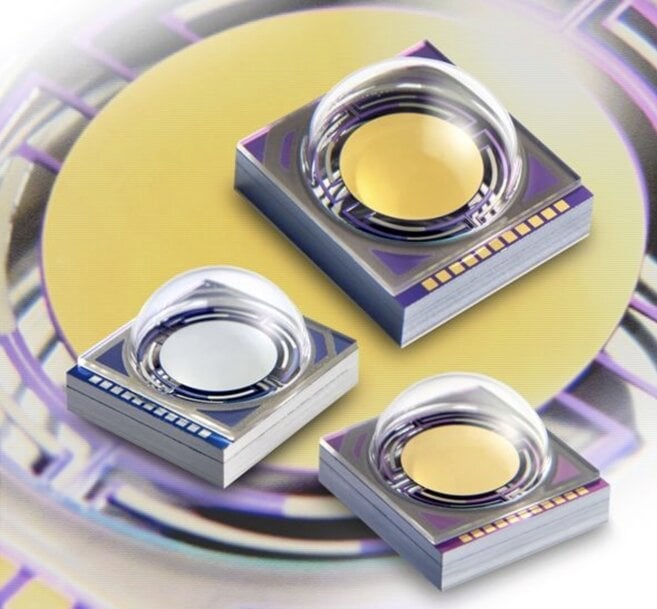
How can robots safely collaborate with humans in shared production environments? Researchers within the Fraunhofer-Gesellschaft have addressed this question through the NeurOSmart flagship project, a technology platform that combines LIDAR-based sensing, embedded AI processing and neuromorphic computing to enable intelligent human-robot collaboration in industrial settings.
The system is designed to allow robots to perform complex tasks while continuously monitoring and adapting to human presence in real time.
Integrated 3D Sensing with MEMS LIDAR
At the core of NeurOSmart is a LIDAR (Light Detection and Ranging) sensor system that observes the shared workspace from a bird’s-eye perspective. The laser emits short pulses in the near-infrared spectrum and measures 3D distances based on reflected signals.
Movable MEMS mirrors scan the laser across the entire work area, generating high-resolution spatial data. The mirrors are fabricated using piezoelectric aluminum scandium nitride (AlScN) with a layer thickness of approximately 1 micrometer. This material choice enhances actuation efficiency and reduces power consumption while maintaining high scanning performance.
The result is continuous, high-resolution 3D monitoring of the robot cell, enabling precise detection of human proximity and movement trajectories.
Embedded AI for Edge Data Processing
A distinguishing feature of the NeurOSmart platform is that data processing is integrated directly into the sensor system. Instead of transmitting large image datasets to centralized controllers, the system performs preprocessing at the edge.
AI algorithms developed by Fraunhofer IMS aggregate incoming signals and identify regions of interest within the scene. This selective processing reduces data rates and energy consumption by focusing computational resources only where human-robot interaction is likely.
By embedding AI-supported evaluation into the sensing hardware, the platform minimizes latency between perception and reaction.
Neuromorphic Computing for Millisecond Response
For deeper signal evaluation and motion control decisions, NeurOSmart employs neuromorphic computing. Researchers at Fraunhofer IPMS developed a specialized accelerator chip consisting of a matrix of interconnected computing units on a wafer. Each unit operates as a decentralized processing element, inspired by biological neural networks.
This architecture enables parallel signal evaluation with high energy efficiency. In combination with AI models developed by Fraunhofer IAIS, the system processes sensor input and triggers mechanical responses within a few milliseconds.
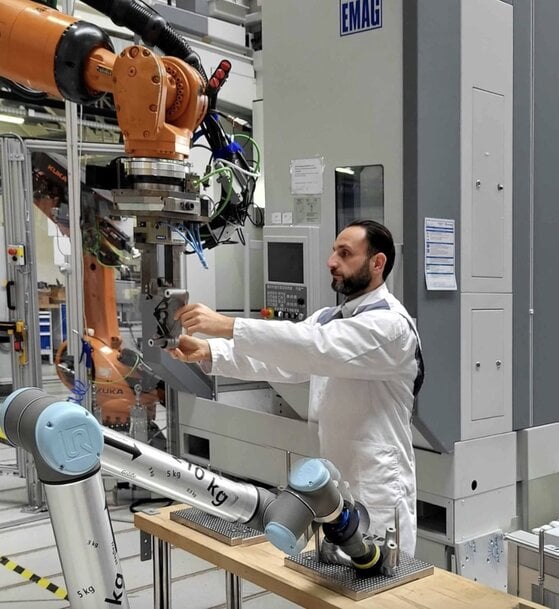
The rapid processing cycle allows robots—including heavy-duty industrial arms—to slow down or stop immediately when a human enters a defined safety zone. Simulation environments developed by Fraunhofer IAIS were used to model hazardous scenarios for AI training that cannot be reproduced safely in real production environments.
Modular Platform for Industrial Applications
The NeurOSmart components form a standardized technology platform coordinated by Fraunhofer ISIT, with participation from Fraunhofer IPMS, IMS, IWU and IAIS. The modular approach enables industrial partners to adapt the platform to application-specific production scenarios.
Beyond manufacturing, the combination of LIDAR sensing, AI-based edge processing and neuromorphic chips could support energy-efficient autonomous systems such as drones or agricultural monitoring platforms, where extended battery life and low-latency decision-making are critical.
By integrating sensor hardware, embedded AI and brain-inspired computing architectures, the NeurOSmart platform demonstrates how intelligent, low-power systems can enable safe and responsive human-robot collaboration in modern production environments.
www.fraunhofer.de
