
www.ptreview.co.uk
10
'26
Written on Modified on
Robotics Partnership Targets Scalable Physical AI
NEURA Robotics and Qualcomm Technologies collaborate on robotics architectures combining edge AI computing with real-time control for next-generation autonomous robots.
www.qualcomm.com
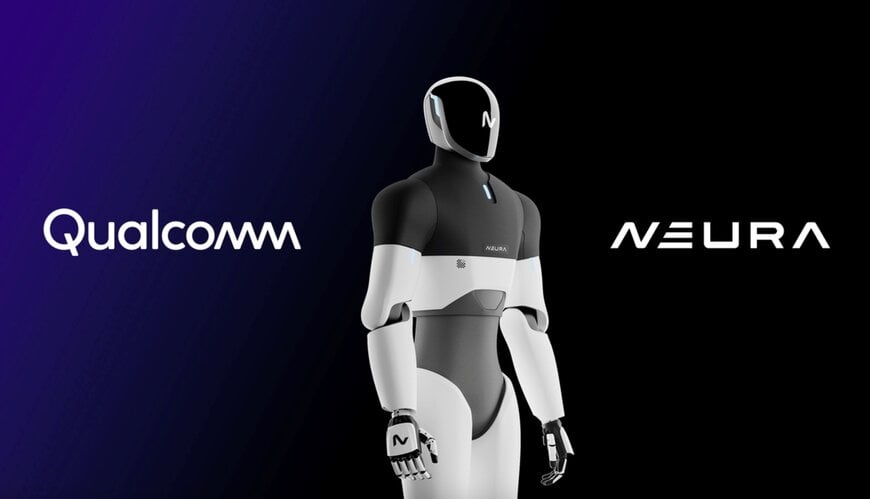
NEURA Robotics and Qualcomm Technologies have announced a long-term strategic collaboration to develop next-generation robotics and physical AI platforms. The partnership combines Qualcomm’s expertise in edge AI processors, connectivity and robotics computing with NEURA’s robotic hardware systems and embodied AI software to accelerate deployment of intelligent robots in real-world environments.
Brain and Control Architecture for Robots
The collaboration focuses on developing reference architectures described as “Brain + Nervous System” platforms. These architectures combine high-level AI capabilities—such as perception, reasoning and planning—with deterministic, low-latency control systems required for robotic motion and interaction.
Qualcomm’s robotics processors, including the Dragonwing IQ10 series, will provide the AI computing layer and connectivity platform. These processors are designed to support heterogeneous edge computing workloads and AI inference tasks directly on the robot.
NEURA will contribute robotic hardware platforms and its embodied AI software stack, which enables robots to interpret environmental data and translate AI decisions into coordinated physical movement.
Mixed-Criticality Systems for Physical AI
The collaboration addresses the technical challenge of combining AI workloads with safety-critical robotic control systems. Robots operating in human environments must process sensor data, execute AI reasoning and maintain deterministic motor control simultaneously.
To support this, the companies plan to integrate mixed-criticality architectures where real-time control functions run alongside AI inference workloads. Qualcomm’s edge computing platforms will manage high-performance AI processing while ensuring deterministic behavior for time-sensitive robotic actions.
The system architecture will also incorporate machine learning operations pipelines and a data feedback mechanism that continuously improves AI models as robots collect operational data.
Standardized Deployment and Development Interfaces
A key objective of the partnership is to simplify the transition of physical AI systems from research prototypes to large-scale deployment. The companies plan to define standardized runtime and deployment interfaces for AI models used in robotic systems.
These interfaces are intended to support validation, updates and lifecycle management of AI workloads across multiple robot platforms. Standardization allows developers to iterate on AI algorithms more rapidly while maintaining reliability and safety.
Simulation and Shared Intelligence Networks
The collaboration will also integrate NEURA’s Neuraverse platform, a cloud-based environment designed for simulation, training and orchestration of robotic AI workloads. The platform connects robots into a shared intelligence network where improvements learned by one system can be distributed across fleets.
NEURA’s hardware platforms—including robotic arms, mobile robots, service robots and humanoid robots—will serve as development and validation systems for the architecture. These systems provide real-world testing environments for AI algorithms and control frameworks.
Expanding the Robotics Developer Ecosystem
The companies aim to support a global developer ecosystem for robotics applications by enabling a “build once, deploy across multiple platforms” approach. Third-party developers will be able to develop AI-based robotics applications that can operate across different robotic form factors.
By combining edge AI computing, embodied robotics platforms and shared development infrastructure, the partnership aims to accelerate the deployment of robots capable of operating safely alongside humans in industrial, service and household environments.
Edited by Industrial Journalist, Romila DSilva – AI Powered
