
www.ptreview.co.uk
17
'26
Written on Modified on
Synopsys Accelerates Engineering Innovation Through Strategic NVIDIA GTC 2026 Partnership
From March 16–19, in San Jose, CA, Synopsys demonstrates how integrating NVIDIA’s accelerated computing and AI helps R&D teams design, simulate, and verify intelligent products with unprecedented speed.
www.synopsys.com
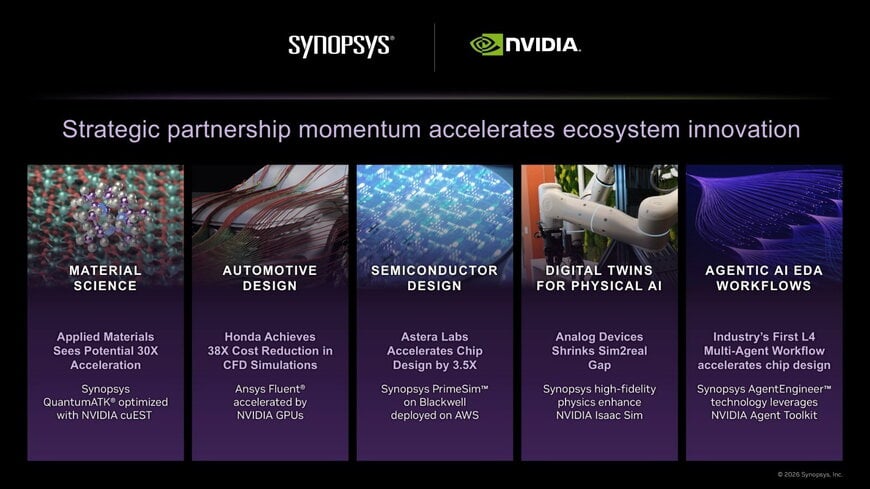
The collaboration between Synopsys and NVIDIA at GTC 2026 marks a decisive shift in the industrial R&D landscape, positioning their joint silicon-to-systems strategy as the primary alternative to legacy CPU-based engineering. While traditional design methods struggle to keep pace with the complexity of software-defined systems, Synopsys is differentiating itself by integrating NVIDIA’s accelerated computing and AI directly into its market-leading EDA and multiphysics platforms. This deep integration allows R&D teams to bypass the performance bottlenecks and high infrastructure costs that typically hamper large-scale semiconductor, aerospace, and automotive projects.
Overcoming the Computational Ceiling with GPU Acceleration
A primary challenge in modern engineering is the "computational ceiling" of CPU-only environments, which often forces engineers to sacrifice simulation fidelity for speed. Synopsys is addressing this by optimizing its broadest portfolio of applications for NVIDIA GPUs, enabling a level of throughput that competitors relying on traditional hardware cannot match.
In materials science, the integration of Synopsys QuantumATK with NVIDIA cuEST has demonstrated the ability to accelerate quantum chemistry workloads by up to 30 times compared to open-source CPU models. This leap allows companies like Applied Materials to model atomic-level behaviors in a fraction of the time previously required. Similarly, in fluid dynamics, the migration of Ansys Fluent workloads to NVIDIA Blackwell GPUs has enabled Honda to achieve 34 times faster computation while reducing costs by 38 percent compared to massive cloud-based CPU clusters. These efficiencies prove that accelerated computing is no longer just an optimization but a requirement for remaining competitive in high-fidelity simulation.
Streamlining Chip Design through Cloud-Based AI Infrastructure
The race for AI connectivity requires ultra-high-speed interfaces that demand exhaustive circuit-level verification. Synopsys has differentiated its workflow by leveraging the scalability of the cloud, specifically through AWS instances powered by NVIDIA Blackwell GPUs. By running Synopsys PrimeSim in this environment, firms like Astera Labs have cut design validation cycles by 3.5 times. This synergy between Synopsys software, NVIDIA hardware, and AWS infrastructure removes the burden of local hardware management, allowing designers to focus exclusively on innovation and precision in next-generation silicon.
Bridging the Sim-to-Real Gap with Physical AI and Digital Twins
Beyond traditional electronics, Synopsys is establishing a unique position in the development of physical AI by grounding virtual environments in precise real-world physics. By augmenting the NVIDIA Isaac Sim environment with Synopsys multiphysics, the partnership is closing the gap between simulation and reality for autonomous systems and robotics.
This high-fidelity approach is currently being utilized to develop digital twins for robotic dexterity, such as bi-manual robotic arms used in automotive manufacturing. By simulating critical physical components like fiber optic sensors and tactile feedback with extreme accuracy, developers can generate high-purity synthetic data. This process, supported by partners like ADI and Kawasaki Heavy Industries, significantly reduces the need for expensive physical prototyping and ensures that AI policies learned in a virtual environment transfer seamlessly to the physical world.
The Evolution Toward Agentic AI in Silicon Engineering
Synopsys is further distancing itself from standard automation by introducing an open, secure, hardware-accelerated agentic AI stack. Developed in collaboration with NVIDIA, the Synopsys AgentEngineer platform utilizes multi-agent workflows to orchestrate complex chip design tasks that were previously manual and error-prone. By supporting NVIDIA NIM inference services and Nemotron models, Synopsys is delivering the industry’s first L4 agentic workflow for design and verification. This evolution transforms AI from a simple assistant into an autonomous engine capable of managing the escalating complexity of the AI era, ensuring that engineers can maintain control over increasingly sophisticated silicon-to-system architectures.
Edited by an industrial journalist, Evgeny Churilov.
www.synopsys.com
