
www.ptreview.co.uk
19
'26
Written on Modified on
Edge controller for autonomous multi-sensor robotics
Acceed introduces RQX-59 platform for ROS 2-based edge AI processing and synchronized sensor fusion in mobile robotics and automated driving systems.
acceed.com
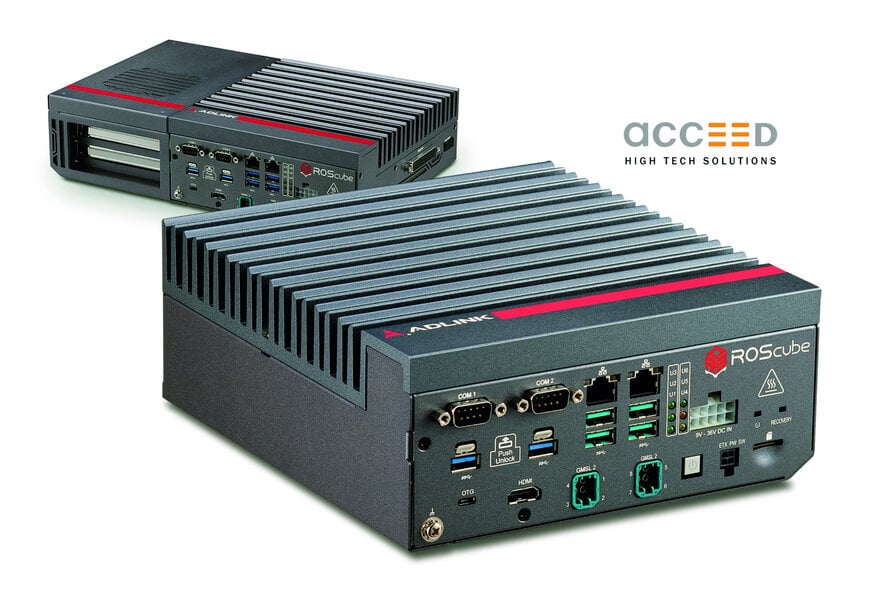
The RQX-59 is an embedded AI controller designed for autonomous mobile systems, combining high-performance edge computing with synchronized multi-sensor processing for robotics, transport automation, and research platforms.
Real-time perception in mobile autonomous systems
Autonomous mobile robots (AMR), automated guided vehicles (AGV), and experimental automated driving platforms require two core capabilities: reliable environmental perception and deterministic real-time response. These systems depend on the fusion of multiple sensor inputs such as cameras, radar, and LiDAR processed locally to avoid latency and connectivity constraints associated with cloud-based computation.
The RQX-59 addresses these requirements as part of the ROScube-X family, positioned as an edge AI platform for ROS 2-based robotics. It is designed to support automotive data ecosystem applications where synchronized sensing and on-device inference are critical for operational safety and system reliability.
Embedded AI performance based on Jetson architecture
The controller is built on the Nvidia Jetson AGX Orin system-on-module. This integrates a 64-bit ARM Cortex-A78AE processor with a GPU featuring up to 2048 CUDA cores and 64 Tensor cores. This configuration enables execution of advanced AI models directly on the device, including:
- Object detection
- Depth estimation
- Semantic segmentation
With a power envelope starting at approximately 40 W, the system targets battery-powered mobile platforms, balancing computational performance with energy efficiency. This allows deployment of complex inference workloads without reliance on external compute infrastructure.
Synchronized multi-camera processing and sensor fusion
A defining technical feature of the RQX-59 is its capability to process multiple automotive camera streams with hardware-level synchronization. The system supports both GMSL (Gigabit Multimedia Serial Link) and FPD-Link III interfaces, enabling high-speed serialized video transmission with frame-level synchronization across multiple inputs.
This capability is essential for:
Synchronized multi-camera processing and sensor fusion
A defining technical feature of the RQX-59 is its capability to process multiple automotive camera streams with hardware-level synchronization. The system supports both GMSL (Gigabit Multimedia Serial Link) and FPD-Link III interfaces, enabling high-speed serialized video transmission with frame-level synchronization across multiple inputs.
This capability is essential for:
- 360-degree environmental perception
- High-speed object detection
- Accurate SLAM (Simultaneous Localization and Mapping)
By integrating synchronization directly into the platform, the controller eliminates the need for external timing hardware and reduces system integration complexity. This improves robustness in multi-sensor fusion pipelines, particularly in dynamic or high-speed operational environments.
Connectivity and system expansion for industrial deployment
The RQX-59 provides a range of industrial communication interfaces suited for integration into distributed robotic systems. These include dual Gigabit Ethernet ports, six USB 3.0 interfaces (two with locking mechanisms), and serial interfaces supporting RS-232 and RS-485 protocols.
Storage and expansion options include M.2 slots for NVMe SSDs and wireless modules supporting WiFi 6, Bluetooth 5.2, and optional 5G connectivity. Memory configurations of 32 GB or 64 GB LPDDR5 are available, complemented by onboard eMMC storage for the operating system.
For higher-performance configurations, an extended version supports PCIe expansion through an external box, enabling integration of additional accelerators or sensor interfaces.
Industrial design and software integration
The hardware is designed for mobile and vehicle-based deployment, supporting a wide input voltage range from 9 to 36 V with reverse polarity protection. Compliance with IEC standards for shock and vibration resistance indicates suitability for industrial and field environments.
On the software side, the platform includes Ubuntu Linux with Nvidia JetPack, providing CUDA support, TensorRT optimization, and a complete driver stack for Jetson hardware. Integration with ROS 2 is supported through the Neuron SDK from ADLINK, reducing development effort for sensor integration and AI deployment.
Application relevance in robotics and automated mobility
The RQX-59 is positioned for applications requiring reliable edge-based perception and control, including industrial automation, logistics robotics, and experimental autonomous driving systems. Its integration of synchronized sensor processing and AI inference supports deployment scenarios where deterministic behavior and low latency are critical.
By combining embedded AI acceleration with native support for multi-sensor synchronization, the platform addresses a key challenge in the digital supply chain of autonomous systems: integrating perception, computation, and communication within a compact, deployable unit.
Edited by an industrial journalist, Sucithra Mani, with AI assistance.
www.acceed.com
Connectivity and system expansion for industrial deployment
The RQX-59 provides a range of industrial communication interfaces suited for integration into distributed robotic systems. These include dual Gigabit Ethernet ports, six USB 3.0 interfaces (two with locking mechanisms), and serial interfaces supporting RS-232 and RS-485 protocols.
Storage and expansion options include M.2 slots for NVMe SSDs and wireless modules supporting WiFi 6, Bluetooth 5.2, and optional 5G connectivity. Memory configurations of 32 GB or 64 GB LPDDR5 are available, complemented by onboard eMMC storage for the operating system.
For higher-performance configurations, an extended version supports PCIe expansion through an external box, enabling integration of additional accelerators or sensor interfaces.
Industrial design and software integration
The hardware is designed for mobile and vehicle-based deployment, supporting a wide input voltage range from 9 to 36 V with reverse polarity protection. Compliance with IEC standards for shock and vibration resistance indicates suitability for industrial and field environments.
On the software side, the platform includes Ubuntu Linux with Nvidia JetPack, providing CUDA support, TensorRT optimization, and a complete driver stack for Jetson hardware. Integration with ROS 2 is supported through the Neuron SDK from ADLINK, reducing development effort for sensor integration and AI deployment.
Application relevance in robotics and automated mobility
The RQX-59 is positioned for applications requiring reliable edge-based perception and control, including industrial automation, logistics robotics, and experimental autonomous driving systems. Its integration of synchronized sensor processing and AI inference supports deployment scenarios where deterministic behavior and low latency are critical.
By combining embedded AI acceleration with native support for multi-sensor synchronization, the platform addresses a key challenge in the digital supply chain of autonomous systems: integrating perception, computation, and communication within a compact, deployable unit.
Edited by an industrial journalist, Sucithra Mani, with AI assistance.
www.acceed.com
