
www.ptreview.co.uk
14
'26
Written on Modified on
Agentic AI Architecture Targets Industrial Automation Workflows
Lantek collaborates with IKERLAN to develop a multi-agent AI system for manufacturing, focusing on real-time decision-making, data control, and scalable industrial deployment.
www.lantek.com
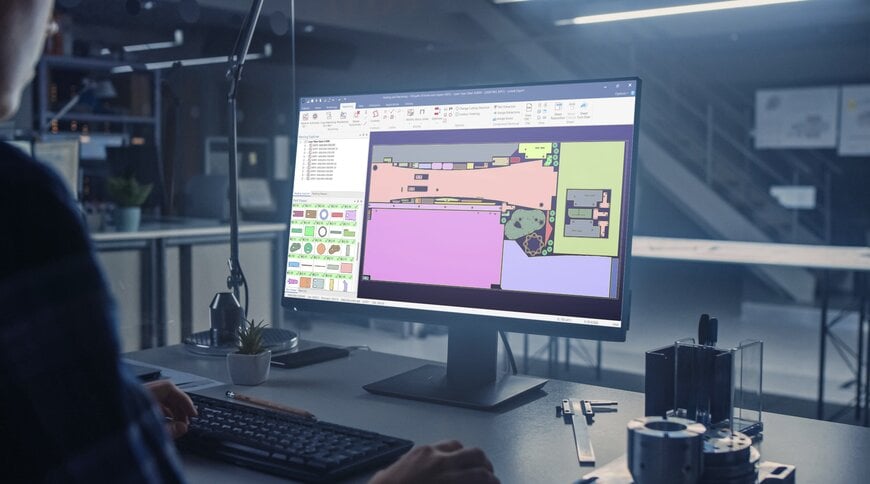
Manufacturing environments are increasingly adopting AI systems that move beyond analysis toward execution and process control. In this context, Lantek and IKERLAN have partnered to develop an agentic AI architecture under the GALAXIA project, targeting coordinated task automation in industrial production settings.
Moving from analytical AI to coordinated execution
Traditional AI deployments in manufacturing have focused on data analysis, prediction, and operator support. The GALAXIA project introduces an agent-based architecture designed to extend these capabilities into execution, where AI systems can perform coordinated actions within production workflows.
This shift is relevant for industries such as sheet metal processing and discrete manufacturing, where multiple interdependent tasks must be synchronized across design, planning, and production stages. The system is designed to operate in real environments, enabling continuous data processing and real-time decision-making.
Multi-agent architecture for distributed industrial intelligence
At the core of the project is a multi-agent system in which specialized AI agents perform distinct roles such as analysis, planning, supervision, and execution. These agents operate in coordination, forming a structured system capable of handling complex industrial processes.
This architecture enables organizations to maintain control over their data, processes, and operational knowledge while reducing reliance on external platforms. It also supports scalability across different applications, allowing the same framework to be adapted to multiple manufacturing scenarios.
The project is supported by the Basque Government’s HAZITEK program and reflects an approach aimed at strengthening local development of industrial AI technologies.
Practical use cases across manufacturing and operations
The system is designed for deployment across a range of industrial use cases. Examples include automatically generating quotations from incoming communications, triggering inventory replenishment using computer vision in retail environments, and resolving technical incidents without manual intervention in repetitive workflows.
These applications demonstrate how agentic AI can transition from a support function to executing complete operational tasks, reducing manual workload while maintaining process continuity.
Integration with regulatory and governance frameworks
The GALAXIA platform is being developed in alignment with the European Artificial Intelligence Regulation, which defines requirements for transparency, security, and system governance.
The multi-agent design incorporates mechanisms that define the scope and autonomy of each agent, ensuring that system behavior remains controlled and traceable within industrial environments. This is particularly relevant as AI systems become more autonomous and integrated into critical production processes.
Role of partners and ecosystem validation
Lantek coordinates the project, contributing expertise in industrial software, data processing, and production-oriented AI applications. IKERLAN leads the technological development, focusing on intelligent systems and applied industrial research.
The consortium includes companies from sectors such as manufacturing and retail, including Eroski, Mondragon Assembly, Goizper, Xabet, Ubikare, Lis Data, and Fagor Arrasate. These participants are validating the system through application-specific use cases, supporting technology transfer across industries.
Positioning within the digital supply chain
The development aligns with broader trends in the digital supply chain, where AI systems are increasingly integrated into end-to-end workflows. By enabling coordinated, multi-agent execution, the GALAXIA project aims to connect data-driven insights with direct operational actions.
This approach supports a transition toward more autonomous manufacturing systems, where AI augments human decision-making by handling repetitive and analytical tasks while operators focus on supervision and process optimization.
Edited by Aishwarya Mambet, Induportals Editor, with AI assistance.
www.lantek.com
