
www.ptreview.co.uk
21
'26
Written on Modified on
Deterministic Real-Time Communication via Li-Fi Technology
Fraunhofer IPMS introduces Li-Fi Grathus®, a light-based wireless system providing gigabit-speed data transmission with sub-microsecond latency for industrial environments.
www.fraunhofer.de
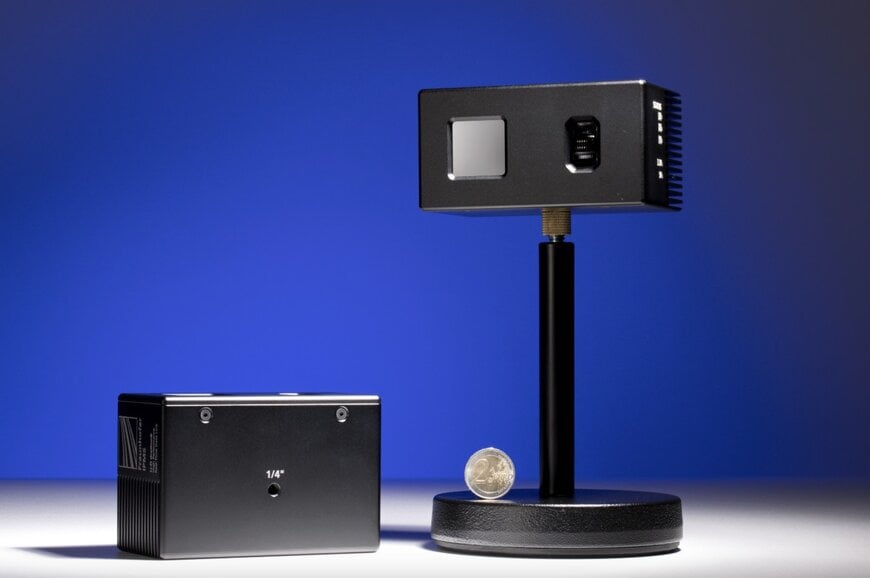
Fraunhofer IPMS has launched Li-Fi Grathus®, an optical wireless communication system designed to replace traditional cabling and radio-based wireless (Wi-Fi/cellular) in demanding industrial settings. By utilizing light waves instead of radio frequencies, the system achieves a data rate of 1 Gbit/s and a deterministic latency of less than 100 nanoseconds. This level of performance is critical for the digital supply chain, where synchronized robotics and high-speed sensor arrays require instantaneous feedback loops.
Technical Performance and Determinism
Unlike standard wireless protocols that can suffer from jitter and variable packet delays, Li-Fi Grathus® offers predictable, real-time performance. Its primary technical specifications include:
- Throughput: 1 Gbit/s full-duplex (simultaneous transmit and receive).
- Latency: Deterministic delay $< 100$ ns, enabling "truly real-time" control.
- Range: Reliable transmission up to 10 meters.
- Side Channel: A dedicated 1 Mbit/s channel for management, diagnostics, and safety-critical signaling.
Immunity to Interference and Integration
A significant advantage of light-based communication is its inherent immunity to electromagnetic interference (EMI). In metallic industrial environments where radio waves often reflect and cancel each other out (multipath interference), Li-Fi Grathus® maintains a stable link. The system is designed for "plug-and-play" integration into established industrial networks, supporting:
A significant advantage of light-based communication is its inherent immunity to electromagnetic interference (EMI). In metallic industrial environments where radio waves often reflect and cancel each other out (multipath interference), Li-Fi Grathus® maintains a stable link. The system is designed for "plug-and-play" integration into established industrial networks, supporting:
- Industrial Ethernet Standards: Profinet, EtherCAT, EtherCAT G, and SERCOS III.
- Time-Sensitive Networking (TSN): Essential for converged networks requiring prioritized traffic.
- Interfaces: Supports USB 3.0/3.1 and Gigabit Ethernet.
Industrial-Grade Design and Ease of Use
Fraunhofer IPMS has optimized the hardware for the rugged conditions of the factory floor. Key design features include:
Fraunhofer IPMS has optimized the hardware for the rugged conditions of the factory floor. Key design features include:
- Multi-path Lens Technology: A patented lens system that allows for higher transmission power and simplifies manual alignment, removing the need for complex beam-steering or adaptive optics.
- Robust Housing: A compact, thermally stable metal enclosure protects the optical components.
- Safety: Certified as Laser Class 1, ensuring the system is eye-safe for personnel working in proximity.
Strategic Use Cases in Automation and Logistics
The flexibility of Li-Fi Grathus® makes it a viable solution for the automotive data ecosystem, where modular production lines are frequently reconfigured. Typical applications include:
Dynamic Motion Control: Precise synchronization of robotic arms and multi-axis machines.
The flexibility of Li-Fi Grathus® makes it a viable solution for the automotive data ecosystem, where modular production lines are frequently reconfigured. Typical applications include:
Dynamic Motion Control: Precise synchronization of robotic arms and multi-axis machines.
- Automated Guided Vehicles (AGVs): High-bandwidth "burst" data transfers for uploading sensor logs or downloading new mission parameters.
- Rotating Machinery: Replacing slip rings or complex cable carriers in large rotating systems.
- Network Backhaul: Serving as a wireless backbone for Wi-Fi or cellular access points in areas with high radio congestion.
Fraunhofer IPMS currently offers an evaluation kit containing two modules and necessary peripherals, allowing manufacturers to test the seamless replacement of 1 Gbps wired links with optical wireless connections in their specific operational environments.
Edited by Romila DSilva, Induportals Editor, with AI assistance.
Edited by Romila DSilva, Induportals Editor, with AI assistance.
