
www.ptreview.co.uk
06
'26
Written on Modified on
TDK Introduces SensorGPT for Edge AI Development
Synthetic sensor data platform reduces training data dependency in smart IoT and Ambient IoT applications.
www.tdk.com
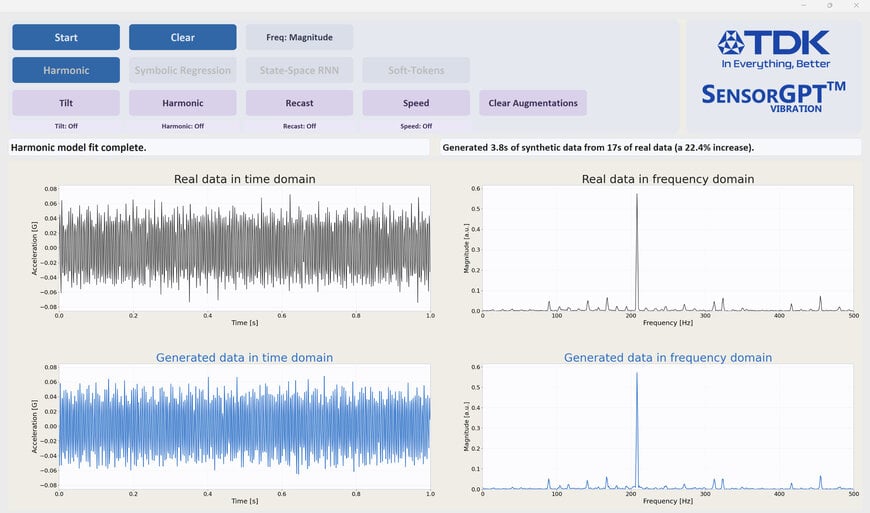
TDK Corporation has introduced SensorGPT, a synthetic sensor data generation platform designed to accelerate edge AI model development for IoT, industrial systems, and Ambient IoT applications. The technology combines generative AI, signal processing, statistical modeling, and physics-based simulations to create scalable sensor datasets for training and validating machine learning models.
The platform addresses a major constraint in edge AI deployment: the time and cost associated with collecting and curating real-world sensor data. According to the company, traditional AI solution development spends nearly 80% of project time on data acquisition and preparation. SensorGPT is designed to reduce reliance on real-world datasets to approximately 10%, enabling faster model iteration and deployment cycles.
Synthetic data generation for edge AI systems
Edge AI systems rely heavily on sensor data for functions such as motion detection, environmental monitoring, predictive maintenance, wearable analytics, and industrial automation. However, gathering large volumes of labeled sensor data across multiple operating conditions remains a significant challenge, particularly in distributed IoT environments.
SensorGPT uses multiple data synthesis methods to address this limitation. Generative AI models are trained on limited real-world datasets to reproduce sensor patterns and behaviors under different operating scenarios. Physics-based simulation models further extend dataset generation by mathematically reproducing real-world sensor interactions and environmental dynamics.
The platform also incorporates signal processing techniques that simulate the characteristics and variability of actual sensor outputs. Data augmentation capabilities automatically create expanded datasets representing diverse operational conditions and edge cases, improving model robustness during training.
TDK stated that the synthetic datasets generated by SensorGPT achieve approximately 90% similarity to real-world sensor data, allowing the generated data to support production-grade edge AI deployment.
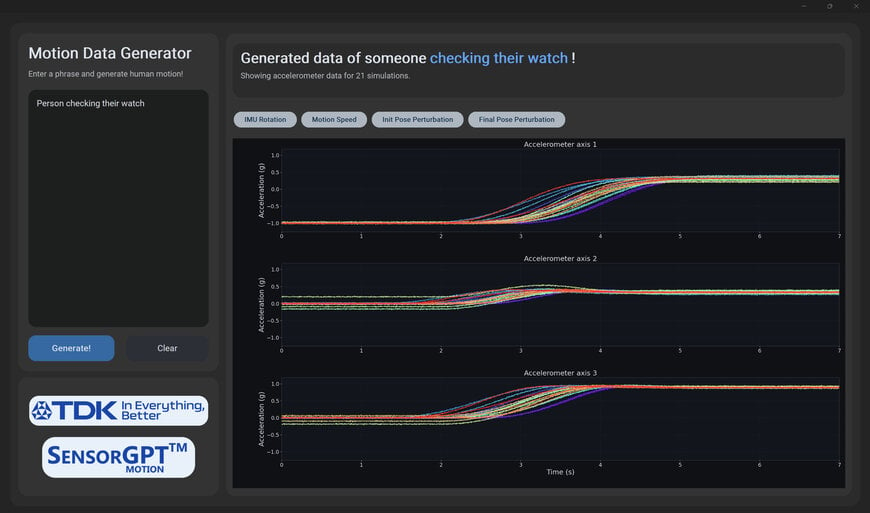
Faster model training and deployment cycles
The company indicated that SensorGPT can reduce edge AI model development timelines from several months to a few weeks. The platform supports faster prototyping and proof-of-concept development by enabling large-scale dataset expansion without requiring extensive field data collection campaigns.
Assisted annotation capabilities are also integrated into the platform to simplify training-data labeling workflows, improving the usability and consistency of datasets for machine learning applications.
The technology is intended for applications across IoT devices, wearables, mobile systems, industrial IoT environments, physical AI systems, and Ambient IoT infrastructure. These sectors increasingly require scalable data generation frameworks as demand grows for decentralized AI processing and intelligent edge computing.
Competitive context in synthetic AI data generation
Synthetic data generation has become an important area within the broader edge AI and digital supply chain ecosystem, particularly for applications where collecting diverse real-world sensor data is expensive or operationally difficult.
Comparable technologies in the market typically focus on simulation-based data generation, AI-assisted augmentation, or digital twin environments. Performance benchmarks in this segment commonly evaluate similarity to real-world data, dataset scalability, annotation efficiency, training speed improvements, and reductions in data acquisition costs.
TDK’s approach combines generative AI with simulation and signal-processing techniques within a single framework, targeting broader coverage of operating conditions and improved adaptability across different sensor types and IoT deployments.
Jim Tran, Corporate Officer and General Manager at TDK USA Corporation and Deputy General Manager of Technology & Intellectual Property HQ, said the platform is intended to transform sensor data into a scalable development resource by combining generative AI modeling with simulation-based data generation techniques.
Edited by Natania Lyngdoh, Induportals editor, with AI assistance.
www.tdk.com
