
www.ptreview.co.uk
21
'26
Written on Modified on
Edge AI Processors for Autonomous Robotics
Intel deploys Core Ultra Series 3 processors as a unified edge AI computing platform for service robots, humanoid systems and industrial automation.
www.intel.com
Intel has introduced its Core Ultra Series 3 processors as a heterogeneous computing architecture designed for physical AI and edge robotics applications. The platform combines a CPU, GPU and NPU on a single chip to replace the discrete graphics processors traditionally used in autonomous robots and edge AI systems.
The technology is already being deployed by robotics developers in hospitality, healthcare, education and manufacturing environments. Sensory AI, Trossen Robotics, Circulus and Oversonic Robotics have started deploying or testing the architecture for robots capable of running AI inference, machine vision and motion control workloads locally without cloud dependency.
Integrated SoC Architecture for Edge AI Workloads
The Intel Core Ultra Series 3 processor is based on a system-on-chip architecture integrating multiple specialized computing engines. The CPU manages general processing and software orchestration, while the integrated GPU accelerates parallel graphics and computer vision workloads. A dedicated NPU handles continuous AI inference tasks with lower power consumption.
This approach is intended to reduce dependence on discrete GPUs commonly used in robotics for real-time AI processing. According to Sensory AI, previous generations required an Intel processor combined with a dedicated GPU, whose cost could exceed the price of the rest of the robotic system.
The shift to a fully integrated Intel architecture reduces power consumption, thermal output and hardware costs while simplifying maintenance for deployed robotic systems.
Physical AI and Real-Time Service Robotics
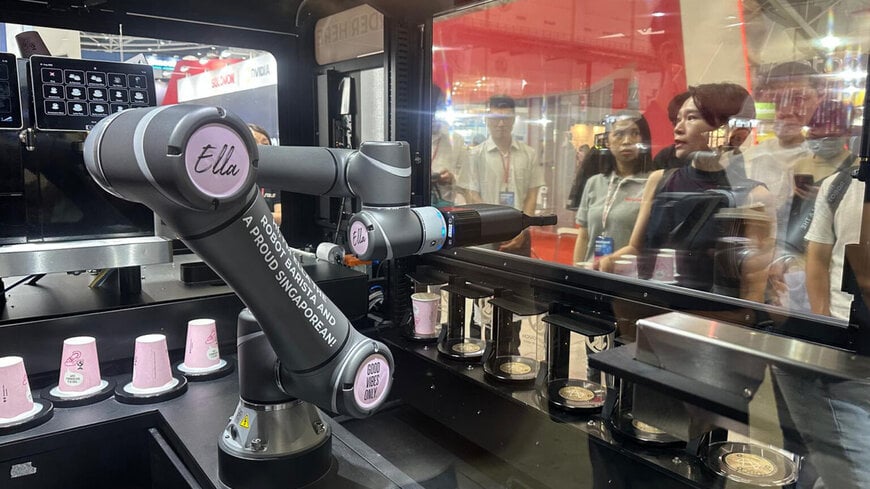
Sensory AI has transitioned its autonomous barista robot Ella entirely to Intel Core Ultra Series 3 processors. The system is designed for automated retail and unattended hospitality environments.
The robot can simultaneously run multiple specialized AI agents locally on the processor. The Avatar Agent manages customer interaction, the Ella Agent analyzes store-level operational patterns, and the Guardian Agent monitors system health and recovery procedures.
This architecture allows the system to execute computer vision, natural language processing and robotic motion control tasks without sending data to remote cloud servers. During Computex 2026 in Taipei, Ella was scheduled to produce up to 200 drinks per hour while running several AI agents concurrently.
According to Sensory AI founder Keith Tan, the architecture enables a deployment model aligned with the operational economics of automated retail by reducing the total cost of ownership of robotic kiosks.
Inference-First Computing for Industrial Automation
The transition toward inference-focused workloads represents a broader change in edge AI robotics. After AI models are trained on high-performance infrastructure, deployed robots no longer require large gaming-class GPUs for daily operation.
Intel states that its integrated architecture enables robots to execute trained models locally with response times suitable for real-time industrial environments.
Illinois-based Trossen Robotics is currently testing Core Ultra Series 3 processors for robotic arms used in industrial automation and food-service applications. The company also develops machine learning research platforms for universities and engineering laboratories.
Marc Dostie, Principal Solutions Architect at Trossen Robotics, noted that x86 architecture remains widely adopted among robotics developers because of broad software framework support and developer ecosystem maturity.
Humanoid Robotics and Cloud-Independent AI Processing
In South Korea, Circulus is deploying a modular robotics operating system on Intel Core Ultra Series 3 processors for humanoid and social robotics platforms.
The company focuses on local data processing to support low latency, data privacy and autonomous robot operation, including offline environments. Applications include human-robot interaction, collaborative manufacturing and humanoid assistance systems.
Italian company Oversonic Robotics is also deploying Intel Core Ultra Series 3 processors in humanoid and centaur robots used in industrial manufacturing and healthcare rehabilitation. The integrated AI accelerators support real-time processing for speech, computer vision, contextual reasoning and robotic motion control.
These systems are designed to recognize individuals, interpret gestures and analyze environments without reliance on external cloud infrastructure.
Additional Context: Technical Specifications and Competitive Benchmarking
Intel Core Ultra Series 3 processors belong to a growing category of edge AI platforms integrating CPU, GPU and dedicated neural processing accelerators within a single package. The architecture competes directly with Nvidia Jetson modules widely used in autonomous robotics and embedded AI systems.
Nvidia Jetson Orin platforms rely on CUDA-enabled GPUs for AI inference and high-performance parallel computing, with some configurations delivering hundreds of TOPS of AI performance. Intel’s approach emphasizes x86 compatibility, integrated heterogeneous computing and support for combined CPU, GPU and NPU workloads on a single platform.
Key comparison metrics in edge robotics include power consumption, inference performance per watt, thermal efficiency, I/O connectivity, latency, developer ecosystem support and compatibility with AI frameworks such as OpenVINO, TensorFlow and PyTorch.
Integrated edge AI architectures are becoming increasingly important in applications requiring low-latency processing, data privacy and offline operation, particularly in healthcare robotics, smart manufacturing and autonomous service systems.
Edited by Sucithra Mani, Induportals editor – adapted by AI.
www.intel.com
