
www.ptreview.co.uk
25
'26
Written on Modified on
PULS Expands Industrial DC Power Architectures
PULS presents centralized and decentralized industrial power conversion systems for machine automation, distributed control, and resilient manufacturing infrastructure.
www.pulspower.com
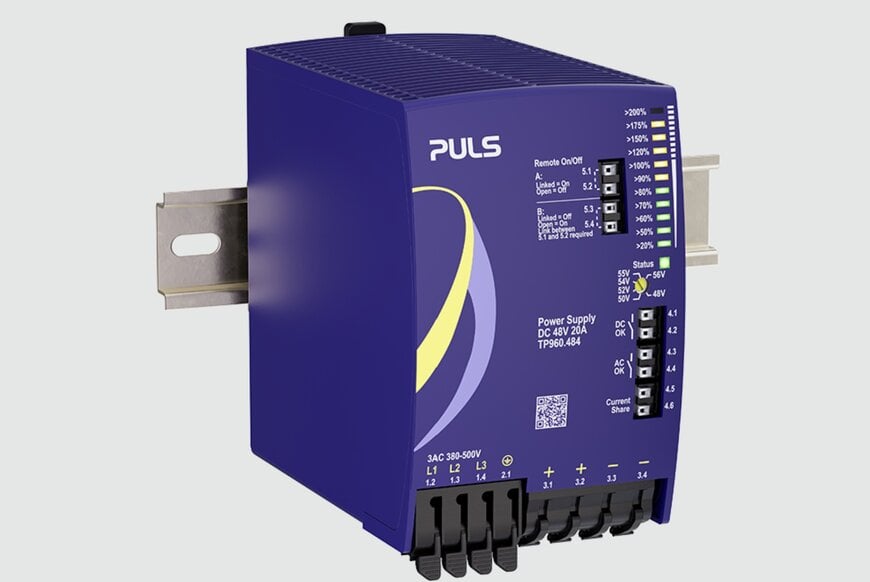
PULS presented new DC power solutions for industrial automation at Smart Manufacturing Week, held at the NEC Birmingham on 3–4 June 2026 (stand N124). The portfolio addressed two common manufacturing power architecture requirements: centralized control cabinet power distribution and decentralized machine-level power delivery for distributed automation systems.
DC Power Design for Industrial Automation Infrastructure
Industrial automation systems increasingly require stable 24 VDC power architectures that support PLCs, industrial PCs, sensors, actuators, communication modules, and motion control equipment. Power supply design affects system uptime, thermal management, cabinet footprint, and maintenance complexity.
At Smart Manufacturing Week 2026, PULS focused on both conventional DIN rail power supplies for control cabinets and decentralized field-mounted systems intended to reduce wiring complexity in modular automation layouts. This aligns with broader smart manufacturing and digital supply chain trends, where machine builders are moving toward more distributed electrical architectures.
DIN Rail Power Supplies for Centralized Control Cabinets
For cabinet-based automation, PULS showcased its DIN rail DC power supply portfolio for single-phase and three-phase industrial applications.
A featured product family is PLANET, described as the company’s next-generation DIN rail power supply platform.The units are designed for compact installation, reduced power losses, and dynamic power reserves of up to 200% during peak-load events.
Transient overload capacity is relevant in industrial systems where inductive loads, motor startup, inrush current, or switching events temporarily exceed nominal demand. A power supply capable of short-duration overload support can reduce nuisance shutdowns and improve system stability.
Reduced heat generation is also operationally significant because thermal load directly affects enclosure cooling requirements, component derating, and long-term reliability in densely packed control cabinets.
Decentralized Field-Level Power Distribution
PULS also presented additions to its FIEPOS decentralized field power supply range, targeting machine-level installation outside conventional control cabinets.
Unlike cabinet-mounted supplies, field-mounted power units can be installed directly on machinery, reducing cable runs and enabling more modular machine design. In manufacturing environments with distributed sensors, conveyors, robotic cells, and modular assembly stations, this approach can simplify electrical integration and reduce installation labor.
The expanded FIEPOS range spans 94 W to 1400 W, adding new 100 W and 200 W low-power variants alongside a new 1400 W high-power model. Existing 360 W and 600 W versions remain part of the portfolio.
Optional IO-Link communication support enables device-level diagnostics and integration into industrial automation networks. The units are available with IP54, IP65, and IP67 ingress protection ratings, indicating suitability for environments exposed to dust, moisture, or washdown conditions, depending on installation requirements. Manufacturer specifications indicate FIEPOS systems are designed for direct field installation and support decentralized 24 VDC distribution architectures.
Manufacturing Use Cases for Distributed Power Architecture
Centralized cabinet power remains common in traditional automation systems, particularly where environmental protection and maintenance access are priorities.
Decentralized architectures are increasingly relevant in applications such as packaging machinery, material handling systems, intralogistics conveyors, automotive assembly equipment, and modular production cells. In these environments, locating power conversion closer to loads can reduce voltage drop, shorten installation time, and improve modular reconfiguration.
The inclusion of IO-Link support also supports predictive maintenance workflows by enabling status monitoring and diagnostics at the device level.
Additional Context
This section details technical specifications and competitive benchmarking not included in the original news release.
Distributed industrial power supply design is an active segment in factory automation. Comparable offerings include Siemens SITOP distributed power systems and Phoenix Contact industrial power supply platforms, both targeting 24 VDC industrial automation infrastructure.
PULS’ published FIEPOS specifications indicate efficiency above 95% for certain models, direct field installation capability, and support for IP54/IP65/IP67 protection classes. Competitive differentiation in this market often depends less on nominal output power alone and more on environmental resilience, installation flexibility, and diagnostics integration.
Edited by Aishwarya Mambet, Induportals Editor, with AI assistance.
www.pulspower.com
