
www.ptreview.co.uk
30
'26
Written on Modified on
Automated Screw Removal System for Electric Vehicle Battery Recycling
Liebherr integrated advanced servo-pneumatic control technology to streamline the decommissioning of end-of-life automotive battery packs.
www.festo.com
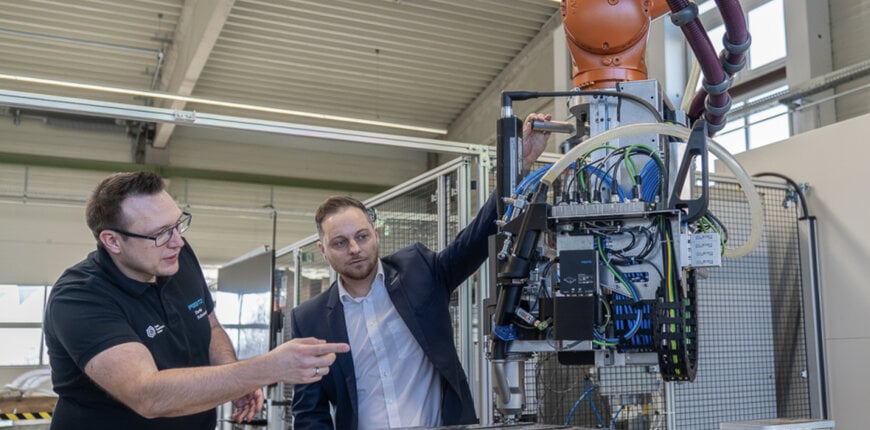
The dismantling of end-of-life batteries from electric vehicles has historically relied on intensive manual labor. A qualified high-voltage electrician typically requires several hours to fully disassemble a single automotive battery pack. This manual approach presents a significant operational bottleneck for recycling facilities facing skilled labor shortages and an anticipated tenfold increase in used battery volumes within the European Union by 2030.
"In view of the shortage of skilled workers and the millions of used batteries expected in the coming years, this is time that a recycling company does not have," explains Viktor Bayrhof, Product Manager at Liebherr-Verzahntechnik.
Beyond labor constraints, the physical architecture of battery housings complicates automated processing. Fastening screws are often distributed across both horizontal and vertical planes and frequently feature a mix of geometries, such as Torx and hexagonal heads. Furthermore, components arriving at recycling centers are frequently dirty or damaged, which reduces the reliability of conventional optical recognition systems.
Implementing Servo-Pneumatic Automation Solutions
To resolve these operational challenges, Liebherr developed the LHDismantle, a robotic disassembly cell designed to automate cover screw removal without requiring complex programming or robotics expertise from facility staff. "The system operators do not need to have knowledge of robotics or automation, as operating the system requires no knowledge of programming or teaching," notes Daniel Reischmann from Technical Sales Automation E-Mobility at Liebherr.
To achieve reliable, position-independent unscrewing, the system incorporates the CMAD servo-pneumatic position controller developed by Festo. This controller manages the clamping jaws of the gripping tool, providing the system with the precise position and force control characteristics of an electric gripper while retaining the low weight and mechanical robustness of pneumatic drives. This weight optimization is highly advantageous for end-of-arm applications on robotic manipulators, where minimizing payload weight is critical.
The control architecture utilizes integrated piezo valves to operate small pneumatic cylinders in a closed-loop system. This setup is supported by a proportional pressure control valve for precise adjustments at low flow rates, a flexible valve terminal, and standard pneumatic cylinders.
Technical Validation and Operational Benefits
The integration of the servo-pneumatic position controller allows the robot grippers to exert a specified force with a spatial accuracy of 0.2 mm across both vertical and horizontal orientations. Because the controller features integrated spatial position detection, it maintains a constant force even as the tool orientation changes during operation. This capability enables the system to handle screws located on different sides of the battery housing seamlessly.
Furthermore, the mechanical design utilizes a patented tactile setting stage during the unscrewing sequence. This tactile approach removes the need for an optical vision system, making the tool resilient against deformed, contaminated, or misaligned fasteners.
The technical configuration underwent extensive validation prior to deployment. "The development of the CMAD position controller allowed us to dispense with the previously used vision system," states Jan Pollmann, Head of Development at Liebherr, noting that collaboration with technical experts at the Festo Experience Centre in Esslingen allowed the engineering teams to thoroughly evaluate the solution under simulated operational conditions.
The implementation of this automated system allows recycling plants to scale operations efficiently to recover critical raw materials, including lithium, cobalt, and nickel. By automating the extraction of these materials, vehicle manufacturers can fulfill regulatory recycling quotas cost-effectively.
Edited by Maria Brueva, Induportals editor – adapted by AI.
www.festo.com
