
www.ptreview.co.uk
16
'26
Written on Modified on
Industrial automation for battery and electric motor manufacturing
Automated pneumatic and electric drive solutions from Festo optimize the production of electrified powertrains for the global electromobility sector.
www.festo.com
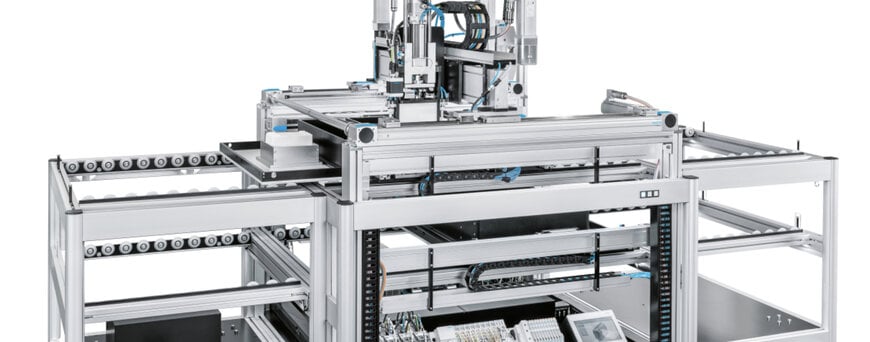
The integration of specialized pneumatic and electric drive systems enables the transition toward fully automated manufacturing within the electromobility supply chain. This technical architecture addresses the global expansion of electric vehicles by automating critical production phases from battery cell fabrication to module assembly.
Environmental requirements for cleanrooms and dry rooms
The manufacturing of electrified powertrains is undergoing a transition from traditional semi-automated processes to completely automated industrial configurations. Global electric vehicle production is projected to increase at an annual rate of 30% until 2030. Within this economic landscape, battery cells represent approximately 40% of the vehicle's added value, with European production capacity projected to grow from 6% to nearly 25% by 2030.
To operate in this segment, automation components must satisfy strict standards regarding dry areas, cleanrooms, and the absence of non-ferrous metals susceptible to causing contamination. Cylinder systems, valves, grippers, sensors, and filters across more than 80 product lines are certified for use in ISO Class 7 controlled environments, with models compliant with Classes 6, 5, and 4. This level of cleanliness is achieved through the exclusive use of reinforced polymers (GRP/CFRP) and more than 60 water-free lubricant formulations, preventing the drying out of abrasive components. To avoid chemical deterioration of the cells, materials containing copper, zinc, or nickel as primary elements are completely excluded from the metallurgical design.
Handling systems and degassing processes
During the phases following the initial electrical contact of the cells, automation manages critical operations such as piercing via lances and forming gas extraction. Degassing and sealing processes require high geometric precision and repeatable cycles. Compact spindle axes with integrated double guides are utilized for loading and unloading process chambers, suitable for two-dimensional and three-dimensional cantilever configurations.
The assembly of battery modules and packs requires flexibility regarding variable geometries and production volume fluctuations. Implementing standardized drive technology optimizes spare parts availability and reduces machinery downtime. Integrating these systems within a digital supply chain ensures workflow efficiency from the earliest design phases. Combining pneumatic and electric vectors—such as pneumatic cylinders equipped with integrated position transmitters, mechanical safety brakes, electric cantilever axes, and dedicated servomotors—allows robust cell handling by linking inline process control with full lot traceability.
Functional safety and decentralized process control
Functional safety during module assembly is guaranteed by pneumatic rotary actuators that execute active cell locking. Optical sensors detect mechanical alignment during the cycle, while the IO-Link interface enables their logical parameterization. Electrical polarity control is performed inline, determining the automatic ejection of non-compliant components before final positioning in the housing.
The control architecture relies on decentralized logic to maximize overall equipment effectiveness (OEE), overcoming the constraints of rigid sequential lines. Adopting automation systems equipped with motion control based on the CODESYS V3 standard reduces the computational load of the master controller. The freed resources facilitate peripheral data processing and the integration of devices into a transparent automotive data ecosystem. This approach supports the creation of digital twins for simulation and interfaces with dedicated learning platforms for the technical qualification of workshop personnel.
Additional Context: This section details technical specifications and competitive benchmarking not included in the original product announcement
Lithium-ion battery cell production imposes rigorous industrial standards to prevent metallic particle contamination, often defined within quality regulations such as the German VDA 19 specification. In the industrial automation components market, the controlled exclusion of copper, zinc, and nickel represents a fundamental competitive benchmarking parameter among major pneumatic and electric system manufacturers.
Direct competitor SMC offers dedicated lines of copper- and zinc-free actuators and valves, such as special series marked with the 25A- and 25- prefixes, specifically designed to withstand environments with an extremely low dew point, typical of dry rooms down to -60°C. For its part, Bosch Rexroth supplies modular chain transfer systems and linear guides with special surface treatments, focusing on the structural rigidity required in high-speed handling systems for prismatic or pouch cells. Omron concentrates its offering on code traceability and synchronized control of stacking systems via its integrated Sysmac platform. The analyzed solution positions itself in the market by offering ISO compliance up to Class 4 for more than 80 standard product ranges, reducing the need for system integrators to develop special custom variants.
Edited by Maria Brueva, Induportals editor – adapted by AI.
www.festo.com
