
www.ptreview.co.uk
02
'26
Written on Modified on
Energy-Efficient Edge Systems for Industrial Automation
Avalue Technology integrates advanced processors into fanless architectures to optimize performance per watt and extend hardware lifecycles in smart manufacturing environments.
www.avalue.com
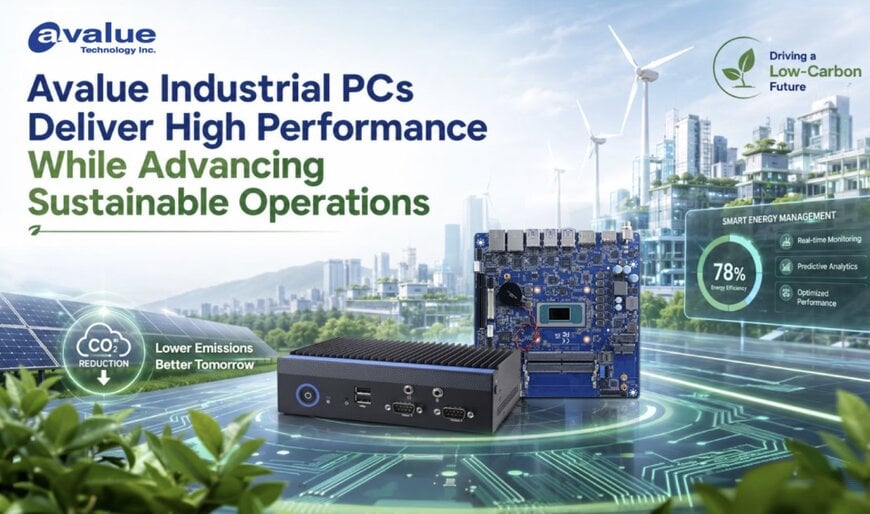
Avalue Technology is releasing a new portfolio of industrial motherboards and embedded systems, including the EMS-ARH fanless system and the ECM-PTL single-board computer. These platforms are engineered to execute localized artificial intelligence workloads while minimizing power consumption across smart manufacturing, machine vision, and intelligent transportation applications.
Heterogeneous Processing for Edge AI Platforms
As artificial intelligence (AI) models increase in complexity, industrial facilities face rising data processing volumes that drive up localized energy consumption. To address the demand for higher computing power without proportionally increasing thermal output, hardware manufacturers are prioritizing performance per watt as a primary operational metric.
The EMS-ARH fanless system utilizes Intel Core Ultra processors to deliver up to 99 Tera Operations Per Second (TOPS) of AI performance. This processing capability is achieved through heterogeneous computing, which distributes workloads across the central processing unit (CPU), graphics processing unit (GPU), and neural processing unit (NPU). By routing specific processing tasks to the most efficient architecture, the system sustains high-performance AI inference while keeping thermal output low enough to function reliably within a sealed, fanless enclosure.
For deployments with strict spatial constraints, the ECM-PTL utilizes a 3.5-inch single-board computer (SBC) form factor. This highly integrated footprint provides equipment manufacturers with a low-power hardware option for localized intelligent edge devices.
High-Density Inference and Hardware Longevity
To support generative AI and large-scale image analytics, the product line also includes the EMX-PTLP Thin Mini-ITX motherboard. Built on the Intel Panther Lake architecture, this board targets up to 180 TOPS of AI computing performance, significantly increasing the ratio of localized inference capability to overall power consumption.
Beyond processor efficiency, industrial computing stability relies heavily on hardware durability. These embedded computing platforms are constructed with industrial-grade electronic components validated for continuous, round-the-clock operation. Extending the operational lifecycle of edge computing infrastructure reduces mechanical failure rates, limits maintenance cycles, and subsequently decreases the volume of electronic waste generated by industrial facilities. Furthermore, integrating these Edge AI platforms with facility sensors enables localized energy management, allowing operators to autonomously monitor power consumption and optimize resource utilization in real time.
Additional Context
This section details technical specifications and competitive benchmarking not included in the original news release.
In the industrial PC (IPC) sector, heavy edge AI inference traditionally required the installation of discrete graphics cards, which significantly increased the system's total thermal design power (TDP) and necessitated active fan cooling. The integration of Neural Processing Units (NPUs) directly into Intel Core Ultra (Meteor Lake) and Panther Lake processors allows systems like the Avalue EMS-ARH to compete with entry-level discrete accelerators while maintaining a system TDP strictly under 45 watts.
When benchmarking these platforms against comparable hardware, such as Advantech's ARK series or Axiomtek's eBOX fanless systems, the primary measurable differentiator is the TOPS-per-watt ratio. Achieving 99 to 180 TOPS without active cooling represents a distinct architectural shift. Previously, reaching the 100 TOPS threshold required integrating dedicated PCIe accelerators that pushed system power consumption well above 100 watts, rendering them unsuitable for sealed environments subject to high ambient temperatures or heavy particulate matter. By consolidating the AI acceleration onto the main processor die, these modern SBCs and Thin Mini-ITX boards reduce both the physical volume and the electrical overhead required for industrial machine vision and predictive maintenance tasks.
Edited by Aishwarya Mambet, Induportals Editor, with AI assistance.
www.avalue.com
