
www.ptreview.co.uk
23
'26
Written on Modified on
Software Development for Industrial Humanoid Robotics
BMW Group collaborates with academic and technological partners to implement software architectures intended for robotics supported by artificial intelligence.
www.bmw.com
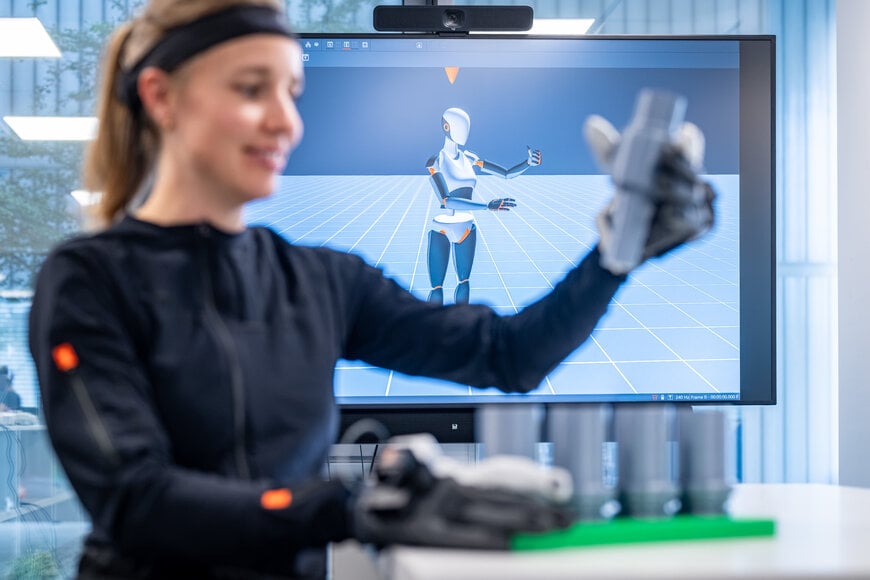
The initiative addresses the development and implementation of open software platforms for the training of humanoid robotic systems within real production environments. The technical solution finds application in component manufacturing, combining physical artificial intelligence with the fine motor skills required in industrial processes. The BMW Group plant in Landshut assumes the role of competence center for software development linked to industrial robotics. The technical challenge consists of integrating robotic systems into complex workspaces, overcoming the limits of traditional deterministic programming. To face this demand, the company collaborates with the startup Athenyx Robotics, born at RWTH Aachen University, and with the University of Applied Sciences Landshut. The integration of these competencies allows uniting industrial practice with the development of architectures based on artificial intelligence.
Technical Solution Architecture
The solution is based on the creation of a modular robotic ecosystem that integrates perception, learning, simulation, and decision-making processes. The system leverages vision, language, and action models to combine visual information, language understanding, and robotic operations. Specialists from Athenyx Robotics develop the software architecture, while BMW Group supplies the training data derived from the production lines. The systems acquire competencies through demonstration-based learning, using camera systems and motion capture suits in order to convert operational schemes into generalizable behavioral models.
Implementation and Operational Validation
The implementation is carried out at the Landshut facilities, where the project team virtually models the work sequences within robotic simulations before physical execution. The new functions are initially tested outside of ongoing production and, subsequently, are integrated into pilot projects to evaluate their performance parameters. The open platform infrastructure guarantees that the acquired competencies can be transferred and scaled among the various operating systems within the plant.
Industrial Applications and Operational Impact
Industrial applications are concentrated in component production, specifically for tasks that require environment recognition, spatial position determination, and precise object manipulation. The use of this software architecture allows robots to evaluate situations in real time and derive appropriate actions autonomously. The technical impact of this integration lies in the acceleration of machine learning processes and the creation of an operational base to increase the flexibility and efficiency of existing production lines.
Edited by Maria Brueva, Induportals editor – adapted by AI.
www.bmw.com
