
www.ptreview.co.uk
20
'26
Written on Modified on
Rodriguez Introduces Thomson Movotrak CTU Collaborative 7th Axis
The solution extends workspaces up to 10 meters with collision detection and Freedrive capabilities for industrial cobots.
www.rodriguez.de
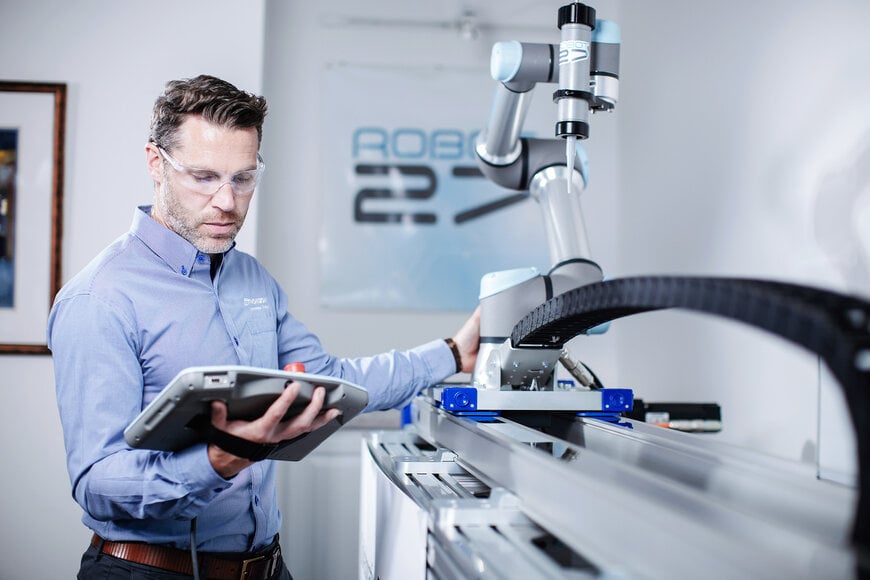
Rodriguez has introduced the Thomson Movotrak™ Cobot Transfer Unit (CTU), offering a collaborative reach extension that adds a movable 7th axis to industrial cobots. This solution allows a single cobot to be deployed across multiple stations within a production line, structuring processes more flexibly and maximizing system utilization without time-consuming retooling. Depending on the configuration, the CTU can provide an operating radius of up to 10 meters. Through modular horizontal, ceiling, or wall mounting options, the system is compatible with a wide range of standard cobots currently on the market.
Autonomous Safety and Simplified Programming
The Movotrak CTU is the only 7th axis on the market equipped with autonomous collision detection, which identifies collisions while the unit is in motion and automatically halts movement. While this complements the overall safety architecture to facilitate operation in environments with increased human-machine interaction, it does not replace standard-required safety functions. Furthermore, the CTU incorporates a Freedrive function, enabling operators to manually guide the robot along the axis and save positions directly for rapid teaching and reduced changeover times. Built on two rigid linear units that ensure maximum torque capacity even at full arm extension, the complete Rodriguez-supplied system includes the motor, gearbox, and switch cabinet. Typical applications include machine tending, large-area welding and dispensing, material handling, and quality assurance inspections for large components.
Additional Context
This section provides technological and market background not explicitly detailed in the original release.
In modern manufacturing, collaborative robots (cobots) have traditionally been limited to stationary tasks due to their fixed base and restricted reach. As facilities shift toward high-mix, low-volume (HMLV) production, the ability to redeploy a single cobot across multiple CNC machines, palletizing bays, or inspection stations dramatically accelerates return on investment (ROI). Historically, integrating a standard linear transfer unit introduced new pinching and crushing hazards that negated the cobot's collaborative rating, forcing integrators to install physical safety fencing. By embedding collision detection directly into the 7th axis, advanced transfer units maintain a fence-free, collaborative environment. This allows human operators and automated tracks to safely share the same floor space during large-scale manufacturing tasks.
Edited by Lekshman Ramdas, Induportals editor – adapted by AI.
www.rodriguez.com
