
www.ptreview.co.uk
28
'26
Written on Modified on
Motion Controller Optimizes Kinematics and Odometry in Mobile Robotics
Oriental Motor introduces a dedicated drive calculation unit engineered to streamline drive integration and position feedback across industrial automated guided vehicles.
www.orientalmotor.com
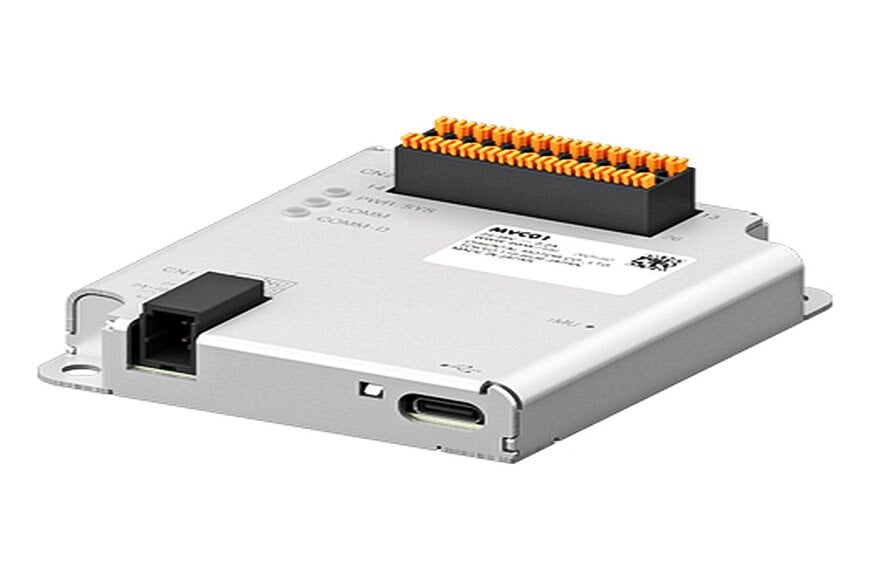
Industrial logistics and manufacturing automation increasingly rely on automated guided vehicles and autonomous mobile robots that require streamlined motion architectures. The MVC01 mobile robot controller addresses this demand by executing vehicle drive kinematics on dedicated hardware to reduce computational loads on upper-level industrial computing systems.
Integrated Drive Kinematics and Software Architecture
Traditional autonomous platform development requires host processors to execute low-level drive algorithms, trajectory calculations, and coordinate conversions within software frameworks such as the Robot Operating System (ROS). The controller simplifies this architecture by receiving high-level target velocity commands directly from the main host and calculating multi-axis wheel speeds internally. Shifting these computational routines to embedded hardware decreases the number of active software nodes, simplifies communication bus traffic, and accelerates commissioning cycles for platform developers.
System configuration, real-time operating telemetry, and parameter tuning are managed through dedicated configuration software. This utility allows engineering teams to set motor parameters, calibrate mechanical dimensions, and evaluate diagnostic data during assembly and routine field maintenance.
Sensor Fusion and Drive Integration
Accurate localization in unstructured warehouse environments requires reliable dead reckoning. The unit integrates an internal Inertial Measurement Unit (IMU) directly into the motion control loop. By fusing angular velocity data from the onboard gyroscope with encoder pulse feedback from the wheel actuators, the hardware generates filtered gyro odometry. This internal calculation detects wheel slip during acceleration or over low-traction surfaces and supplies higher-precision relative positioning data to navigation systems.
The controller interfaces directly with BLV Series R Type brushless DC motors and drivers. This matched drive combination delivers high power density within a compact, lightweight footprint, allowing integration into low-profile autonomous chassis where internal space and payload capacities are tightly constrained.
Additional Context: Technical Specifications and Competitive Benchmarking
Dedicated mobile robot motion controllers operate between high-level navigation computers (such as industrial IPCs running ROS/ROS 2) and lower-level motor drives. In standard mobile base architectures, differential or omnidirectional kinematics are typically resolved either inside a general-purpose industrial PC via open-source software packages or through dedicated multi-axis motion coordinators from manufacturers such as Roboteq or Elmo Motion Control.
- Kinematics Processing: Generic industrial motor drivers require external software to calculate wheel velocities from linear and angular vectors. Dedicated units such as the MVC01 and Roboteq dual-channel controllers embed these differential drive algorithms at the firmware level, eliminating the latency of external ROS velocity-to-wheel-speed conversion loops.
- Odometry Calculation: Basic mobile drive systems compute wheel odometry purely from incremental motor encoders, which accumulate unbounded error during wheel slippage. Integrating hardware-level IMU fusion directly on the motion controller provides real-time slip compensation without requiring separate IMU interface hardware or host-level Extended Kalman Filter (EKF) nodes for raw sensor integration.
- System Topology: Unlike centralized multi-axis servo drives that handle power switching and high-level trajectory directly on a single high-voltage board, this modular architecture pairs a low-voltage motion brain with distributed brushless DC drivers. This separation reduces thermal concentration within compact automated guided vehicle chassis while maintaining synchronized CAN or serial communication across the drivetrain.
