
www.ptreview.co.uk
16
'26
Written on Modified on
Agility Robotics Unveils Digit 5 Humanoid Robot for Scalable Industrial Work
New architecture enables cooperative operation near people, while higher payload, faster charging and swappable tools expand automation across complete facility workflows.
www.agilityrobotics.com
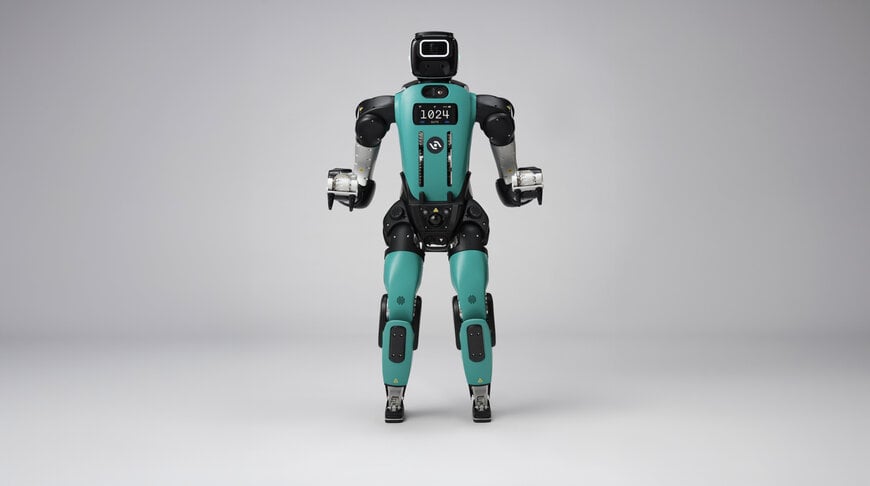
Agility Robotics has introduced Digit 5, the next iteration of its bipedal mobile humanoid system engineered to execute full facility workflows in logistics and manufacturing without external safety fences. Developed from more than 65,000 operational hours recorded by its predecessor, the platform integrates functional safety controls designed to comply with shared human-robot workspace guidelines.
Integrated Functional Safety Architecture
Deploying bipedal platforms alongside human personnel has historically required dedicated safety barriers or physical work cells. The Digit 5 safety framework addresses these isolation constraints through an independent motion supervisor paired with hardware-level sensing. Using proprietary artificial intelligence models and redundant sensor arrays, the platform continuously tracks personnel within its workspace. If an operator breaches the predefined safety zone, the control system initiates autonomous path avoidance, executes a safety stop, or transitions the mechanical frame into a low-center-of-gravity seated state.
Visual and auditory signaling systems communicate immediate directional intent to nearby staff. On the compute layer, Agility Robotics paired its control algorithms with the NVIDIA IGX Thor platform and Halos Core robotics framework. In parallel with product deployment, the company is participating in technical working groups drafting the ANSI/A3 TR R15.108 standard for dynamically stable industrial mobile robots, alongside the development of the international ISO 25785-1 standard for humanoid systems.
Mechanical Kinematics and Power Distribution Upgrades
The mechanical design has been modified to address single-worker material handling demands defined by industrial regulatory guidelines. Incorporating cycloidal actuator technology into the lower limbs, Digit 5 provides a maximum repetitive lifting payload of 50 pounds (22.7 kilograms), representing a 40 percent increase over the previous model. The mechanical frame stands 5 feet 11 inches (1.81 meters) tall, weighs 284 pounds (129 kilograms), and provides a vertical reach envelope of 7.2 feet (2.2 meters) to access standard logistics rack tiers and workstations.
Tool interfaces utilize an ISO-standard flange system, enabling rapid end-effector swaps between specialized tote-handling mechanisms and general-purpose tooling. Power delivery is managed by a re-engineered battery architecture that supports autonomous docking. A full 90-minute runtime requires 9 minutes of high-speed charging, delivering a 10:1 run-to-charge operational ratio that supports over 20 hours of daily duty cycle.
End-to-End Workflow Execution and Fleet Integration
While early industrial humanoid implementations targeted isolated tote movement, Digit 5 expands physical AI training across consecutive operational nodes. Supported manipulation workflows include inbound depalletizing, precision kitting and parts sequencing, machine tending, optical quality checks, and outbound palletizing. Handoff operations interface directly with existing autonomous mobile robots and conveyor lines.
Fleet management and operational telemetry are routed through Agility Arc, a central software layer that connects to enterprise warehouse management systems, warehouse execution software, and manufacturing execution systems. Key performance metrics—including uptime, cycle times, and mean time between incidents—are visualized on the cloud console. System telemetry is protected via end-to-end encryption with mTLS and TLS 1.2+ protocols anchored to an internal certificate authority, while operational computer vision data is processed locally on the edge compute unit.
Production Scale and Commercialization Schedule
Series manufacturing takes place at the 70,000-square-foot RoboFab facility in Salem, Oregon, which is engineered for a maximum capacity of 10,000 units annually. Applied engineering and physical AI validation operate across offices in Pittsburgh, Pennsylvania, and Fremont, California. Customer validation includes multi-year commitments totaling over $300 million across manufacturing, warehousing, and 3PL partners such as GXO, Schaeffler, Amazon, and Toyota Motor Manufacturing Canada.
Initial international commercial operations will target the European Union and the United Kingdom. Regulatory compliance will incorporate the CE mark, with regional customer early access commencing in the first half of 2027 followed by commercial availability in late 2027.
Additional Context:
This section details technical specifications and competitive benchmarking not included in the original product announcement
Industrial mobile humanoids operate in a direct competitive matrix with specialized mobile manipulators and emerging dynamic bipedal platforms, primarily the Boston Dynamics electric Atlas, Figure AI Figure 03, and the Apptronik Apollo system.
Operational duty cycles represent a key industrial benchmark. While systems like the Figure 03 utilize battery systems that require longer charge dwell intervals or manual battery changes, the Digit 5 achieves a 10:1 operational ratio through high-current 9-minute autonomous DC charging. This allows a continuous operational cycle of over 83 percent availability per 24-hour cycle without requiring manual pack swaps.
In payload capacity, the 50-pound (22.7 kg) rating matches the United States National Institute for Occupational Safety and Health manual lifting equation limit for single-person handling. This surpasses the 40-pound (18 kg) payload threshold specified for Apptronik Apollo and Figure series humanoids, which commonly trade absolute load carriage for multi-articulated five-finger hand compliance.
From a compliance and workspace coexistence standpoint, industrial deployment has historically been evaluated under ANSI/A3 R15.06-2025 (integrating ISO 10218-1/2) and ANSI/A3 R15.08 standards for industrial mobile robots. However, dynamically stable bipeds do not have static tipping boundaries. Agility’s integration of the NVIDIA IGX Thor platform running hardware-isolated safety kernels provides a certified execution environment capable of real-time speed and separation monitoring under dynamic balance conditions, aligning with draft requirements set in ISO 25785-1.
Edited by Natania Lyngdoh, Induportals editor, assisted by AI.
www.agilityrobotics.com
