
www.ptreview.co.uk
30
'26
Written on Modified on
Generative Artificial Intelligence Integration for Robotic Programming Platforms
ABB Robotics integrates a large language model into its simulation software, streamlining automation deployment for emerging industrial sectors and training applications.
global.abb
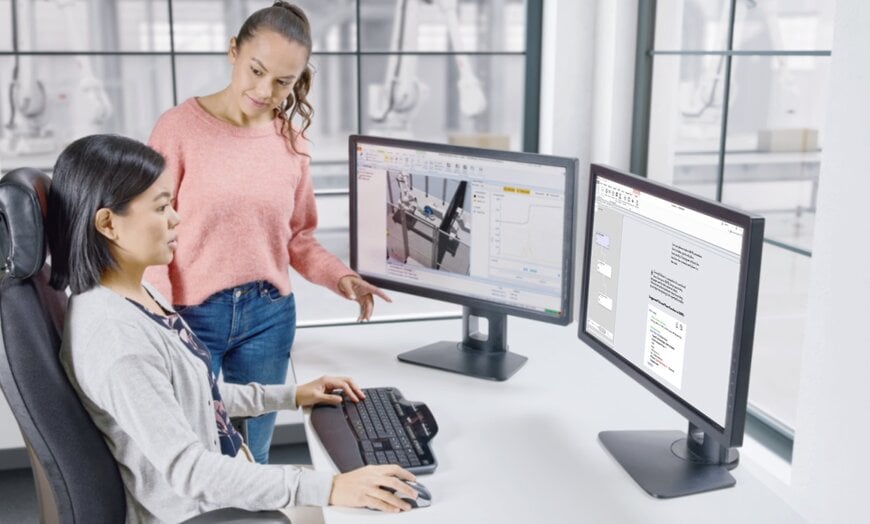
ABB Robotics has released a generative artificial intelligence assistant for its RobotStudio software to provide real-time, step-by-step guidance during robotic programming. This cloud-hosted integration targets small businesses and educational institutions, addressing the industry-wide skill shortage by enabling operators to configure automation tasks through natural language prompts.
Large Language Model Architecture and Natural Language Processing
The generative AI assistant operates on a large language model (LLM) designed to interpret conversational inputs. To ensure accuracy and applicability, the system processes technical queries by cross-referencing its outputs directly with existing technical manuals and proprietary documentation. By leveraging this structured data ecosystem, the interface delivers highly contextualized responses, allowing automation engineers to configure robotic cells rapidly while maintaining adherence to verified mechanical and software parameters.
Industrial Application Areas and Workforce Training
Historically, the digital supply chain for industrial robotics has faced bottlenecks due to extended commissioning cycles and a shortage of specialized programming personnel. By embedding the AI assistant within an offline programming environment, the software becomes accessible to emerging industries and small-scale manufacturing operations that frequently lack dedicated automation experts. Furthermore, educational institutions and training centers utilize the cloud-hosted platform as a practical tool to equip students and young professionals with hands-on experience in automation deployment.
Automatic Path Planning and System Optimization
The simulation tool features automatic path planning, a computational function that calculates optimized physical trajectories for robotic arms. This capability directly reduces mechanical wear, limits energy consumption, and minimizes production downtime, thereby optimizing the overall productivity of automated physical processes. The software architecture also supports remote, real-time collaboration among engineering teams regardless of their geographic location or local hardware setups.
Autonomous Versatile Robotics and Future Automation
The integration of generative artificial intelligence shifts machine programming away from strictly procedural, code-based environments. This evolution addresses the demand for production flexibility by extending configuration capabilities to less experienced users, while simultaneously equipping experts with accelerated diagnostic capabilities for technical faults.
“Driven by major advances in generative AI, we are evolving robotics beyond an environment based on procedures and code, towards a model where robots can autonomously plan and execute a wide variety of tasks,” said Marc Segura, President of ABB Robotics. “We call this Autonomous Versatile Robotics, a new step towards truly flexible and independent systems.”
Additional Context
This section details technical specifications and competitive benchmarking not included in the original news release.
The industrial automation sector is actively adopting large language models to lower the barrier to entry for machine configuration. While the featured simulation platform utilizes an integrated conversational assistant for offline programming and spatial planning, prominent competitors offer parallel frameworks for industrial control. Siemens utilizes the Siemens Industrial Copilot, which leverages Microsoft Azure OpenAI to generate programmable logic controller (PLC) logic and human-machine interface (HMI) visualization scripts. Similarly, KUKA utilizes the KUKA.Sim virtual commissioning environment, and Universal Robots integrates algorithmic trajectory optimization directly within its UR+ ecosystem. Benchmarking across these simulation platforms is evaluated using objective metrics such as simulation-to-reality transfer accuracy—which reaches up to 99 percent in top-tier offline programming environments—alongside kinematic calculation speeds, edge processing latency, and the integration of universal industrial communication protocols.
Edited by Aishwarya Mambet, Induportals Editor, with AI assistance.
www.abb.com
