
www.ptreview.co.uk
25
'26
Written on Modified on
Automated Drive Systems Enable Low-Vibration Semiconductor Acoustic Metrology
In an automation project by MRK Systeme GmbH, integrated drive packages enable high-throughput acoustic testing of semiconductor components without mechanical interference.
www.hiwin.com
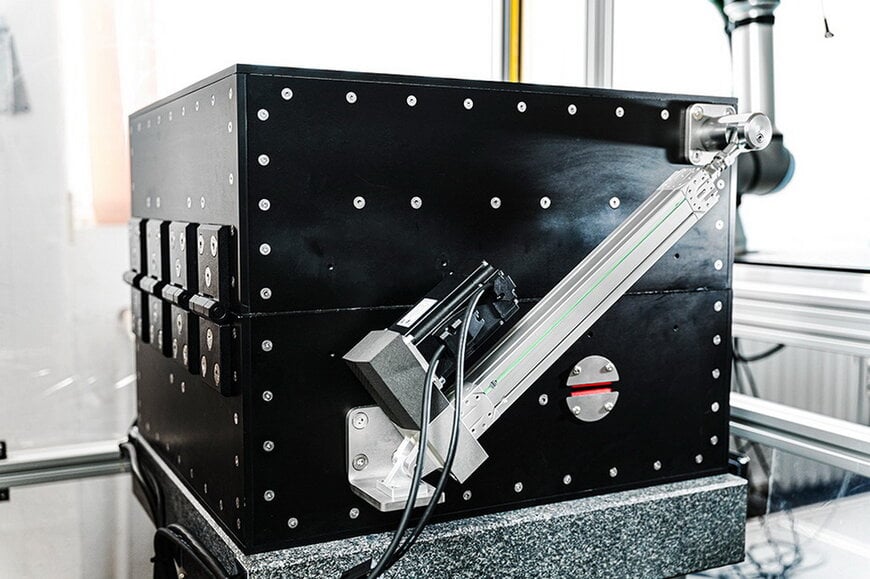
In a collaboration between system integrator MRK Systeme GmbH, drive technology specialist HIWIN GmbH, and semiconductor manufacturer Infineon Technologies AG, an automated acoustic inspection cell was developed for high-volume micro-acoustic component validation. The system automates what was previously a manual laboratory test procedure for MEMS microphones used in consumer electronics, including in-ear headphones.
Mechanical Noise Isolation and Structural Rigidity
Acoustic characterization of sub-millimeter transducers requires absolute decoupling from external mechanical noise and structural resonances. The automated cell utilizes two synchronized electric linear actuators to actuate the soundproofed measuring chamber housing. Because the structural shielding panels weigh in excess of 100 kilograms per moving assembly, the motion profile must handle large moving masses dynamically without inducing residual vibrations or structural oscillations at standstill.
The actuators incorporate a peeled ballscrew mechanism designed for high mechanical stiffness and minimal friction variability. This assembly prevents stick-slip behavior across duty cycles of several thousand iterations per week, suppressing structural vibrations that could otherwise propagate into the acoustic sensor payload and distort signal-to-noise ratios.
Integrated Servo Architecture and Industrial Synchronization
The drive configuration relies on matched linear drive trains comprising electric actuators, EM1 series servomotors, and ED1 servo drives. Operating as a pre-tuned mechatronic system, the dual axes maintain strict dynamic synchronization during high-speed opening and closing cycles.
Control architecture integration is handled natively through industrial Ethernet via Profinet into a Siemens control platform. This unified hardware topology eliminates multi-vendor timing offsets and control-loop tuning discrepancies, facilitating deterministic motion coordination with an adjacent collaborative robot. The robot, guided by a 3D optical vision system, corrects component position offsets in real time to transfer microscopic test specimens into the chamber without mechanical shock.
Additional Context
This section details technical specifications and competitive benchmarking not included in the original product announcement.
In industrial noise-isolated test cells, pneumatic cylinders and traditional linear direct drives represent the standard alternatives to ballscrew-driven electric actuators. Pneumatic cylinders exhibit lower acquisition costs but lack multi-point position programmability, and end-position damping can introduce acoustic impulses up to 70 to 80 dB(A) unless mitigated by complex external baffling. Iron-core linear motors offer high acceleration and smooth velocity profiles, yet continuous high-holding-force applications against heavy masses generate significant thermal dissipation, which can induce thermal drift in sensitive semiconductor test environments. Synchronized peeled-ballscrew electromechanical actuators provide a balanced mechanical alternative, delivering repeatable positioning within micrometer tolerances, mechanical self-locking capabilities, and controlled deceleration profiles that keep background mechanical excitation below ambient lab noise levels.
Edited by Evgeny Churilov, Induportals Media - Adapted by AI.
www.hiwin.de
