
www.ptreview.co.uk
25
'26
Written on Modified on
Automated Quality Assurance for Selective Soldering Systems
EUTECT introduces an inline monitoring platform integrating coaxial machine vision and sensor telemetry to verify joint formation during production.
eutect.de
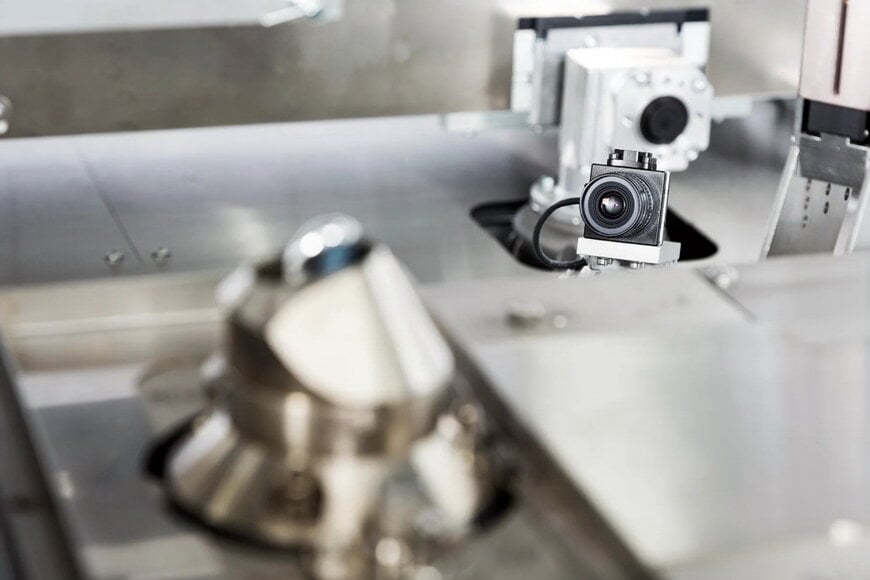
EUTECT has introduced Solder Guard, an inline quality assurance system that couples real-time control metrics with automated optical evaluation for selective soldering applications. The architecture targets high-reliability electronic assemblies across automotive, aerospace, medical technology, defense, railway systems, power electronics, and industrial automation.
Predictive Quality Through Inline Process Telemetry
Conventional manufacturing workflows rely on downstream automated optical inspection (AOI) to evaluate solder joint integrity after thermal processing. Solder Guard shifts evaluation directly into the ongoing soldering cycle, establishing a predictive quality framework. During operation, the control architecture monitors critical parameters within defined tolerance bands. Depending on the specific configuration, the system captures metrics including force- and displacement-controlled wire feeding data, closed-loop temperature profiles, optical feeds, and supplementary sensor inputs. These synchronized data streams generate a digital process record for every individual joint, verifying that formation occurred under controlled conditions.
Integration of Image Processing and Parameter Analytics
The technical architecture is structured around two synchronized software modules: ILSE and EDA. For laser soldering applications, ILSE uses a camera integrated coaxially within the laser processing optics to perform target-versus-actual image comparisons. The camera records individual stills or continuous video streams, executing visual defect detection without requiring secondary external inspection stations. This software layer can be retrofitted directly to existing laser systems utilizing existing optical hardware.
Complementing the visual layer, the EDA module processes the physical machine variables captured during joint execution. It compares operational measurements against defined process limits and qualified baseline parameters. By combining ILSE and EDA, the platform cross-references visual anomalies with synchronous physical telemetry. If an optical defect is flagged, engineering teams can correlate the anomaly with thermal curves, wire feed resistance, or travel speeds. This combined approach reduces false defect classifications while accelerating root-cause failure analysis.
Pathways to Autonomous Process Control and Traceability
Beyond defect identification, the real-time logging of sensor and optical data establishes a foundation for adaptive manufacturing. The continuous evaluation architecture provides the framework required for dynamic closed-loop parameter adjustments, allowing the system to compensate for minor process variations before non-conforming joints occur. For mission-critical electronics operating under strict regulatory standards, the platform provides complete per-joint traceability, retaining long-term historical records to demonstrate process stability and compliance.
Additional Context
This section details technical specifications and competitive benchmarking not included in the original product announcement.
Traditional selective and laser soldering inspection typically depends on post-process, off-line automated optical inspection (AOI) or automated X-ray inspection (AXI) platforms, such as those produced by Koh Young, Omron, or Viscom. Standard post-process AOI systems assess geometry, fillet shape, and bridging after complete board cooling, which decouples defect detection from the immediate thermal and mechanical causes. Conversely, inline coaxial optical systems like EUTECT Solder Guard directly monitor the molten solder pool and wetting process in real time.
Compared to standalone post-reflow inspection, process-integrated coaxial monitoring provides immediate correlation between visual wetting phenomena and internal machine variables—specifically wire-feed feed rates and infrared pyrometer temperature feedback. While post-process 3D-AOI platforms provide volumetric topographical measurements across an entire printed circuit board assembly (PCBA), integrated coaxial telemetry limits inspection scope strictly to the active joint site. However, it delivers localized process verification, eliminating downstream inspection bottlenecks and enabling immediate rejection or parameter correction at the point of origin.
Edited by Evgeny Churilov, Induportals Media - Adapted by AI.
www.eutect.de
