
www.ptreview.co.uk
01
'26
Written on Modified on
Confocal Chromatic Sensors for Precision Industrial Metrology
Micro-Epsilon expands the confocalDT IFS2404 series with the IFS2404-18 sensor to optimize non-contact displacement measurements in confined spaces.
www.micro-epsilon.com
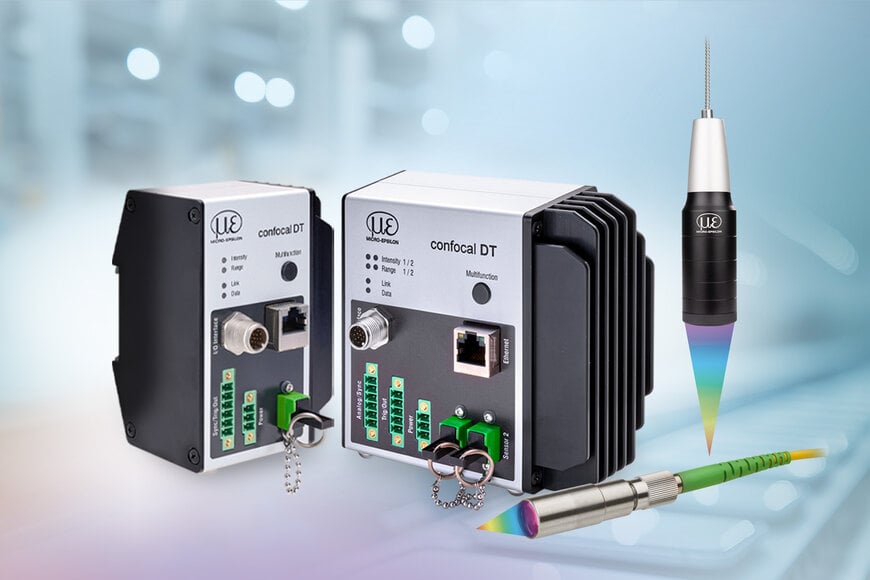
Precision inline inspection, micro-assembly, and semiconductor packaging require continuous non-contact distance and thickness tracking across varying target geometries without causing mechanical surface disruption. To address the spatial limitations of recessed targets and deep boreholes, Micro-Epsilon has introduced the IFS2404-18 alongside standalone models in the confocalDT IFS2404 series, providing an optical sensor design tailored for high-precision displacement measurements.
Engineering Challenges in Confined Optical Inspection
Automated quality control of deep microtiter vessels, fluid dispensing channels, and tight internal enclosures presents major optical measurement challenges. Standard optical displacement systems often experience beam clipping when directed into deep wells or narrow cavities, losing essential signal integrity along sidewalls.
Furthermore, parts transported on fast-moving conveyors or indexed stages frequently present component tilt, surface curvature, and positioning tolerances. Optical systems with high sensitivity to reflection angles frequently suffer signal dropouts on non-flat surfaces. When sensor heads must sit close to targets to maintain measurement resolution, they risk mechanical collisions with moving tooling, liquid splashes, or thermal radiation.
Optical Working Principle and Beam Path Geometry
Confocal chromatic measurement relies on controlled chromatic aberration. A broadband white-light source passes through a multi-lens optical assembly that splits the beam into distinct monochromatic focal points along the optical measurement axis. When a target intersects this spectral focal line, the wavelength focused exactly on the surface reflects back through a confocal pinhole onto a spectrometer. Because only the sharply focused wavelength passes through the aperture, the controller determines target distance based on spectral wavelength rather than reflected light intensity.
The IFS2404-18 integrates an optical architecture configured with a numerical aperture of 0.17. This lower numerical aperture produces a narrow, collimated light cone that penetrates deep cavities and narrow openings without clipping adjacent walls. The sensor provides an 18 mm measuring range starting at an offset distance of approximately 61 mm. This configuration bridges the physical gap between existing 10 mm and 28 mm range optics, providing clearance to protect the front optical element while maintaining sufficient measuring depth for component and process variations.
Angular Tolerance and Surface Versatility
Target tilt presents a frequent source of signal loss in optical metrology. The IFS2404-18 tolerates tilt deviations with a maximum measuring angle of ±9°. This angular acceptance allows the sensor to capture stable measurement values across slightly curved surfaces, shallow geometric flanks, and misaligned workpieces without requiring real-time mechanical tilt compensation.
The confocal chromatic mechanism operates across diverse material compositions, performing stable measurements on specularly reflective metals, diffuse ceramic surfaces, liquids, and transparent glass layers. Because the optical sensor head contains no active electronic components, heat dissipation at the measurement point is eliminated, preventing thermal drift during micro-scale inspection tasks.
Expanded Sensor Lineup and Controller Integration
Micro-Epsilon has also expanded the wider IFS2404 family by releasing the IFS2404-1, IFS2404-3, and IFS2404-6 models as individual components. Previously restricted to pre-packaged bundles with the IFD2411 controller, these sensors can now be coupled with the complete confocalDT IFC controller series.
Additionally, the manufacturer has introduced the IFS2404-4, a variant delivering a 4 mm measuring range packaged in a slim cylindrical housing to fit within dense automation fixtures and multi-channel inspection arrays.
Additional Context:
This section details technical specifications and competitive benchmarking not included in the original product announcement.
Non-contact industrial surface measurement is dominated by three primary optical methodologies: laser triangulation, spectral white-light interferometry, and confocal chromatic sensing.
Laser triangulation sensors project a laser spot onto a surface and image the reflection onto a spatial detector array at an angle. While triangulation sensors offer high stand-off distances, they suffer from triangulation shadowing in steep-walled cavities and struggle with one-sided thickness measurements of transparent materials.
White-light interferometers achieve sub-nanometer axial resolution but operate with narrow stand-off margins, often under 5 mm, making them susceptible to target collisions on dynamic production lines.
Confocal chromatic sensing occupies an intermediate position, offering sub-micron resolution on a coaxial optical axis that eliminates optical triangulation shadows. By pairing passive sensor heads via fiber-optic cables to remote spectrometers, the measuring heads remain compact, immune to electromagnetic interference, and thermally stable.
Standard industrial confocal sensors typically feature higher numerical apertures between 0.30 and 0.50 to maximize light collection on dark diffuse surfaces. However, this wide light cone restricts access to deep recesses. An optical design with a numerical aperture of 0.17 combined with a 61 mm offset distance provides a geometry suited for liquid level verification inside multi-well plates and micro-machined bores, where traditional wide-angle optical heads suffer signal loss from wall reflections. Furthermore, pairing with IFC series controllers allows acquisition rates up to 30 kHz, enabling dynamic inline measurement on continuous web lines and high-speed indexing tables.
Edited by Natania Lyngdoh, Induportals editor, with AI assistance.
www.micro-epsilon.com
