
Autonomous Greenhouse Robotic Harvesting
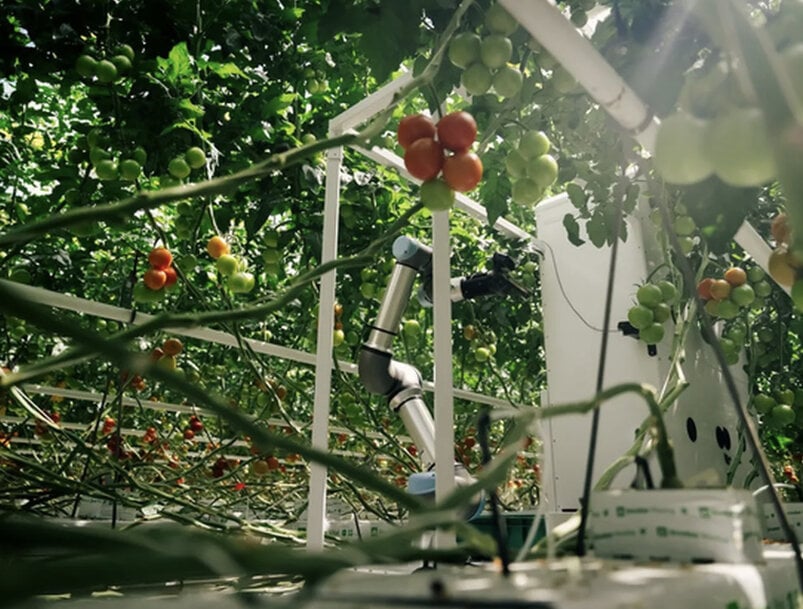
Eternal.ag and Universal Robots deployed advanced collaborative robotic harvesting systems to eliminate labor bottlenecks at a commercial greenhouse facility in Germany.
www.universal-robots.com
Application area:Controlled-environment agriculture and horticulture
Industry sector: Greenhouse farming and crop production
Controlled-environment agriculture plays a critical role in the global food supply by enabling fresh produce to be cultivated year-round regardless of external climate conditions. However, the sector faces severe operational constraints due to persistent labor shortages, rising operational costs, and the need to achieve sustainable, predictable production. Across Europe and international markets, labor availability has become a primary limiting factor, threatening both operational profitability and long-term food security in an era characterized by climate change and decreasing arable land.
Autonomous Harvesting with Collaborative Robots
To address these labor bottlenecks, eternal.ag integrated its flagship autonomous Harvester solution powered by Universal Robots UR5e collaborative robots within real-world greenhouse environments. This robotic architecture combines advanced artificial intelligence and computer vision systems to perform precise, automated harvesting tasks while maintaining strict standards for crop quality and plant health.
Simulation-First Development and System Integration
The technical solution relies on a simulation-first development environment that allows engineers to train, test, and validate robotic behavior in a virtual space before physical deployment, reducing system development cycles from months to weeks. The collaborative robots feature integrated safety functions and precise motion control, enabling them to operate safely alongside human staff while executing delicate handling tasks required for sensitive produce like tomatoes.
Sherry Kunjachan, Co-founder and Chief Technology Officer at eternal.ag, noted the development efficiency of the platform, stating that the simulation-first environment allows the engineering team to train, test, and validate the bots in a virtual environment and cut development time from months to weeks.
Operational Benefits and Future Outlook
By automating repetitive and physically demanding cultivation tasks, the deployment allows human operators to focus on high-level crop management and strategic farm operations. The integration of physical AI and collaborative robotics establishes a scalable foundation for fully autonomous greenhouse management, improving operational efficiency and long-term economic resilience for modern growers.
Editado por Sucithra Mani, editora de Induportals – adaptado por IA.
www.universal-robots.com
