
www.ptreview.co.uk
06
'26
Written on Modified on
High-Speed 2.2-Micron Global Shutter CMOS Sensor Optimizes Machine Vision
OMNIVISION introduces a high-resolution, stacked backside-illuminated image sensor designed to reduce power consumption and motion artifacts in automated industrial environments.
www.ovt.com
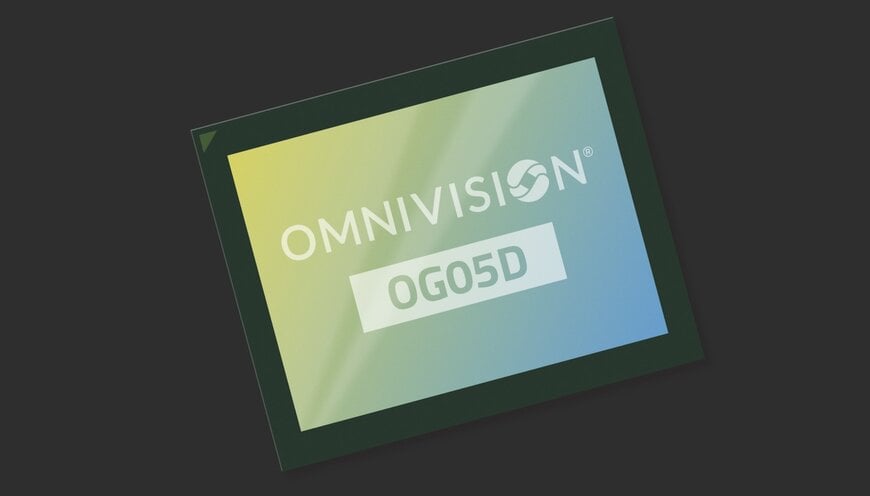
OMNIVISION has launched the OG05D, a 5-megapixel global shutter CMOS image sensor engineered specifically for industrial machine vision, humanoid robotics, and barcode scanning systems. The component provides high-speed imaging and embedded processing to improve data collection and optical navigation for autonomous systems operating across dynamic factory settings.
Sensor Architecture and Processing Capabilities
The OG05D utilizes a stacked backside-illuminated (BSI) architecture combined with a 2.2-micron global shutter pixel, allowing all pixels across the matrix to be exposed simultaneously. This hardware design eliminates the focal plane distortion and motion artifacts typically associated with rolling shutter arrays during rapid spatial movement. Operating at a maximum output of 146 frames per second (fps) in linear mode, the sensor increases data acquisition speeds by 143% compared to previous-generation 5-megapixel models. It incorporates dual conversion gain (DCG) hardware to support 60 fps single-exposure high dynamic range (HDR) combinations, minimizing motion blur while capturing scenes that contain intense highlights and deep shadows. The sensor also supports 60 fps three-exposure HDR combinations alongside on-chip RGB-IR processing and re-mosaic capabilities.
Near-Infrared Efficiency and Hardware Integration
To support autonomous navigation and robotic data ecosystem training under low-light or zero-ambient-light conditions, the sensor leverages proprietary near-infrared (NIR) enhancements. This structural modification achieves a quantum efficiency (QE) of over 55% at 850 nanometers (nm) and over 35% at 940 nm. The 5-megapixel array fits into a 1/2.5-inch optical format within a 6.6 by 5.3-millimeter package. This form factor represents a 30% reduction in physical size while operating with a 30% lower power consumption profile relative to previous iterations, directly supporting embedded AI camera integration and extending operational runtimes in battery-powered robotic payloads.
Availability and Industrial Deployment
Providing an HDR-capable pixel exceeding 70dB, the unit supports monochrome, RGB, and RGB-IR configurations for strict quality control networks. Samples of the OG05D are currently available for engineering validation, with mass production scheduled for the fourth quarter of 2026. The hardware is being exhibited at the VISION Show in Stuttgart, Germany, spanning October 6 to 8, 2026.
Additional Context
This section details technical specifications and competitive benchmarking not included in the original news release.
Within the 5-megapixel industrial image sensor market, the OG05D establishes a new dimensional baseline by achieving a 2.2-micron global shutter pixel. It competes directly against established global shutter sensors such as the Sony Pregius S series (e.g., the IMX568) and the Gpixel GMAX3405. The Sony Pregius S architecture utilizes a 2.74-micron pixel size, requiring a larger 1/1.8-inch optical format to accommodate a full 5-megapixel array. Similarly, the Gpixel GMAX3405 features a 3.4-micron pixel, pushing the required optical format to 2/3-inch. By scaling the pixel pitch down to 2.2 microns while retaining stacked BSI and dual conversion gain capabilities, the OMNIVISION component fits a 5-megapixel matrix onto a smaller 1/2.5-inch sensor format. This dimensional reduction allows hardware engineers to specify smaller, lighter, and less expensive C-mount or M12 lenses without sacrificing global shutter functionality, which proves critical for weight-constrained environments like drone optics and robotic end-effectors. Furthermore, the typical NIR quantum efficiency for standard silicon global shutter sensors at 850 nm generally peaks around 33% (as benchmarked by the GMAX3405); OMNIVISION’s architecture elevates this parameter past 55%, yielding greater target illumination while requiring less active infrared LED power.
Edited by Aishwarya Mambet, Induportals Editor, with AI assistance.
www.ovt.com
