
www.ptreview.co.uk
09
'26
Written on Modified on
Robot Vision Edge Computing Architecture for Industrial Automation Integration
KUKA introduces iiQKA.AI Vision to simplify 2D and 3D robotic guidance without external industrial computers.
www.kuka.com
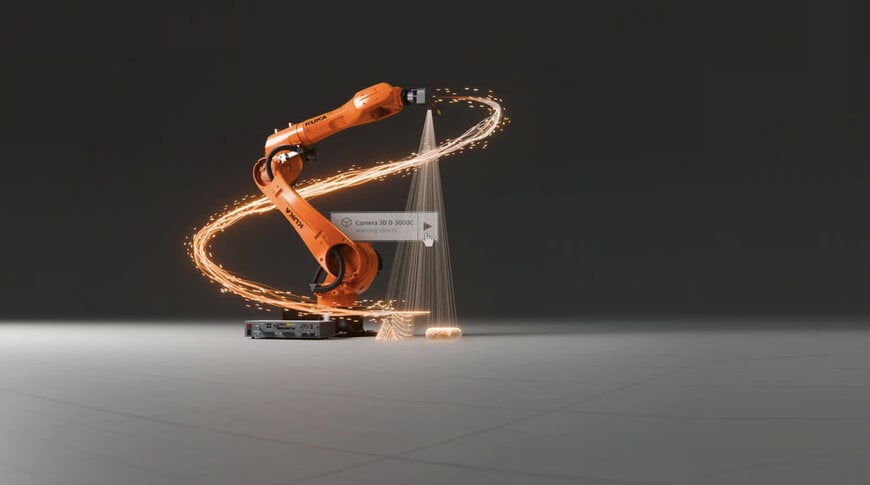
Implementing vision-guided robotics in manufacturing lines frequently introduces integration bottlenecks, requiring external industrial personal computers, specialized vision programming skills, and complex communication bus protocols that increase system latency and deployment costs. To eliminate these hardware layers and simplify optical guidance, automation manufacturer KUKA has launched iiQKA.AI Vision, an integrated software suite that executes artificial-intelligence-driven 2D and 3D image processing directly within the robot controller.
Embedded Edge Processing and Hardware Integration
Traditional machine vision systems rely on separate industrial personal computers (IPCs) or remote cloud processing to execute compute-intensive visual algorithms, introducing latency and network vulnerabilities to the production cell. In contrast, iiQKA.AI Vision executes image processing locally on the KUKA AI Extension Platform, an integrated compute module based on the NVIDIA Jetson Orin architecture embedded directly inside the robot controller.
This embedded architecture eliminates the need for external computer hardware, cloud connectivity, or supplementary network infrastructure. By processing and storing all image data and neural network inference on-board, the system ensures deterministic, low-latency communication between perception algorithms and motion control loops while isolating visual data from external network risks.
Unified Engineering Workflow and Graphical Configuration
Software deployment operates through iiQWorks, where vision applications are configured using a graphical user interface with drag-and-drop programming. Pre-engineered application templates and guided commissioning workflows allow non-specialized engineering teams to implement vision-guided automation without writing custom image-processing code.
The system provides centralized administration and diagnostic monitoring via a unified web interface, bridging engineering setup and daily manufacturing floor operations. Standardized camera sensors and matching optical components tailored to industrial environments interface directly with the controller stack.
Automated Feature Extraction and Kinematic Guidance
Operating across both 2D and 3D imaging domains, iiQKA.AI Vision performs object segmentation, spatial coordinate determination, and automated gripper pick-point calculation. In 3D operations, the platform evaluates point clouds derived from sensor data or CAD models to calculate collision-free trajectory strategies and stable grasping angles, maintaining recognition accuracy despite ambient lighting variations or workpiece surface inconsistencies. In 2D workflows, the software identifies workpieces, tracks conveyor movements, and calculates dynamic offsets to guide robot manipulators in real time.
Target industrial deployments include bin picking of unsorted workpieces, automated machine loading and unloading, end-of-line depalletizing, precision assembly, and in-line quality inspection. KUKA has scheduled technical demonstrations of iiQKA.AI Vision for the NVIDIA GTC event in Berlin from October 20 to 22, 2026, highlighting physical AI implementations in production environments.
Additional Context:
This section details technical specifications and competitive benchmarking not included in the original product announcement.
The transition toward embedded neural-network processing inside robot controllers reflects an industry-wide shift toward edge-based physical AI in discrete manufacturing. Standard vision-guided robotics have traditionally relied either on standalone smart cameras (such as the Cognex In-Sight series) communicating via industrial Ethernet protocols (Profinet, EtherNet/IP) or external IPC-based 3D vision systems (such as Photoneo PhoXi or Keyence CV-X architectures). While smart cameras handle 2D inspection effectively, high-density 3D bin picking and spatial point-cloud processing routinely demand dedicated graphics processing units, which traditionally added 4,000 to 15,000 euros in external hardware and licensing expenses per production cell.
In the robot-native vision market, KUKA's controller-integrated approach directly benchmarks against established proprietary platforms such as FANUC iRVision and ABB Integrated Vision.
FANUC iRVision embeds 2D and 3D visual guidance directly into the R-30iB Plus controller without external PCs, using dedicated internal processing boards and proprietary vision software. While iRVision provides deep deterministic coupling with robot kinematics, its traditional algorithms rely heavily on structured geometric matching, requiring trained vision technicians to configure complex lighting, calibration grids, and 3D sensor baselines.
ABB Integrated Vision, powered by Cognex vision tools and programmed within ABB RobotStudio, similarly streamlines 2D camera setup via FlexPendant interfaces. However, complex 3D deep-learning bin picking on ABB platforms typically necessitates third-party vision engines (such as Pickit 3D or Mech-Mind) running on dedicated industrial PCs.
By adopting the NVIDIA Jetson Orin system-on-module (delivering up to 275 trillion operations per second of AI compute in its top 64 GB configuration), the KUKA AI Extension Platform provides sufficient tensor-processing throughput directly within the control cabinet. This enables deep neural network segmentation and dynamic 3D grasp pose estimation without outsourcing point-cloud calculations to peripheral computers, consolidating footprint, power draw, and multi-vendor software overhead in robotic cells.
Edited by Natania Lyngdoh, Induportals editor, with AI assistance.
www.kuka.com
