
www.ptreview.co.uk
21
'26
Written on Modified on
Electrohydraulic Pump Control for Variable Displacement Systems
Bosch Rexroth AG launches the H4U.cube pQ modular control system to simplify commissioning and pressure-flow regulation in industrial electrohydraulic machinery.
www.boschrexroth.com
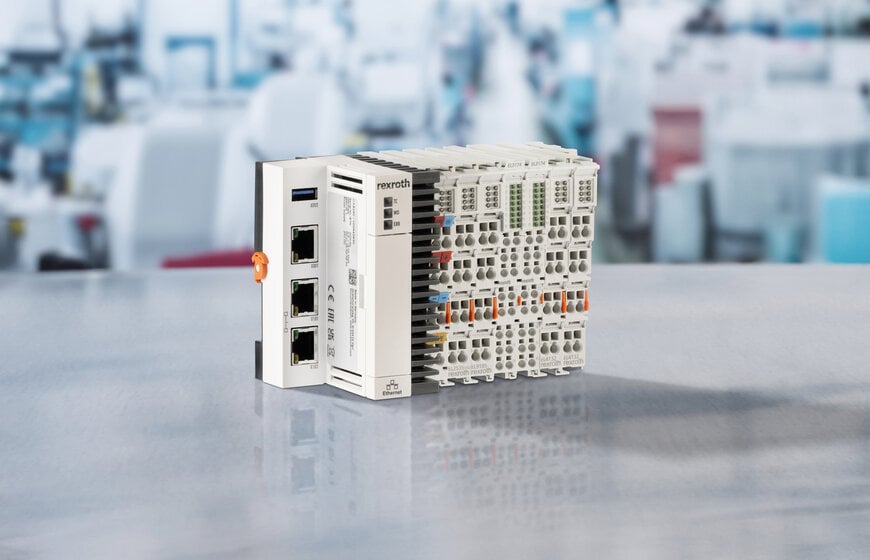
Industrial manufacturing and sheet metal forming equipment increasingly require hydraulic drives that combine high power density with digital connectivity and energy efficiency, despite a widespread industry shortage of specialized hydraulics engineers. To address this operational gap in factory automation and heavy machinery, Bosch Rexroth has developed the H4U.cube complete solution, integrating preconfigured software, control hardware, and a guided user interface for decentralized electrohydraulic pump control.
Industrial Challenges in Electrohydraulic Drive Integration
Modern production systems face strict energy efficiency mandates alongside increasing automation complexity. Traditional hydraulic systems often rely on hardware-bound controllers or complex manual valve tuning, which require specialized fluid power expertise to commission and optimize. When machine builders integrate variable displacement pumps into automated production lines, mismatches between fluid dynamics and digital programmable logic controllers (PLCs) can lead to pressure overshoots, thermal losses, and extended commissioning times.
Bosch Rexroth designed the modular H4U (Hydraulics for You) platform to transfer hydraulic control intelligence from mechanical hardware into software. Expanding this architecture, the H4U.cube complete solution combines pre-engineered H4U.apps software modules with dedicated control hardware and the H4U.ui interface. The initial configuration, designated H4U.cube pQ, is engineered specifically for continuous pressure and volumetric flow control. Bosch Rexroth presents the H4U.cube pQ system at the EUROBLECH 2026 trade exhibition for sheet metal working technology, taking place from October 20 to 23, 2026, in Hanover, Germany.
Operating Principle and Dual-Pump System Architecture
The H4U.cube pQ regulates pressure and flow across either a single unit or two variable displacement axial piston pumps simultaneously, supporting Bosch Rexroth pump series such as the A3V2Q, A10VSO, and A4VSO. From an engineering perspective, volumetric flow in these axial piston units is governed by continuously adjusting the swashplate swivel angle and, optionally, modulating the electric drive motor speed via a frequency converter. By matching fluid delivery directly to the load cycle rather than throttling excess flow over relief valves, the system improves control accuracy and reduces electrical power consumption.
A primary architectural advantage of the H4U.cube pQ is its dual-pump capability. Controlling two variable displacement pumps from a single hardware control unit reduces the required cabinet footprint, wiring complexity, and overall hardware investment costs in multi-pump hydraulic power units.
Fieldbus Connectivity and Automated Parameter Tuning
To eliminate system discontinuities between fluid power components and higher-level factory automation, the H4U.cube integrates directly into third-party machine control systems via standardized fieldbus interfaces, including PROFINET RT. This vendor-independent architecture allows automation engineers to implement hydraulic control loops within their existing PLC engineering environments.
“In the H4U.cube complete solution, we bring together our comprehensive expertise – from hardware and software competence to application and control know-how, user experience and connectivity,” says Rainer Henning, Senior Product Manager Software and H4U.app at Bosch Rexroth. “This makes it easier, faster and more intuitive than ever before to design and integrate decentralized control functions – independently of the machine control system and with the same high level of performance users expect.”
Technical Specifications
The H4U.cube pQ system provides continuous closed-loop pressure (p) and volumetric flow (Q) regulation via swashplate swivel angle adjustment and optional rotational speed control. Each control unit supports a capacity of one or two variable displacement pumps and is compatible with Bosch Rexroth variable displacement axial piston pump types A3V2Q, A10VSO, and A4VSO. For machine integration, the hardware incorporates standardized industrial fieldbus connectivity, including PROFINET RT. System commissioning and optimization are executed through the menu-guided H4U.ui interface, which features a parameter proposal assistant, manual fine-tuning via four plus/minus adjustment fields, and automated autotuning.
Real-World Applications in Metal Forming and Industrial Presses
In industrial metal forming and hydraulic press workflows, rapid transitions between fast approach strokes (high flow, low pressure) and material pressing phases (low flow, high pressure) frequently cause hydraulic shock and pressure overshoots when the press ram contacts the workpiece.
During integration into press systems, the H4U.ui commissioning assistant proposes baseline controller parameters suited to the specific pump geometry. Engineers can then execute an autotuning routine or adjust dynamic response via four plus/minus parameter fields. In press applications, the control algorithm automatically compensates for ram impact transitions, damping pressure overshoots and allowing working pressure to stabilize at the setpoint rapidly. Furthermore, integrated diagnostic functions, maintenance indicators, and lifecycle software updates help maintenance teams minimize unplanned machine downtime.
Additional Context:
This section details technical specifications and competitive benchmarking not included in the original product announcement.
Independent technical documentation from Bosch Rexroth clarifies the underlying mechanics of the H4U platform and the compatible pump series referenced in the announcement. Prior to the H4U.cube hardware-software bundle, Bosch Rexroth introduced the H4U.app pQ in 2023 as a pure PLC function block designed to run on existing machine controllers (such as Siemens TIA Portal V18 environments or Bosch Rexroth ctrlX CORE hardware). The underlying H4U.app pQ algorithm utilizes a parallel controller structure with alternating control that transitions between flow and pressure regulation without control jerks. It incorporates stored component databases for axial piston pumps, automated pilot valve zero-point calibration, system plant identification, and active leakage compensation. According to previous Bosch Rexroth testing data, applying H4U pressure and flow control in a multi-axis press application reduced energy consumption by up to 30 percent, depending on the load cycle.
Within Bosch Rexroth’s own portfolio, the H4U.cube pQ serves as a decentralized, fieldbus-ready evolution alongside conventional electrohydraulic control systems such as the SY(H)DFE series and Sytronix variable-speed pump drives. In standard SY(H)DFE1 configurations on A4VSO pumps, swivel angle and pressure control are governed via analog command values (0 to 10 V) or fieldbus valve amplifiers, achieving linearity tolerances of 1.0 percent or less for swivel angle control and 1.5 percent or less for pressure control, with hysteresis and repeat accuracy within 0.2 percent. While traditional DFE systems tie control electronics directly to a single pump pilot valve, the H4U.cube decouples and centralizes the control intelligence for up to two pumps simultaneously.
Regarding the supported pump hardware specified for the H4U.cube pQ, Bosch Rexroth engineering datasheets define two distinct pressure classes for open-circuit hydrostatic drives. The A10VSO variable displacement axial piston pump (such as Series 52) is engineered for medium-pressure industrial applications, featuring a nominal working pressure of 250 bar (3,600 psi) and a maximum peak pressure of 315 bar (4,550 psi). For higher-load requirements, the A4VSO axial piston pump (Series 10 and 30, sizes 40 to 355) is designed for heavy-duty industrial equipment such as metallurgical presses, operating at a nominal pressure of 350 bar and a maximum peak pressure of 400 bar.
In the broader industrial hydraulics sector, preconfigured decentralized p/Q pump controllers compete with closed-loop drive platforms such as Parker Hannifin’s Drive Controlled Pump (DCP) systems and Moog’s Electrohydrostatic Pump Unit (EPU) and digital radial/axial piston control architectures, which similarly pair variable displacement mechanics with automated fieldbus commissioning to reduce energy losses in industrial forming machinery.
Edited by Sucithra Mani, Induportals editor – adapted by AI.
www.boschrexroth.com
