
www.ptreview.co.uk
13
'26
Written on Modified on
Rockwell Automation Introduces LogixEdge Controllers
Industrial PC-based platform combines Logix control with edge computing and containerized application support.
www.rockwellautomation.com
Industrial enterprises modernizing legacy production lines face a structural divide between deterministic operational technology (OT) control hardware and flexible information technology (IT) edge computing platforms. Traditionally, machine builders and plant engineers deployed dedicated programmable logic controllers (PLCs) for sub-millisecond I/O scanning and motion control while installing separate industrial PCs, protocol gateways, and edge servers to host human-machine interfaces (HMIs), local data historians, machine vision models, and cloud connectors. Maintaining fragmented multi-box architectures inflates control cabinet space requirements, complicates inter-device networking, and introduces lifecycle management friction when updating software across distributed production cells. Furthermore, running general-purpose enterprise software alongside real-time control loops on unpartitioned hardware risks introducing jitter or OS interrupt latency that can disrupt deterministic machine execution. Overcoming these integration hurdles requires converged industrial PC platforms capable of executing isolated deterministic control engines alongside containerized software workloads under standardized DevOps lifecycle workflows.
Unified Industrial PC Architecture and Containerized Workloads
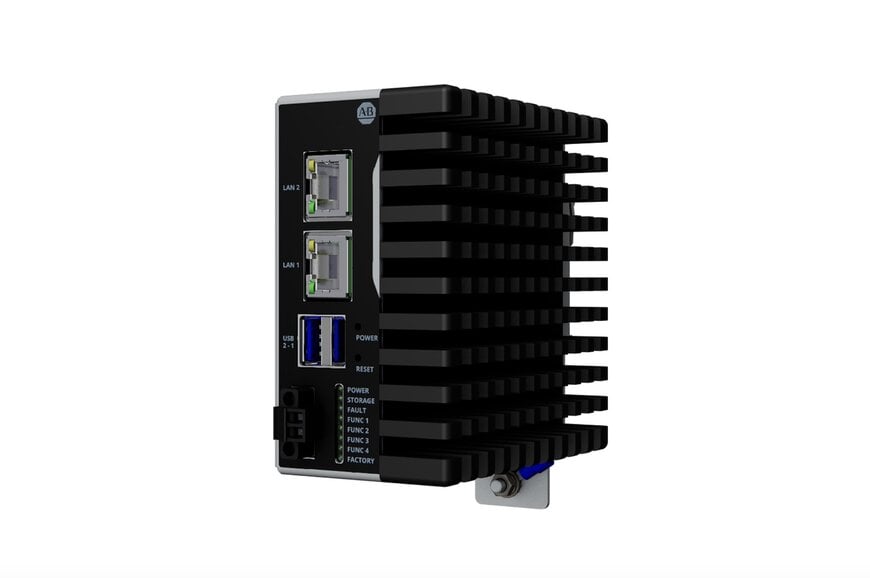
To simplify control panel architectures and bridge OT and IT environments, Rockwell Automation, Inc. announced the commercial launch of the LogixEdge controller. Built on a compact industrial PC-based architecture powered by an Intel Atom-class processor, the platform combines Rockwell’s established Logix control engine with open edge computing capabilities on a single unified device.
By hosting deterministic control and modern software applications on a common platform, manufacturers can eliminate auxiliary edge gateways and deploy visualization, analytics, and digital services directly adjacent to machine operations. The controller natively supports containerized workload execution, enabling engineering teams to deploy, patch, and manage software consistently across distributed factories using modern container orchestration and lifecycle management practices. Out of the box, the open workload environment supports FactoryTalk Optix for modern HMI visualization and data modeling, Module Type Package (MTP) orchestration, FactoryTalk Remote Access, customer-hosted web servers, and custom third-party Docker containers.
Software-Defined Automation and Deterministic Isolation
Stefano Schiavella, Product Manager at Rockwell Automation, noted that industrial automation is transitioning away from rigid, hardware-centric topologies toward software-defined systems that simplify scaling and lifecycle management. Within the LogixEdge platform, the deterministic control partition executes standard discrete, process, batch, and sequencing routines—incorporating native support for PlantPAx process libraries, PhaseManager, and SequenceManager—without interference from user-selectable edge compute containers.
To preserve deterministic network segregation, the hardware incorporates dual one-gigabit front Ethernet ports configured with dual IP addressing: one interface is dedicated exclusively to the Logix control engine for real-time EtherNet/IP communication across up to 35 nodes—supporting POINT I/O, PointMax, Compact 5000, and FLEX 5000 remote I/O platforms—while the second port handles open edge workloads, third-party protocols such as OPC UA, MQTT, and Modbus TCP, and upstream enterprise connectivity.
Additional Context
This section details technical specifications and competitive benchmarking not included in the original product announcement.
In converged industrial edge controllers governed by IEC 61131-3 programmable controller standards and IEC 62443 industrial cybersecurity frameworks, running a real-time control runtime alongside a Linux-based container host on multi-core x86 silicon relies on Type-1 hypervisor partitioning or real-time kernel isolation. By pinning dedicated CPU cores, deterministic memory caches, and physical network interface controllers directly to the Logix real-time operating system while allocating separate cores to the container runtime, the architecture prevents garbage collection, graphical rendering, or network traffic spikes inside user containers from inducing scan-time jitter in the PLC task scheduler. On the security front, LogixEdge aligns with ODVA CIP Security standards, syslog event forwarding, and European Union Cyber Resilience Act readiness via FactoryTalk PolicyManager, ensuring cryptographic device authentication and role-based access enforcement across both the OT control plane and the IT container environment.
Within the rapidly expanding software-defined automation and industrial edge controller sector, Rockwell Automation’s LogixEdge benchmarks directly against converged PLC-IPC platforms from Siemens (SIMATIC S7-1500V virtual PLC and SIMATIC IPCs running Industrial Edge), Beckhoff Automation (TwinCAT 3 on compact C60xx ultra-compact industrial PCs), Bosch Rexroth (ctrlX CORE), B&R Industrial Automation (Automation PC with Hypervisor), and Schneider Electric (EcoStruxure Automation Expert). While PC-based control pioneers like Beckhoff and B&R have long combined Windows or Linux environments with real-time control on x86 hardware, and Bosch Rexroth’s ctrlX CORE popularized app-based container architectures on Arm and x86 footprints, traditional North American manufacturing facilities heavily invested in Studio 5000 Logix Designer previously required separate ControlLogix or CompactLogix hardware paired with external VersaView industrial computers. By embedding the native Logix engine directly onto an Atom-class IPC alongside FactoryTalk Optix and open Docker containers, Rockwell provides its installed base with a unified, single-footprint migration path into software-defined control without forcing automation engineers to abandon existing Studio 5000 codebases or PlantPAx process libraries.
Edited by Romila DSilva, Induportals Editor, with AI assistance.
www.rockwellautomation.com
