
Deep UV Imaging for Transparent Adhesive Inspection
Basler combines the ace 2 X UV camera, UV lenses and 280 nm lighting to make transparent adhesives visible on reflective aluminium parts.
www.baslerweb.com
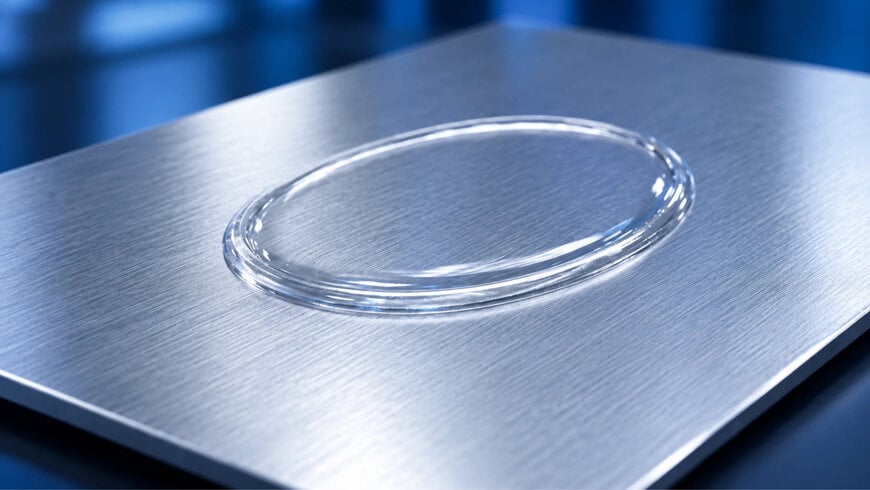
Automated inspection of adhesive beads, potting compounds and transparent resins is a recurring task in electronics, battery and automotive component assembly. The difficulty is optical: many adhesives transmit most of the visible spectrum between roughly 400 and 780 nm. On a reflective aluminium substrate, the light reflected by the metal dominates the image, and the adhesive appears only as faint edges with very little contrast.
Basler has described a machine vision approach that solves this problem by moving image acquisition into the deep ultraviolet (DUV) range.
Why Visible Light Fails on Transparent Materials
Conventional workarounds include additional lighting, multiple viewing angles or several cameras. Each adds hardware, alignment effort and inspection time, and the result still depends heavily on part position and surface finish. Higher camera resolution does not help, because the limiting factor is contrast, not pixel count.
Absorption Contrast at 280 nm
The approach uses the different optical behaviour of materials in the DUV range. At a wavelength of 280 nm, certain adhesives and resins absorb strongly, while aluminium continues to reflect. In the image, the adhesive therefore appears dark against a bright background. In Basler's demonstration, the adhesive was clearly visible at an exposure time of 1 ms under DUV light, whereas white light at 0.4 ms showed only faint boundaries.
Camera, Optics and Illumination as One System
Basler points out that DUV illumination alone is not sufficient. The camera, lens and lighting must be selected together. The setup uses the Basler ace 2 X UV camera with the Sony Pregius S IMX487 sensor, which offers a sensitivity range of 200 to 400 nm, a resolution of 8.1 MP and a global shutter for imaging moving parts without distortion. UV-transmitting lenses are required, because standard optical glass absorbs much of the UV range, and the illumination is a dedicated 280 nm DUV light source.
Inspection Tasks and Process Benefits
With sufficient contrast, the vision system can verify the presence, distribution, boundaries and coverage of an adhesive layer. Because contrast is achieved from a fixed camera position, system designers need fewer additional lights or viewing angles, which can simplify the mechanical layout and shorten inspection cycles. The same principle can be applied to other transparent resins and glass, depending on their UV absorption and on the substrate.
Additional Context:
This section details technical specifications and competitive benchmarking not included in the original product announcement.
UV imaging in machine vision is commonly divided into near UV (about 315 to 400 nm) and the shorter-wavelength UV-C/DUV range below 280 nm. Sony's Pregius S IMX487 is a back-illuminated global shutter sensor optimised for the 200 to 400 nm band and is used in several industrial UV cameras on the market. Alternative methods for transparent material inspection include fluorescence imaging, where UV-fluorescent additives are mixed into the adhesive, and polarisation imaging. DUV absorption imaging avoids the need to modify the adhesive formulation.
Edited by Evgeny Churilov, Induportals Media - Adapted by AI.
