
ENEMAC EWS and EWE couplings for high-speed automation drives
Designed for high-dynamic drives, both dynamically balanced coupling series deliver backlash-free torque transmission, low inertia, and high concentricity.
www.enemac.de
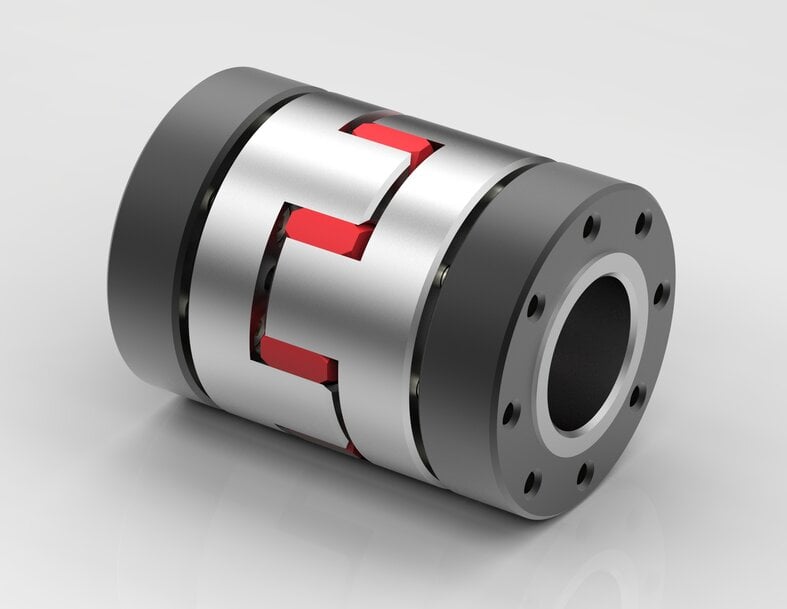
High rotational speeds, rapid acceleration cycles, and strict positioning accuracy impose demanding mechanical requirements on drivetrain components. With its EWS metal bellows coupling and EWE elastomer coupling, ENEMAC supplies two rotationally symmetrical, dynamically balanced coupling series engineered specifically for high-dynamic drives and high-speed automation. Both designs provide backlash-free torque transmission alongside low mass moments of inertia and high concentricity to support smooth, accurate motion sequences at elevated speeds.
EWS metal bellows coupling for maximum torsional stiffness
Rated for rotational speeds of up to 57,000 rpm, the EWS metal bellows coupling transmits torque without backlash while accommodating axial, radial, and angular shaft misalignment. Its low mass moment of inertia supports rapid acceleration and deceleration profiles, while permanent micro-plasma welding between the hub and bellows ensures mechanical stability. Available in six sizes, the EWS covers nominal torque ratings from 25 to 700 Nm and shaft diameters ranging from 5 to 60 mm.
EWE elastomer coupling for vibration damping and electrical insulation
Engineered for rotational speeds of up to 35,000 rpm, the EWE elastomer coupling pairs dynamic responsiveness with vibration and shock damping. A high-strength polyurethane elastomer spider compensates for axial, radial, and angular misalignment while providing electrical insulation between shafts. Precision jaw geometry ensures positive torque transmission, complemented by high-strength aluminium hubs with double-sided taper locking assemblies for high concentricity. Redundant torque transmission provides additional operational safety in the event of elastomer spider failure.
Matching coupling selection to automation drive requirements
Across robotic joints, gantry axes, CNC machine spindles, positioning systems, and measurement and control equipment, both series maintain reliable power transmission under high dynamic loads. Machine builders can select the EWS where maximum torsional stiffness and speeds of up to 57,000 rpm are critical, or specify the EWE when applications additionally require vibration damping and electrical insulation.
Additional Context:
This section explains general principles of torsional stiffness, dynamic balancing, and shaft clamping mechanics in high-speed servo drivetrains not included in the original press release.
In precision servo drives and high-speed CNC spindles, torsional stiffness determines how faithfully rotational motion and encoder feedback are transmitted from motor to load without angular wind-up or resonant oscillation. Metal bellows couplings—typically formed from thin-walled, hydroformed stainless steel convolutions—exhibit high torsional rigidity combined with low radial and angular restoring forces, minimising radial bearing loads on adjacent motor and gearbox shafts.
At rotational speeds exceeding 30,000 rpm, even minute asymmetrical mass distributions generate centrifugal forces that induce bearing vibration and positioning errors. Rotationally symmetrical double-sided taper locking hubs clamp concentrically around the shaft without keyways, eliminating the mass imbalance inherent in keyed connections and preserving dynamic balance across high-speed acceleration ramps.
Edited by an industrial journalist, Lekshman Ramdas, with AI assistance.
