
www.ptreview.co.uk
25
'26
Written on Modified on
Highly available automation with CODESYS Redundancy
Weidmüller Showcases High-Availability Automation with CODESYS Redundancy SL on u-OS and u-control M4000 at SPS 2026.
www.weidmueller.com
Continuous industrial manufacturing lines, energy infrastructure, and critical process plants face severe financial and operational penalties whenever a programmable logic controller (PLC) experiences hardware faults, firmware hangs, or scheduled maintenance interruptions. Historically, deploying fault-tolerant controller redundancy required proprietary, closed hardware ecosystems with expensive dedicated synchronization backplanes and specialized engineering tools, preventing machine builders from integrating modern edge analytics or third-party software containers on the same control platform. Conversely, standard open edge controllers often lacked deterministic dual-CPU failover capabilities needed to sustain continuous operation during single-point failures. Overcoming these reliability and architectural trade-offs requires pairing ruggedized, high-performance industrial controllers with a Linux-based open operating system and standardized IEC 61131-3 software redundancy.
Synchronized Dual-Controller Failover Architecture
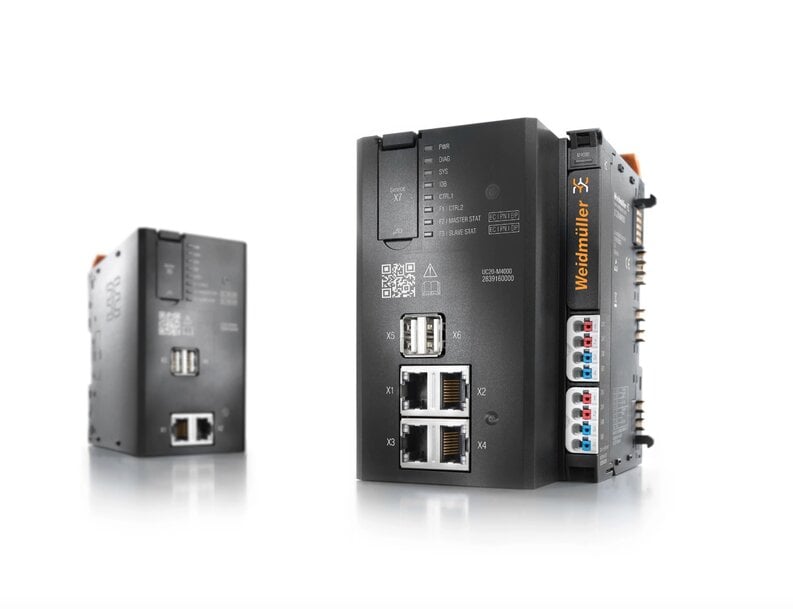
To safeguard operational continuity across demanding machines and process plants, Weidmüller presented its redundant control solution on the joint CODESYS booth at SPS 2026. The architecture links two high-performance u-control M4000 controllers into a synchronized, fault-tolerant control system coordinated by CODESYS Redundancy SL running atop Weidmüller’s open u-OS operating system.
During continuous operation, CODESYS Redundancy SL synchronizes control instances between the primary and standby u-control M4000 units. If the active controller experiences a fault or requires scheduled servicing, the software orchestrates an immediate switchover to the healthy standby unit, minimizing downtime and preserving uninterrupted process execution.
Open Software Extensibility and Scalable Engineering Workflows
Built upon the open u-OS software platform, the architecture extends beyond standard deterministic PLC execution. Alongside the CODESYS runtime, users can deploy Weidmüller applications, third-party software containers, and custom user modules directly on the controller hardware. This modular approach allows automation engineers to add data acquisition, edge analytics, cloud communication, and device management functions without re-architecting the underlying control system.
Designed for applications requiring high availability and predictable maintenance windows, the solution preserves familiar CODESYS engineering workflows within redundant topologies, enabling OEMs and plant operators to scale existing application code seamlessly into fault-tolerant deployments.
Additional Context
This section details technical specifications and competitive benchmarking not included in the original product announcement.
In industrial PLC redundancy governed by IEC 61508 and IEC 61131-3 automation standards, software-based hot-standby architectures like CODESYS Redundancy SL synchronize process images, retained variables, and task states over dedicated high-speed Ethernet links between two identical CPU nodes without requiring proprietary optical sync modules. Running on Weidmüller’s Linux-based u-OS (which supports Docker containerization alongside real-time RT-Preempt kernel scheduling) and the quad-core u-control M4000 hardware platform, the system isolates deterministic control tasks from non-real-time IT/OT edge workloads while maintaining bumpless switchover to redundant fieldbus I/O (such as PROFINET S2/R1 or EtherCAT cable redundancy).
Within the open-architecture redundant PLC market, Weidmüller’s u-control M4000 and CODESYS Redundancy SL solution benchmarks directly against Phoenix Contact’s PLCnext Technology redundant controllers (such as the RFC 4072R), WAGO’s PFC200/PFC300 redundant CODESYS controllers, Beckhoff’s TwinCAT 3 Controller Redundancy, and Siemens’ SIMATIC S7-1500R/H fault-tolerant systems. While Siemens S7-1500H offers hardware-synchronized lockstep redundancy for large process plants within a closed TIA Portal ecosystem, Weidmüller differentiates itself by combining open Linux container extensibility via u-OS with standardized CODESYS Redundancy SL, giving mid-sized machine builders and infrastructure operators a vendor-neutral path to high-availability automation.
Edited by Romila DSilva, Induportals Editor, with AI assistance.
www.weidmueller.com
