
www.ptreview.co.uk
25
'26
Written on Modified on
Edge AI Inference Platform for Industrial Automation Systems
Aaron and Advantech introduce a Blackwell-based computing system providing localized processing power for advanced industrial automation and autonomous robotics.
www.aaronn.de
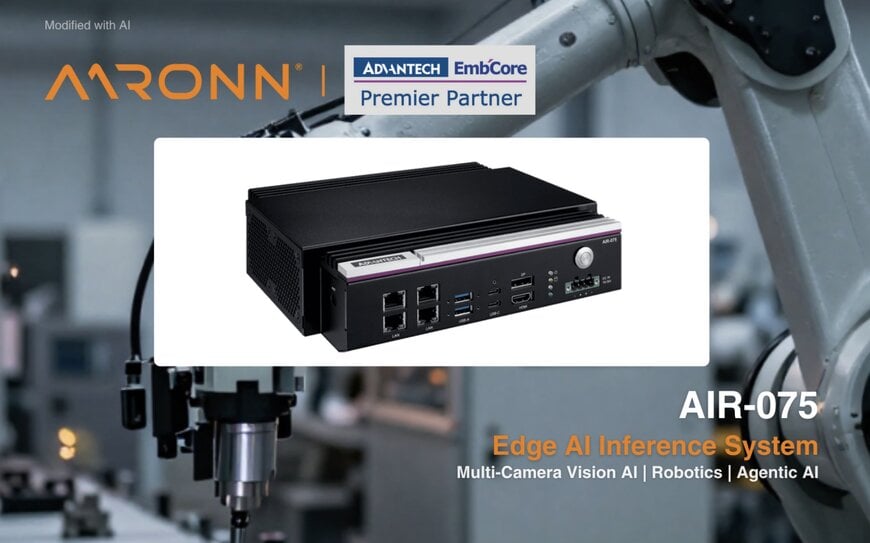
Advantech is releasing the AIR-075 edge AI inference system, distributed by technology partner Aaron Electronic, to support high-throughput vision AI, robotics, and industrial automation. The platform executes physical and agentic AI workloads locally at the machine level, eliminating latency and cloud dependency in automated manufacturing environments.
Computing Architecture and Multimodal Processing Capabilities
The computing framework relies on NVIDIA Jetson T5000 and T4000 modules, which utilize the Blackwell GPU architecture. The flagship T5000 configuration integrates a 14-core Arm Neoverse V3AE processor alongside a GPU featuring 2,560 cores and 96 Tensor Cores. Supported by 128 GB of LPDDR5X memory with a bandwidth of 273 GB/s, this setup achieves up to 2,070 TFLOPS of FP4 sparse AI performance. This computational capacity is necessary to process generative AI and agentic workflows, where systems interpret contextual data from multiple sources to derive autonomous actions. A secondary T4000 variant scales to 1,200 TFLOPS with 64 GB of memory and 1,536 GPU cores. To ensure long-term reliability for industrial procurement, the modules utilize validated on-module DRAM.
High-Bandwidth Connectivity for Vision AI Workloads
To facilitate high-bandwidth data acquisition in factory automation, the AIR-075 incorporates native 10GbE networking. The T5000 model features four RJ45 10GbE ports, while the T4000 includes two, with optional IEEE 802.3af PoE support available. This network architecture allows multiple high-resolution IP cameras to connect directly to the inference platform, eliminating the requirement for external network aggregation switches. For direct machine-level integration, the hardware includes two RS-232/422/485 serial interfaces. The T5000 variant further expands this connectivity with two CAN bus interfaces and an 8-bit digital I/O interface, enabling the system to interface directly with physical sensors and robotic controllers.
Physical Deployment and Modular System Expansion
Engineered for distributed edge AI deployment across factory floors, the 235.8 × 174 × 59 mm hardware enclosure supports wall mounting and operates on a 19 to 36 V DC input voltage. Power consumption for the T5000 configuration ranges from 13.2 W during standard operating system idle to a peak of 156 W under maximum computational load. The platform integrates a TPM 2.0 module to enforce hardware-based security and cryptographic integrity. Communication and local data storage can be expanded via specialized M.2 slots supporting NVMe SSDs, Wi-Fi, and 5G connectivity, which enables decentralized operations for autonomous machines in geographically distributed environments.
Additional Context
This section details technical specifications and competitive benchmarking not included in the original news release.
Within the industrial edge computing market, NVIDIA Jetson Thor-based systems succeed the previous Jetson AGX Orin generation. While high-end Orin platforms typically deliver up to 275 TOPS for standard machine vision tasks, Blackwell-based Thor systems like the AIR-075 benchmark in the TFLOPS range utilizing FP4 precision. This architectural shift targets the deployment of generative AI and Vision-Language Models (VLMs) directly at the edge. The AIR-075 competes with emerging Thor-based industrial PCs from manufacturers such as AAEON and Neousys, differentiating itself primarily through its density of native 10GbE interfaces and integrated CAN bus capabilities tailored for autonomous physical systems.
Edited by Aishwarya Mambet, Induportals Editor, with AI assistance.
www.aaronn.com
